

Dubai CommerCity is planning an expansion backed by more than AED1.8 billion in investment, adding commercial and logistics capacity to the emirate’s digital-commerce sector. Delivery is scheduled between the first quarter of 2027 and the final quarter of 2028.
The official announcement, reported by WAM on 4 October, says the free zone’s existing office, logistics and retail space is nearly 96% occupied. Dubai CommerCity is a joint venture between the Dubai Integrated Economic Zones Authority, or DIEZ, and Wasl Group.
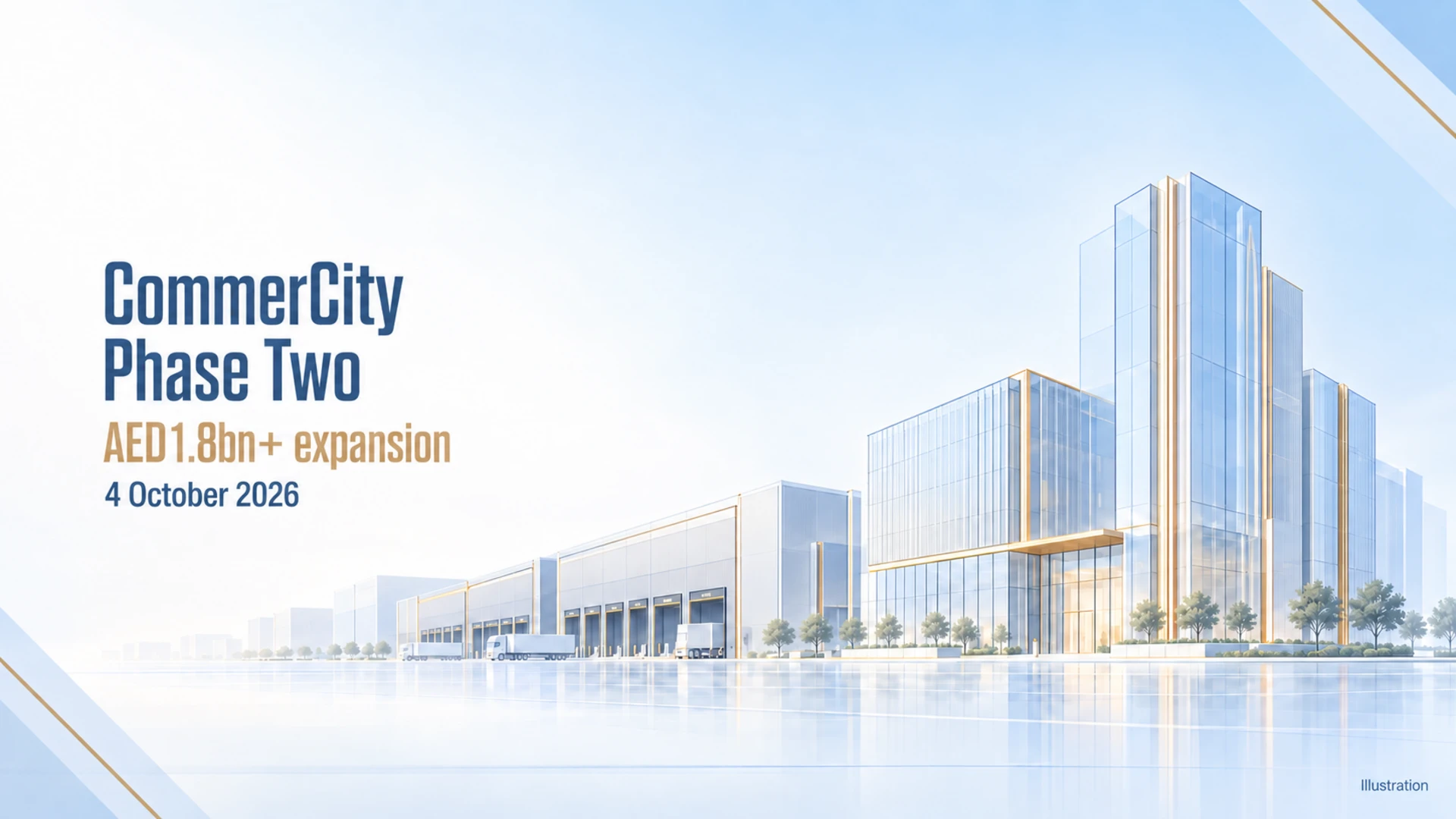
What Dubai CommerCity will add
The programme covers its Business, Social and Logistics clusters. Published project details put the addition at more than 91,000 square metres. Six office buildings will offer shell-and-core, fitted and plug-and-play options, alongside new retail and service space.
A vertical logistics facility called The Hive is planned with 181 flexible units in a 5,600-square-metre building. Its specification includes climate-controlled fulfilment areas, managed loading facilities and last-mile delivery provision. WORLDEF’s 5 October coverage also identifies the mix of offices, retail and logistics uses.
Why the property mix matters
For businesses comparing locations, the useful distinction is how the buildings support daily operations. An office, a fulfilment area and a delivery function can have very different space, access and cost requirements. A shared destination may be convenient, but its suitability still depends on the occupier’s own operating model.
The range of office formats also creates different budgeting questions. A shell-and-core lease requires a separate assessment of fit-out cost and timing. A fitted or plug-and-play option should be compared on the services included, the usable area and the full cost of occupation. These are practical comparisons to make when leasing terms become available.
What remains to be established
The delivery window is a plan. Businesses considering a move should obtain the schedule for the specific building or unit, confirm when utilities and operational approvals will be available, and allow for their own fit-out and relocation requirements.
The reported occupancy figure describes the existing destination. It does not establish that the new premises have already been leased, nor does it demonstrate future rents or investment returns. Those conclusions require separate evidence.
The expansion is therefore a significant addition to Dubai’s commercial development pipeline. The next useful milestones will be building-level completion, confirmed leasing terms and evidence of how companies take up the new space.