
Co-Ownership in Pakistan Real Estate: Complete Guide for 2025–2026 Investors
Introduction: Why Co-Ownership Is on Every Serious Investor’s Radar
If you’ve tried to buy good property recently, you’ve probably felt this:
- Prices keep going up.
- The rupee keeps losing value.
- The “good” projects you actually want feel out of reach.
You’re not alone.
This is the new reality of the Pakistan property market 2025–2026. A decent apartment in a central area, a serviced apartment in a good building, or a hotel apartment in a strong tourism or business location easily runs into many crores. For a salaried person, even for a stable business owner, buying the whole thing alone can feel impossible.
At the same time, you hear more and more about:
- Co-Ownership in Pakistan Real Estate
- fractional ownership in Pakistan
- serviced apartments and hotel apartments
- co-ownership apartments in Lahore and co-ownership investments in Islamabad and Karachi
Behind all these buzzwords is a very simple idea:
You don’t have to own 100% of a good asset to benefit from it.
You can own a share of a better-quality, income-producing property.
Instead of saving 10–15 years for one unit, co-ownership lets you:
- Start with smaller capital
- Own a share in a high-quality serviced or hotel apartment
- Earn your portion of rental income
- Share in long-term capital gains
We’re already seeing this logic in real projects you might know:
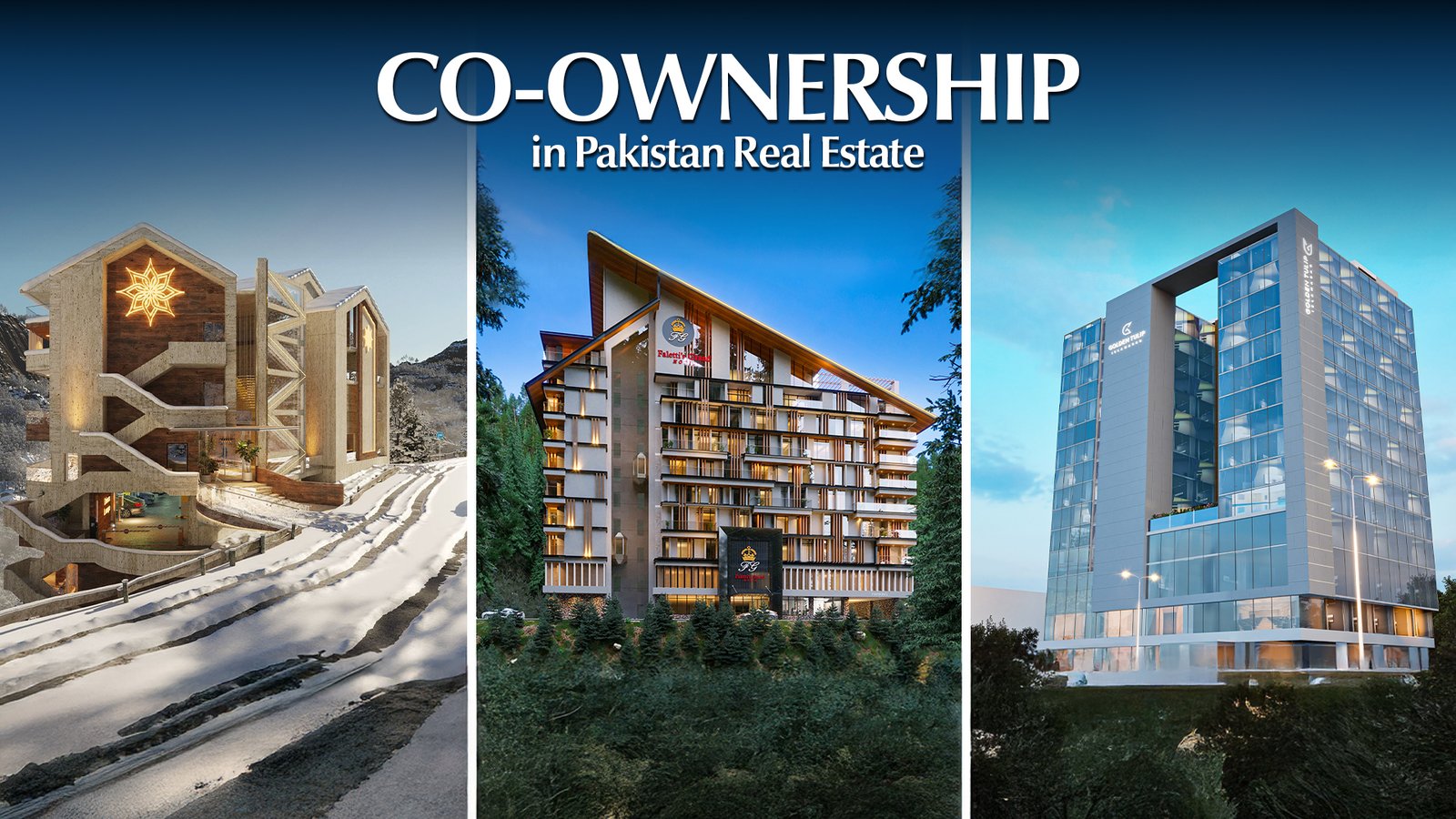
- Clematis by The Cloud in Nathia Gali – boutique hotel apartments in the tourism belt.
- Golden Tulip Hotel Islamabad – a branded hotel and hotel apartment development in Islamabad’s growth corridor.
- Falettis Grand Hotel Ayubia Sky Villas – luxury serviced units in the Ayubia–Murree tourism zone.
These are serious assets. If you tried to own them fully alone, the ticket size would be huge. But with structured co-ownership or fractional-style investing, multiple investors can share the same income-producing property.
This guide explains Co-Ownership in Pakistan Real Estate :
- What it is
- How it works in 2025–2026
- How it connects to long-term wealth-building ideas popularized by global value investors
- How Imlaak-type projects use co-ownership logic in real life
- Pros, cons, risks, due diligence, and practical examples
Think of this as a long, honest conversation with a friend who has been investing in property for years and wants you to avoid common mistakes.
What Is Co-Ownership in Pakistan Real Estate?
Co-ownership means:
More than one person legally owns the same property together, each with a defined share.
Your share might be:
- 10% of a hotel apartment building
- 5% of a serviced apartment unit
- A certain number of “fractions” in a project
In any case, you are not just a lender or a committee member. You are a co-owner of real estate. You have rights to:
- A share in rental income
- A share of sale proceeds if the property or your share is sold
Co-Ownership vs Joint Family Property
Most Pakistanis are already familiar with “joint family property”:
- One house or plot, many relatives
- Emotions, family politics, and verbal understandings
- No proper agreements, no clear exit plan
That is informal joint ownership, and usually it is a headache.
Modern investment co-ownership is very different:
- The number of co-owners is known and limited from day one.
- Each person’s share is clearly defined.
- There are written agreements that explain:
- How income is shared
- Who manages the property
- How a co-owner can exit or sell their share
- It is designed as an investment structure, not a family arrangement.
In short:
Joint family property = emotional and unstructured.
Investment co-ownership = documented, planned, and numbers-driven.
Co-Ownership vs Fractional Ownership vs REITs
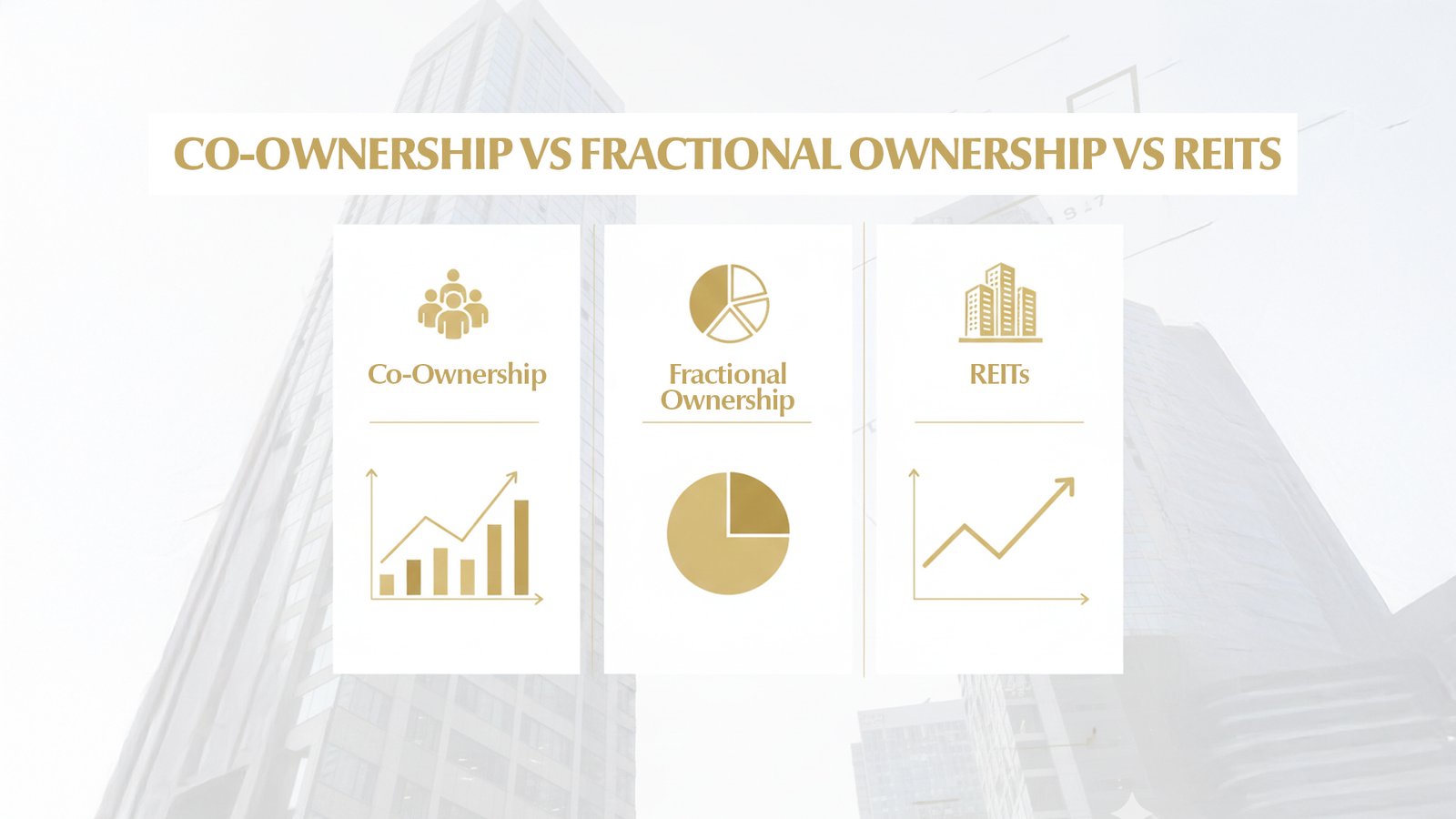
You’ll hear three terms a lot:
- Co-ownership
- Fractional ownership
- REITs (Real Estate Investment Trusts)
They sound similar, but there are differences.
-
Co-Ownership
- A small or medium group of investors (for example 5, 20 or 50) owns one specific property together.
- The structure can be:
- Direct joint title
- Shares of a company that holds the property
- A trust or SPV (special purpose vehicle)
- You usually know exactly which property your money is in.
-
Fractional Ownership
- Same idea but more productized.
- A property is divided into many equal “fractions” or “units”.
- Investors buy these fractions.Each fraction stands for:
- A set amount of ownership
- A set amount of income
- Often made easier by a landlord portal or digital platforms.
So, in Pakistan, fractional ownership is really:
Co-ownership, but in standard “fractions” that are easier for small investors to get to.
-
REITs (Real Estate Investment Trusts)
- A REIT is a regulated fund.
- It owns a portfolio of properties (not just one).
- Investors buy units of the REIT, not direct slices of one building.
- The REIT management decides what to buy, sell, and how to operate.
So:
- Co-ownership / fractional = direct, property-specific exposure.
- REIT = fund-style, portfolio exposure.
Both are valid. But this guide focuses on Co-Ownership in Pakistan Real Estate in the more direct, project-specific sense.
Co-Ownership vs Traditional “Full” Ownership
Traditional full ownership:
- You buy one full apartment or shop in your own name.
- You arrange full payment or financing.
- You handle tenants, repairs, legal matters, and headaches.
Co-ownership:
- You buy a share in a property.
- You pay only for your share.
- A professional manager or operator handles daily operations.
- You receive your percentage of income and value growth.
Think of it like this:
Full ownership = owning one whole mango tree, doing all the gardening yourself.
Co-ownership = owning part of a well-managed orchard, where experts grow and harvest for you.
How Co-Ownership Works in Pakistan (2025–2026)
The structure can vary from project to project, but the logic is similar.
Property Types in Co-Ownership Deals
In Pakistan today, co-ownership usually appears in:
- Hotel apartments and serviced apartments
- Holiday homes and lodges in Murree, Nathia Gali, Ayubia and Galiyat
- City apartments in Lahore, Islamabad, and Karachi
- Branded residences attached to hotel brands
Let’s connect this to some real-world styles.
Holiday Hotel Apartments – Example: Clematis by The Cloud (Nathia Gali)
Clematis by The Cloud in Nathia Gali is another perfect example of co-ownership-style logic:
- Limited number of hotel apartments in a premium tourism location.
- Professional hospitality operator.
- Focus on rental income from tourists.
Here, co-ownership or fractional ownership can make it possible to:
- Investors can buy smaller shares instead of one big lodge.
- Exposure to co-ownership of vacation homes in places like Murree, Nathia Gali, and Ayubia.
- Participation in peak-season rental income and long-term capital appreciation.
Even if investors buy full units, many of the benefits and systems are the same ones you would use in a fractional or co-ownership model.
Branded Hospitality – Example: Golden Tulip Hotel Islamabad
A project like Golden Tulip Hotel Islamabad is a branded hotel and hotel apartment development in Islamabad’s growth corridor.
Key ideas:
- Strong international brand.
- Strategic location tied to airport, business, and tourism traffic.
- Structured hotel operations.
Co-ownership or fractional participation in such a project lets multiple investors:
- Get exposure to hotel apartments investment in Pakistan
- Benefit from brand-led demand and pricing
- Share income from a professional hospitality business, not just from one tenant
For many investors, especially overseas Pakistanis, this feels more comfortable than a random guest house or unbranded building.
Tourism-Focused Serviced Units – Example: Falettis Grand Hotel Ayubia Sky Villas
Falettis Grand Hotel Ayubia Sky Villas represents luxury serviced villas in a tourism hotspot.
- Positioned for families, tourists, and holiday stays.
- Built around rental income when you are not using the unit yourself.
Again, this kind of asset fits naturally with co-ownership and fractional logic, because:
- Multiple investors can participate.
- The operator runs the business.
- Income is shared.
Main Players in a Co-Ownership Structure
To understand Co-Ownership in Pakistan Real Estate, you need to know who is involved.
-
Developer
- Builds the project (hotel, serviced apartment building, mixed-use tower).
- Handles approvals and construction.
- Often works with a real estate advisory firm to structure deals for investors.
-
Operator / Asset Manager
- Runs the property:
- Bookings
- Guest services
- Housekeeping
- Maintenance
- Provides regular reports to investors.
- Often charges a percentage of revenue or profit as a management fee.
- Runs the property:
-
Co-Owners / Investors
- Provide the capital.
- Own shares or fractions.
- Receive income and capital gains.
- May or may not have personal usage rights, depending on the project.
-
Legal / Corporate Structure
- Direct co-ownership on title; or
- Ownership through a company, trust, or SPV; or
- Tokenized or digital fractional units.
The exact structure decides:
- How your ownership is documented
- How easily you can transfer or sell your share
- How decisions are made
You should always have the structure and documents reviewed by a lawyer you trust.
Why Investors Are Considering Co-Ownership Now
Why is real estate co-ownership Pakistan becoming popular now, and not 10 years ago? There are some big reasons.
-
Rising Property Prices and Bigger Ticket Sizes
In major cities, especially Lahore and Islamabad, and in prime tourism areas, property prices have moved much faster than average incomes.
- Good locations cost more.
- Construction costs have increased.
- Land is more expensive.
End result:
A single full apartment or villa in a strong project is out of reach for many serious but mid-sized investors.
Co-ownership lowers the entry ticket. You can:
- Start with a smaller amount.
- Own a share in a better-quality asset.
- Build your portfolio in smaller, intelligent steps.
-
Inflation and Rupee Devaluation
Inflation and rupee devaluation hit savers the hardest.
- Cash in the bank loses purchasing power.
- Imported items and construction materials become more expensive.
- Delaying investment often means paying much more later.
High-quality real estate can act as a hedge:
- Rental income can move with inflation over time.
- Property values in good locations usually adjust upward in rupee terms.
Co-ownership allows you to place part of your savings into real assets instead of keeping everything in cash.
-
Desire for Passive Income and Cash Flow
Global value investors and educators repeat the same message:
Buy assets that generate cash flow, not only assets you “hope” will go up one day.
Plots and files:
- Usually do not give rental income.
- Depend heavily on speculation and future development.
Serviced apartments, hotel apartments, and managed city apartments:
- Can give monthly or quarterly rental income.
- Help you build passive income from Pakistan property.
- Allow you to calculate IRR (Internal Rate of Return), not just “profit after resale”.
Co-ownership focuses on this cash flow mindset, especially when paired with strong operators and landlord portals.
-
Overseas Pakistanis Want Clean, Hands-Off Solutions
Overseas Pakistanis face very real challenges:
- Hard to manage tenants from abroad.
- Trust issues with relatives or local agents.
- Hard to verify whether rent is actually collected.
Co-ownership and fractional ownership in Pakistan that are built with overseas investors in mind usually offer:
- Professional management
- Clear reporting
- Bank-to-bank income distributions
- Digital communication and dashboards
This makes them a natural choice for real estate investment for overseas Pakistanis who want stress-free exposure to Pakistan property.
-
Shift from Speculation to Strategy
Older property culture was:
- “Buy a plot, wait for years, hope it doubles or triples.”
Newer, smarter culture is:
- “Build reliable rental income first.”
- “Balance capital gains with actual cash flow.”
- “Focus on secure property investment in Pakistan rather than hype.”
Co-ownership fits well with this more mature, strategy-driven mindset.
Types of Co-Ownership Opportunities in Pakistan
Now let’s break down major opportunity types and who each one suits.
-
Holiday and Tourism Belt Properties
Locations: Murree, Nathia Gali, Ayubia, Galiyat
These areas are:
- Cooler in summer, snowy in winter
- Very popular for family trips and domestic tourism
- Growing in both tourism and hospitality investment
Property types:
- Boutique hotel apartments
- Serviced villas and lodges
- Branded hotel keys
Examples (style):
- Clematis by The Cloud in Nathia Gali
- Falettis Grand Hotel Ayubia Sky Villas
Who this suits:
- Investors who want a mix of lifestyle and returns
- People who like the idea of owning a share in a holiday property
- Those comfortable with seasonal income patterns
Return pattern (conceptual):
- High income in peak periods (summer, winter holidays)
- Lower income in off-season
- Capital appreciation as the destination grows and supply remains controlled
-
City-Based High-Rise and Serviced Apartments
Locations: Lahore, Islamabad, selected areas of Karachi
Property types:
- Serviced apartments
- Rental-focused studios and 1-beds
- Mixed-use buildings with managed residential floors
Who this suits:
- Investors who want steady year-round demand
- People focused on rental income from apartments in Pakistan
- Those who prefer city exposure over pure tourism
Return pattern (conceptual):
- More stable occupancy vs holiday-only locations
- Income driven by business travel, students, professionals, families
- Capital growth linked to urbanization and infrastructure
-
Branded Hotel Apartments and Residences
Typical example (style):
- Golden Tulip Hotel Islamabad
These are:
- Tied to a known hotel brand
- Run under strict standards and systems
- Positioned for both local and international guests
Who this suits:
- Investors who like institutional-style assets
- Those who value brand, systems, and strong standard operating procedures
- People who want a very hands-off, professionally run investment
Return pattern (conceptual):
- Income driven by brand strength, location, and travel trends
- Potential for attractive yields if occupancy and rates are healthy
- Capital growth linked to the city and corridor development
-
Small Commercial and Co-Working Spaces
Less common but emerging.
Property types:
- Co-owned small shops
- Co-working floors with multiple corporate clients
Who this suits:
- Investors comfortable with business cycle risk
- Those who have more experience with commercial leases
For most new investors, hospitality and serviced apartments are easier to understand than complex commercial setups.
Cash Flow & Return Scenarios
Important: These examples are illustrative only. They are not promises. They are just to help you think in numbers.
Example 1: Share ownership of a serviced apartment in Lahore
Let’s say:
- A serviced apartment in a Lahore project costs PKR 20,000,000.
- It is structured into 10 equal co-ownership shares of PKR 2,000,000 each.
- You buy one share (10%).
Assume, conservatively:
- Net annual rental yield on the full apartment (after all costs) = 8%.
So:
- Net income on full unit = 8% of 20,000,000 = PKR 1,600,000 per year.
- Your 10% share = 10% of 1,600,000 = PKR 160,000 per year.
That is an 8% return on your PKR 2,000,000.
Now add appreciation over time:
- If the value of the property goes up by 5% each year for 10 years:
- The future value of a full apartment is about 32,578,000, which is 20,000,000 times (1.05)^10.
- Your 10% share is about PKR 3,257,800.
So, after ten years:
- The rental income is about PKR 160,000 × 10 = 1,600,000 (not counting rent increases).
- The capital gain is about 1,257,800, which is 3,257,800 − 2,000,000.
Total benefit is about 2,857,800 on an investment of 2,000,000 (this is a rough estimate, not including taxes or rent increases).
Long-term, conservative investors think like this: moderate rent plus moderate price growth over time.
Example 2 – One Big Unit vs Three Co-Owned Positions
You and your friend both have PKR 6,000,000 to invest.
Friend A – One Full Unit in Average Location
- Buys one flat for 6 million in an average neighborhood.
- Net rental yield: 5% (PKR 300,000 per year).
- Low chance of strong capital gains.
You – Three Co-Ownership Shares
You put:
- 2 million into a share in a Lahore serviced apartment
- 2 million into a share in a hotel apartment in Islamabad
- 2 million into a share in a Nathia Gali or Ayubia holiday lodge
Assume that, combined, your overall net yield ends up around 8%.
- Net annual rental income ≈ 8% of 6,000,000 = PKR 480,000 per year.
You also have diversification:
- City business demand
- Airport / transit hospitality demand
- Tourism demand in the hills
Instead of depending on one tenant in one average location, you are plugged into three different demand engines.
Example 3 – Rental Income Helping Pay Installments
Many co-ownership or fractional-style plans are structured on installments, sometimes with post-possession payments.
Imagine:
- Your co-ownership share costs PKR 4,000,000.
- You paid PKR 2,000,000 during construction.
- Remaining PKR 2,000,000 is to be paid in post-possession monthly installments of PKR 100,000 for 20 months.
Now, after possession, your share in the rental income is:
- PKR 60,000 per month (example only).
This means:
- Instead of paying 100,000 from your pocket, you pay:
- 100,000 installment
- minus 60,000 rental income
- = 40,000 net out-of-pocket per month
Over time, you are:
- Paying off your share
- Building ownership in a real asset
- Letting the asset partially self-fund through its income
This is very similar to the philosophy of:
“Let your assets work for you instead of you only working for your assets.”
Due Diligence Checklist for Co-Ownership in Pakistan Real Estate
Before you put a single rupee into Co-Ownership in Pakistan Real Estate, walk through this checklist.
-
Developer Track Record
Ask:
- What projects have they completed?
- What is the quality of their work?
- Do they have a history of delivering on time (or close)?
- Are there real investors already earning income from their older projects?
Focus on developers and advisors who consistently educate investors, not just sell to them.
-
Location Quality
For each project, think:
- City assets:
- Is it a central, strong, “always in demand” area?
- Is it near jobs, business districts, hospitals, universities, or malls?
- Tourism assets:
- Is it in a known destination or just a random hillside?
- How easy is access (road quality, distance)?
- Is tourism in that area growing?
Projects like city-centre serviced apartments in Lahore, tourism lodges in Nathia Gali and Ayubia, or airport-corridor hotels in Islamabad are examples where demand is more visible and logical.
-
Asset Type and Use Case
Understand:
- Is this primarily:
- A hotel apartment building?
- A serviced apartment tower?
- A pure residential building with normal rentals?
- Who is the target guest or tenant?
- Tourists?
- Business travelers?
- Students and young professionals?
- Families?
Your expectation about rental income and vacancy must match the asset type.
-
Legal Structure
Clarify:
- Do you become a co-sharer on title?
- Or do you receive shares in a company that owns the property?
- How is your share recorded in official documents?
- What happens in case of inheritance?
Ask for a lawyer to review:
- Sale deed or allotment documents
- Co-ownership or shareholder agreement
- Management agreement
-
Management and Operator Model
For hotel + serviced apartments, ask:
- Who is operating the property?
- What is their background?
- How are they paid?
- Percentage of gross revenue?
- Percentage of profit?
- Fixed fee?
You want the operator’s interests aligned with your net income, not just top-line sales.
-
Fee and Cost Structure
Understand every rupee, including:
- Management or operator fee
- Platform or portal fee (if any)
- Maintenance, repairs, and utilities
- Reserve funds (for major repairs or upgrades)
Ask to see a sample income statement:
- Gross income
- Minus costs and fees
- Equals net income
- Then your share based on your percentage
If the team cannot show this in a clear way, be careful.
-
Exit and Liquidity
You should know:
- Minimum holding period
- Conditions for selling your share
- Any transfer fees or approvals
- Internal marketplaces or investor networks that help resale
Co-ownership is not meant for trading every few months. But you should still have a logical way to exit after a reasonable time.
-
Suitability for Overseas Pakistanis
If you are overseas:
- Can the entire process be handled digitally or via power of attorney?
- Will you get:
- Regular emails or portal access?
- Clear statements?
- Bank deposits?
If a project positions itself for overseas investors but cannot explain these basics, that’s a concern.
Who Should Consider Co-Ownership – and Who Should Avoid It
Co-Ownership May Suit You If…
- You are a salaried professional or small business owner who wants to start building assets.
- You believe in long-term real estate investing strategy in Pakistan, not fast gambling.
- You want rental income but don’t have time or energy to manage tenants.
- You are an overseas Pakistani who wants structured, professionally managed property exposure.
- You understand that real estate is a multi-year journey, not a lottery ticket.
Co-Ownership May Not Suit You If…
- You want complete control over every detail and cannot accept shared decision-making.
- You might urgently need your money back in less than a year.
- You are looking for “double money in two years guaranteed” type schemes.
- You don’t want to read any documents and only want verbal promises.
- You treat investment like pure entertainment, not a serious responsibility.
Co-Ownership vs Buying a Full Unit Alone
Full unit:
- Full control and emotional satisfaction
- Big ticket size
- Single-location risk
- You handle all tasks
Co-ownership:
- Lower entry cost
- Possible diversification into multiple projects
- Professional management
- Less direct control
- Need to work within the agreed structure
If you already own one or two full units, co-ownership can be a smart next step to diversify and improve your cash-flow profile.
Plots and Files vs. Co-Ownership
Files and plots:
- No income from rentals
- A lot of the time, it’s based on speculation and tied to approvals and development.
- Can stay stuck for years
Sharing ownership of assets that make money:
Focus on rental income and capital gains.
Connected to real human use:
Guests, tenants, and tourists
You move from “hope and rumors” to visible demand and numbers.
Co-Ownership vs Holding Cash or Only USD
Cash and foreign currency:
- Necessary for emergencies and flexibility
- But do not grow by themselves
Co-ownership:
- Converts part of your savings into a productive asset
- Helps protect against inflation and rupee devaluation in the long run
- Still requires patience and discipline
A balanced investor usually has:
- Some liquid savings
- Some foreign currency
- Some well-chosen, income-producing real estate (including co-owned assets)
Co-Ownership vs REITs and Stock Market
REITs and stocks:
- Highly liquid
- Regulated
- Easy to buy and sell via brokerage accounts
But:
- You do not control which exact properties a REIT buys or sells.
- Prices can fluctuate daily due to market noise.
Co-ownership:
- Less liquid, but more direct.
- You know exactly which building your money is in.
- Movements are based more on real occupancy and business, not daily trading mood.
Many advanced investors use both:
- Listed assets (stocks / REITs) for liquidity
- Co-owned real estate for tangible, targeted exposure
Future of Co-Ownership in Pakistan (2025–2026 and Beyond)
Several trends suggest that Co-Ownership in Pakistan Real Estate will keep growing.
- More tech-based solutions for landlords
- Landlord portals, STR (short-term rental) management tools, and digital dashboards make it easier to deal with a lot of co-owners and units.
- Investors can see how well things are going without having to go there in person.
- Tourism and hospitality are growing.
- Tourism in Murree, Nathia Gali, Ayubia, and other places like them is still growing.
- This supports more holiday home co-ownership in Murree, Nathia Gali, Ayubia style projects.
- Demand for city assets that focus on rentals
- Serviced apartments in Lahore and Islamabad are supported by urbanization and changing lifestyles.
- Managed apartments are often the best choice for business and professional tenants.
- Education and being aware
- More advisors are teaching things like IRR vs. ROI, focusing on cash flow, and setting realistic goals.
- As investors learn more, they will want structures that are cleaner and better.
- Possible Changes in Regulations
- As the ecosystem grows, more formal rules may come out that will help fractional and co-ownership models work better.
Overall, co-ownership is likely to become:
A mainstream entry door for small and mid-sized investors
to access institutional-grade properties they could not buy alone.
It won’t replace full ownership or REITs. It will sit alongside them as one more powerful tool.
Conclusion: Think Like a Long-Term Owner, Not a Short-Term Speculator
Co-ownership is not about being clever for one year. It is about being smart for ten, twenty, thirty years.
Co-Ownership in Pakistan Real Estate allows you to:
- Enter high-quality projects with smaller capital
- Own shares in hotel apartments, serviced apartments, and branded residences
- Participate in rental income and capital gains
- Diversify across cities and tourism belts
- Take a position against inflation and rupee devaluation
But this only works if you:
- Choose good locations
- Work with serious developers and operators
- Understand the structure and contracts
- Have a long-term mindset
Think like the value investors whose ideas you hear globally:
- Buy assets you understand.
- Prefer cash-flowing properties over empty land with only “hope”.
- Leave margin of safety by avoiding overpriced, overpromised deals.
- Let your investments serve your future self, not your short-term emotions.
In other words:
Don’t chase noise. Build quiet, reliable assets.
Learn deeply. Verify carefully. Then invest calmly.
If you follow this approach, co-ownership can become one of the most practical and powerful ways for you to build long-term wealth and true passive income in Pakistan’s real estate market.
FAQs: Co-Ownership in Pakistan Real Estate
- Is co-ownership legal in Pakistan real estate?
Yes. Pakistani law already recognizes that more than one person can jointly own the same property. Modern co-ownership and fractional models simply create structured, investor-friendly ways to do this using agreements, companies, or other vehicles. The key is proper documentation.
- What is the difference between co-ownership and fractional ownership in Pakistan?
In simple words:
- Co-ownership means multiple people own the same property together, in any structure.
- Fractional ownership usually means co-ownership has been broken down into standard “fractions” or units, often through a platform or formal program.
In day-to-day conversation, people use both terms to describe shared ownership with shared income.
- How is rental income shared among co-owners?
Normally:
- The property earns income (room rents, apartment rents, etc.).
- Operating expenses and management fees are deducted.
- The remaining net income is distributed to co-owners based on their percentage share.
If you own 10% of the project’s co-ownership pool, you should receive 10% of the net distributable income, as defined in the agreement.
- What happens if one co-owner wants to sell their share?
This depends on the agreement. Common options include:
- Existing co-owners get a first right to buy the exiting owner’s share.
- The exiting owner can sell to a new investor who meets the project’s criteria.
- In some structures, the management or company may offer a buy-back after a certain period.
You should know:
- Minimum holding period
- Allowed buyers
- Any transfer fees or approvals
before you invest.
- Is co-ownership suitable for overseas Pakistanis?
In many cases, yes. Co-ownership and fractional models in serviced and hotel apartments are often designed to be:
- Hands-off (professional management)
- Transparent (statements, dashboards, regular updates)
- Bank-to-bank (rental income into your account)
For overseas Pakistanis, this can be much simpler and safer than trying to manage a local tenant in a random house or shop.
- Is co-ownership only for hotel and serviced apartments?
No. Co-ownership could, in theory, be used for many property types. But in Pakistan right now, it is most common and most logical in:
- Hotel apartments
- Serviced apartments
- Tourism lodges and holiday homes
These assets naturally support shared usage and pooled income models, which makes co-ownership easier to implement.
- How is co-ownership different from a timeshare?
A timeshare:
- Usually gives you the right to use a property for a certain number of days a year.
- Does not always give you a real, appreciating ownership share.
Co-ownership in Pakistan real estate:
- Gives you a real ownership interest.
- Shares rental income and sale proceeds.
- Can typically be transferred or sold (subject to the agreement).
Timeshare is more like buying holiday time. Co-ownership is buying equity.
- Can co-ownership help protect me from inflation and rupee devaluation?
It can help, but nothing is guaranteed. If you choose:
- Good locations
- Strong, income-producing assets
- Reasonable entry prices
…then:
- Rental income can grow over time.
- Asset values can adjust upwards with construction and land costs.
- Your wealth is anchored partly in real estate, not only in cash.
This is why many investors see co-ownership in Pakistan real estate as part of their long-term plan to beat inflation and protect savings.
- What mindset do I need before investing in co-ownership?
You need to think like a long-term business partner, not like a gambler.
- Be ready to hold for multiple years.
- Focus on cash flow plus realistic appreciation, not fantasy numbers.
- Respect the importance of legal agreements and transparent reporting.
- Accept that there is risk, and that careful due diligence is your responsibility.
If you bring this mindset, co-ownership can be a powerful, modern way for you to invest in Pakistan real estate with smaller capital, better diversification, and a clear focus on building passive income and real assets.
Muhammad Ahmad
Chief Business Officer at Imlaak
- Mobile: +92 300 2048048 (WhatsApp)