
Why Investors Need Protection, Transparency and Professional Asset Management After the Sale
For most property investors in Pakistan, the buying process receives almost all the attention.
They compare locations, prices, payment plans, floor plans, discounts and promised rental returns. They visit project sites, speak to sales representatives and study marketing material before finally choosing a unit.
Once the booking form is signed and the initial payment is made, many investors feel that the most difficult part of the journey is over.
In reality, buying the property is often only the beginning.
This is the point at which real estate investor protection becomes crucial, particularly in Pakistan’s developing real estate industry.
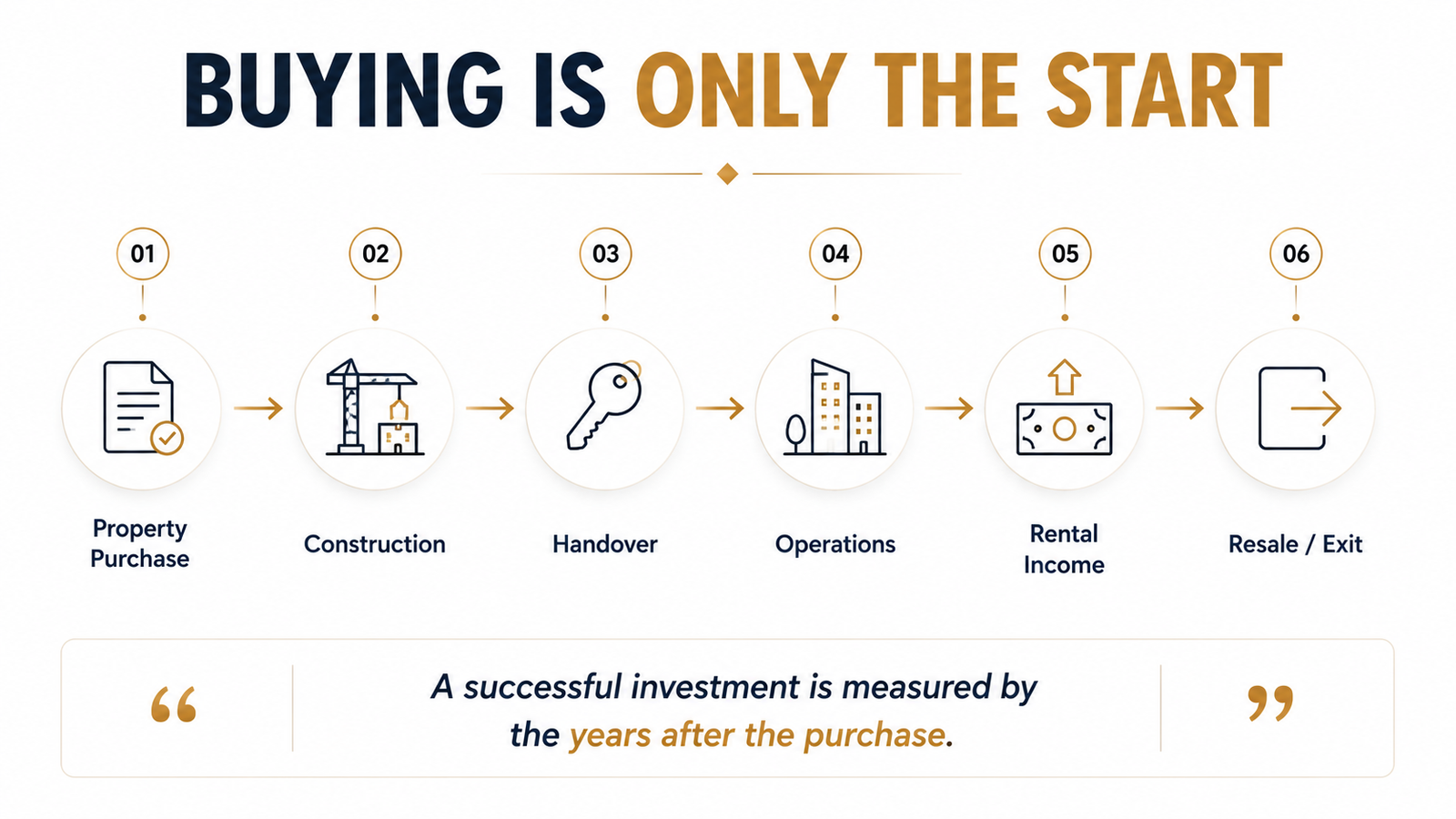
The true performance of a real-estate investment is determined by what happens over the following years:
• Whether construction proceeds according to plan
• Whether the developer communicates transparently
• Whether possession is delivered on time
• Whether the building becomes operational
• Whether promised amenities are completed
• Whether rental income is reported accurately
• Whether expenses remain reasonable
• Whether the property can be resold fairly
• Whether the investor has professional representation when problems arise
A successful investment requires more than a good buying decision. It requires continuous monitoring, management and protection throughout the complete life of the asset. This is the practical foundation of Investor Protection in Real Estate.
This is the philosophy behind Imlaak Asset Management.
Imlaak does not believe that the relationship with an investor should end when a sale is completed. Our objective is to remain involved from acquisition and construction through handover, rental operations, ongoing performance and eventual resale or exit.
The Difference Between Buying a Property and Managing an Investment
Buying a property is a transaction.
Managing an investment is an ongoing responsibility.
A buyer may own an apartment, hotel room, serviced residence or commercial unit. But ownership alone does not guarantee that the property will generate the expected return.
Several things must happen successfully after the purchase.
The project must be completed.
The property must be handed over in the promised condition.
The building needs to be put into use.
The management structure needs to operate effectively.
Transparency in the collection and distribution of rental income is required.
Costs must be kept in check.
And when the investor decides to sell, the property must have a fair and functioning resale market.
The developer is primarily responsible for developing the project.
The operator may be responsible for managing the building or rental operation.
The property manager may handle tenants, maintenance and daily matters.
However, each of these parties has its own commercial responsibilities and interests.
The investor still needs someone focused specifically on the value, income, protection and exit of the investment.
That is the role of professional asset management and a key part of Investor Protection in Real Estate.
What Can Happen After the Booking?
Most property marketing focuses on what investors will receive.
Less attention is given to what may happen between booking and eventual exit.
This is why Investor Protection in Real Estate must begin after the booking, not only when a problem appears.
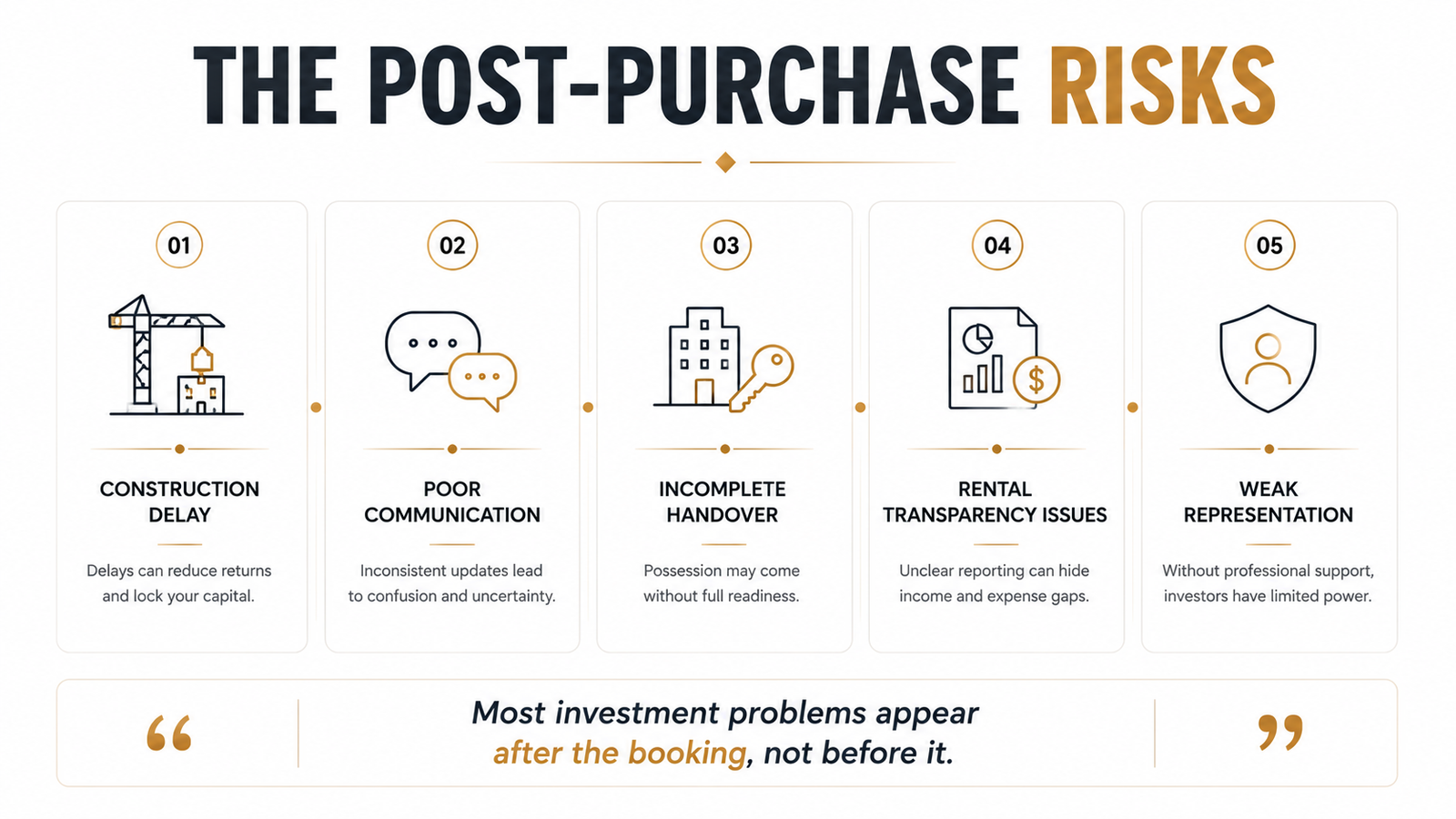
1. Construction may be delayed
A delayed project does not only inconvenience the investor. It may also create a significant financial loss.
Suppose an investor purchases a property for PKR 20 million and expects it to generate an annual rental return of 10%.
A two-year delay may represent approximately PKR 4 million in expected income that was never received.
The investor’s capital also remains blocked.
They may be unable to sell, rent or reinvest the money elsewhere. Some investors may continue paying rent for another residence because they expected to move into the new property. Others may have planned to use the rental income to support future instalments.
A project delay should therefore not be viewed only as a revised possession date. It should be understood as a financial event that can affect the complete investment plan.
2. Communication may become difficult
Before the sale, investors usually receive quick responses.
Communication may slow down or become less structured after the transaction.
various reps may provide investors various timelines. An explanation might be offered to one investor and a totally different response to another.
This does not always imply that the developer is behaving unfairly. Changing conditions, contractors, approvals, and operational difficulties are all part of large projects.
However, investors may find it difficult to get a single, trustworthy account of the situation if they are not well represented.
Investors and developers can communicate in an organized manner thanks to professional representation. One of the most crucial components of Investor Protection in Real Estate is the organized communication.
3. Handover may not mean operational readiness
A project may technically be completed, but the investment may not yet be ready to generate income.
There can be a difference between:
• Physical completion
• Possession or handover
• Completion of amenities
• Operational launch
• Start of rental income
This distinction is especially significant in managed rental complexes, serviced homes, and hotel flats.
It is possible for a unit to be turned over with unfinished common rooms, dining options, recreational spaces, or other promised amenities.
Before rental income starts, the operator might additionally need a soft-opening or stabilization period.
Investors should be aware of these phases beforehand and should not think that possession will result in instant rental returns.
Stronger Investor Protection in Real Estate can improved investment planning are supported by a thorough understanding of these phases.
4. The rental structure may be different from what investors expected
Managed properties can provide investors with a convenient and potentially profitable model.
The operator handles bookings, housekeeping, guests, pricing, maintenance and day-to-day operations. The owner receives an agreed share of the rental income.
However, the structure must be transparent.
Investors should know:
• Who controls the rental rates
• How occupancy is calculated
• Whether direct bookings are included
• How online platform commissions are treated
• Which expenses are deducted
• How the investor’s share is calculated
• Whether all units are treated fairly
• Whether the operator’s performance can be independently reviewed
Receiving a monthly statement is not the same as being able to verify that statement.
Without proper systems and independent oversight, the owner may have to rely completely on whatever information the operator provides.
This is why rental transparency is a core part of Investor Protection in Real Estate.
Why Individual Investors Often Have Limited Power
A developer is an organized institution.
It has legal advisors, finance teams, project management, sales departments and senior decision-makers.
The individual investor, on the other hand, may only have the contact number of a salesperson or customer-service representative.
When a serious issue appears, the investor may be trying to resolve it alone.
One investor may have a complaint about possession.
Another may be concerned about rental income.
Another may want a refund or resale.
Even when many investors face the same problem, they may not have a common strategy.
This is why informal investor groups often struggle.
A WhatsApp group can connect investors, but it does not automatically create professional representation.
Without verified information, clear objectives, leadership and a communication strategy, the group may become emotional rather than effective.
Professional asset management can organize the investors’ position, gather relevant documents, identify common concerns and communicate with the developer in a structured manner.
The objective should not be unnecessary confrontation.
In most cases, the success of the project is also in the investors’ interest.
The goal should be transparency, accountability and a workable commercial solution.
This is the difference between informal complaints and professional Investor Protection in Real Estate.
Why Imlaak Works With Selected Developers
Investor protection cannot be created by the asset manager alone.
The developer, operator and investor representative must all be willing to cooperate.
This is one reason Imlaak works with selected developers rather than attempting to sell every available project.
We look beyond the marketing campaign.
We consider:
• The people behind the development
• The developer’s experience and track record
• The project’s commercial and construction structure
• The realism of the proposed timelines
• The clarity of the rental model
• The developer’s willingness to communicate after the sale
• The developer’s openness to reporting and transparency
• The ability to create long-term asset-management systems
Imlaak values the developers who understand that their responsibility does not end when a unit is sold.
The developers working with Imlaak are showing a willingness to go beyond traditional sales practices by exploring stronger reporting, structured rental operations, better investor communication and professional post-sale support.
This cooperation is essential for long-term Investor Protection in Real Estate.
Investor protection should not be positioned as being against the developer.
Good investor protection can also benefit the developer.
Transparent reporting builds trust.
Well-managed rental operations improve the project’s reputation.
Fair resale systems support long-term property values.
Satisfied investors are more likely to reinvest and recommend the developer to others.
The strongest projects are those where the interests of the developer, operator and investor remain reasonably aligned.
What Imlaak Asset Management Aims to Provide
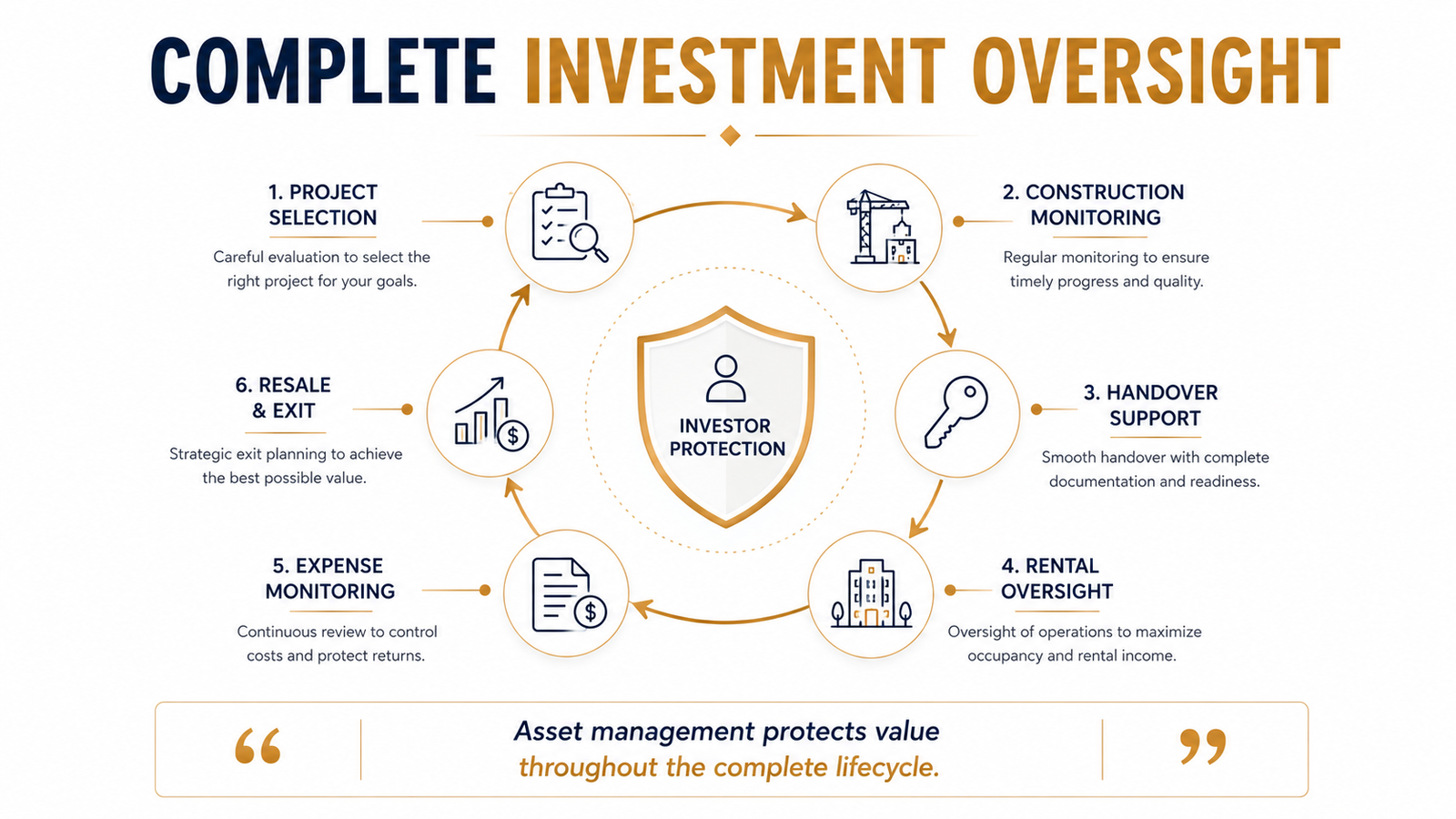
Imlaak Asset Management is being designed to support investors throughout the complete investment lifecycle.
Project selection and acquisition
Before the investment, Imlaak evaluates the project, developer, commercial structure, expected return, operational model and potential exit.
The objective is not simply to identify a property that can be sold.
The objective is to determine whether the property makes sense for the investor’s financial goals and risk profile.
This early-stage review is an important part of Investor Protection in Real Estate because it helps investors understand risk before committing capital.
Construction and developer coordination
After the booking, Imlaak aims to maintain communication with the developer and monitor important project developments.
This can include:
• Construction updates
• Payment and documentation records
• Changes in expected timelines
• Investor notices
• Common concerns across multiple investors
Where issues arise, Imlaak can help organize the investor’s commercial and documentary position and coordinate with appropriate specialists where legal advice is required.
Handover support
The handover stage can involve documentation, physical inspection, snagging, payment reconciliation, utility arrangements and operational preparation.
For rental properties, investors also need clarity on when the building will become operational and when income distribution is expected to begin.
Rental and operator oversight
For managed properties, Imlaak aims to provide investors with greater visibility over:
• Occupancy
• Average rental rates
• Gross revenue
• Management fees
• Operating expenses
• Net owner distribution
• Maintenance and replacement costs
The purpose is not to interfere unnecessarily with the operator.
It is to create checks and balances and ensure that investors can understand how their returns are being generated.
This visibility directly supports Investor Protection in Real Estate for managed rental properties.
Expense monitoring
A property can generate good gross revenue and still produce a weak net return if expenses are not properly controlled.
Management fees, maintenance charges, booking commissions, utilities, furniture replacement and other deductions must be transparent and commercially reasonable.
Imlaak Asset Management can help investors review these charges and identify unusual or unexplained deductions.
Resale and exit support
Every investor should think about the exit before entering the investment.
Imlaak aims to help property owners understand:
• Current market value
• Comparable transactions
• Rental yield
• Buyer demand
• Transfer restrictions
• Developer NOC requirements
• Resale timing
• Wider market exposure
The company managing the building should not be the only party telling an owner what the property is worth.
Independent resale advice can help protect investors from accepting a price that does not reflect the asset’s true market position.
The Role of the Imlaak Landlord Portal in Investor Protection in Real Estate
Technology can help bring the complete investment journey into one place.
The Imlaak Landlord Portal is intended to provide owners with clearer visibility over their properties.
Depending on the project and available integrations, the portal may bring together:
• Property and ownership details
• Booking and payment records
• Agreements and official documents
• Construction and handover updates
• Rental income and occupancy information
• Expense deductions
• Maintenance records
• Net owner distributions
• Resale comparables and market information
• Important notices and communications
The portal is not intended to replace professional asset management.
Technology displays information.
The asset-management team interprets the information, identifies concerns and helps investors take appropriate action.
The combination of technology, professional oversight and collective representation is what can move investors from blind trust to informed ownership.
For Imlaak, this is a practical step toward stronger Investor Protection in Real Estate in Pakistan.
A More Mature Real-Estate Ecosystem for Pakistan
Pakistan’s real-estate sector is evolving.
The next generation of projects should not be designed only around marketing and sales.
They should also be designed around ownership, operations, transparency and exit.
This requires cooperation.
Developers must be willing to communicate and report more clearly.
Operators must provide transparent performance information.
Asset managers must represent investors responsibly.
And investors must understand that their responsibility does not end when they make the booking payment.
Imlaak appreciates the developers and operators who are open to building these systems into their projects.
Their willingness to support structured reporting, professional asset management and stronger investor communication can help improve confidence in Pakistan’s property market.
A more mature market requires stronger Investor Protection in Real Estate, better reporting and more responsible post-sale management.
Conclusion
Buying a property is an important decision, but it is only one stage of the investment journey.
The true result depends on what happens during construction, handover, rental operations, expense management, resale and eventual exit.
Investors should therefore ask one important question before buying:
Who will remain focused on my interests after the sale is completed?
At Imlaak, our objective is not only to help investors enter a project.
We aim to support, manage and protect their interests throughout the complete life of the investment.
Because buying property is a transaction.
Protecting its value, income and exit requires a long-term strategy.
That long-term strategy is the real meaning of Investor Protection in Real Estate.
How Imlaak Can Help
Imlaak can assist investors with:
• Project and investment assessment
• Selected developer access
• Post-sale developer coordination
• Construction and handover support
• Managed-rental oversight
• Income and expense monitoring
• Collective investor representation
• Independent resale guidance
• Exit planning
• Landlord Portal reporting
To discuss an existing property or a new investment, contact the Imlaak Asset Management team for an initial assessment.
For stronger Investor Protection in Real Estate, Imlaak Asset Management helps investors manage, monitor and protect their property investments beyond the sale.
Shahnawaz Yaqub Bhatti
Investment Consultant and CEO at Imlaak
- Mobile: +92 300 3343336 (WhatsApp)
- Mobile: +92 333 1616160 (WhatsApp)
[fc id=’19’ align=’left’][/fc]