
What We Look for Before Recommending a Property Project in Pakistan
The number of real estate projects available in Pakistan has increased significantly.
Investors today can choose from apartments, serviced residences, hotel rooms, resort properties, commercial units and managed rental projects across major cities and tourism destinations.
For a real estate company, it can be tempting to work with every developer and market every available project.
More projects mean more inventory. More inventory creates more opportunities to advertise, generate leads and close transactions.
However, this is not the approach Imlaak wants to follow.
We believe a Real Estate Investment Advisory company should not measure its success only by the number of properties it sells. It should also consider what happens to investors after the sale has been completed.
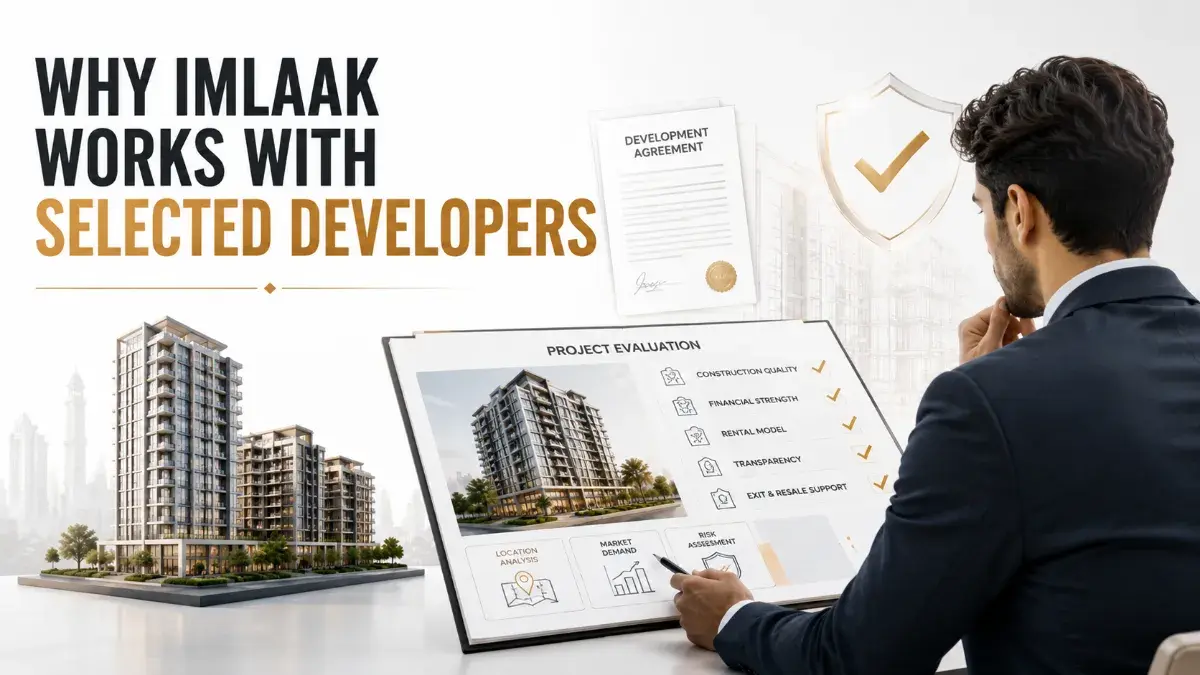
This is why Imlaak works with selected developers and projects.
Our objective is not simply to identify properties that can be sold. We want to work with developers who are willing to create stronger long-term structures for investors, including better communication, clearer rental models, professional handover support, transparent reporting, asset-management oversight and more organized resale assistance.
No property investment can ever be completely free from risk. Construction, market conditions, regulation, operating performance and external economic factors can all affect the final outcome.
However, there is an important difference between accepting a carefully assessed investment risk and recommending a project without understanding what will happen after the booking.
For Imlaak, developer selection is therefore an important part of investor protection and Real Estate Investment Advisory.
Selling a Project Is Not the Same as Standing Behind It
The easiest stage of a property project is often the sales stage.
The project is new. The marketing campaign is active. The brochures and visualizations are attractive. Payment plans are available. The developer’s sales team is accessible.
Everyone is focused on convincing the investor to book.
But the real test of the relationship comes later.
What happens if construction slows down?
What happens if the expected handover date changes?
What happens when investors need clear updates?
How will snagging and handover be managed?
Who will operate the rental model?
How will income and expenses be reported?
What happens if the operator underperforms?
And when an investor eventually wants to sell, who will help protect the property’s resale value?
An advisor should never recommend a project today without considering whether it will be able to stand with the investor tomorrow.
That is one of the central principles behind Imlaak’s developer-selection strategy.
We do not only ask whether the project can be sold.
We ask whether a long-term relationship can be built around it.
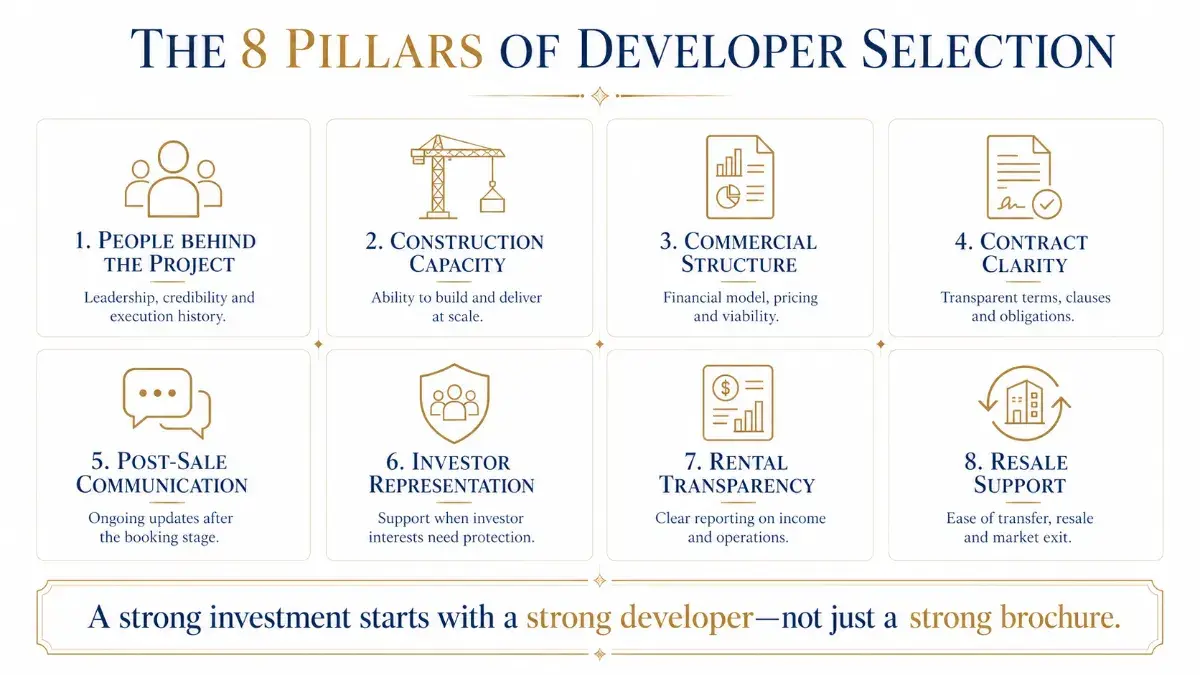
What Imlaak Looks for in a Developer
Every developer and project is different. Therefore, the evaluation cannot depend on one factor alone.
A large brand name does not automatically make every project suitable.
Similarly, a newer developer should not automatically be rejected if the people, structure, planning and financial capacity behind the project are strong.
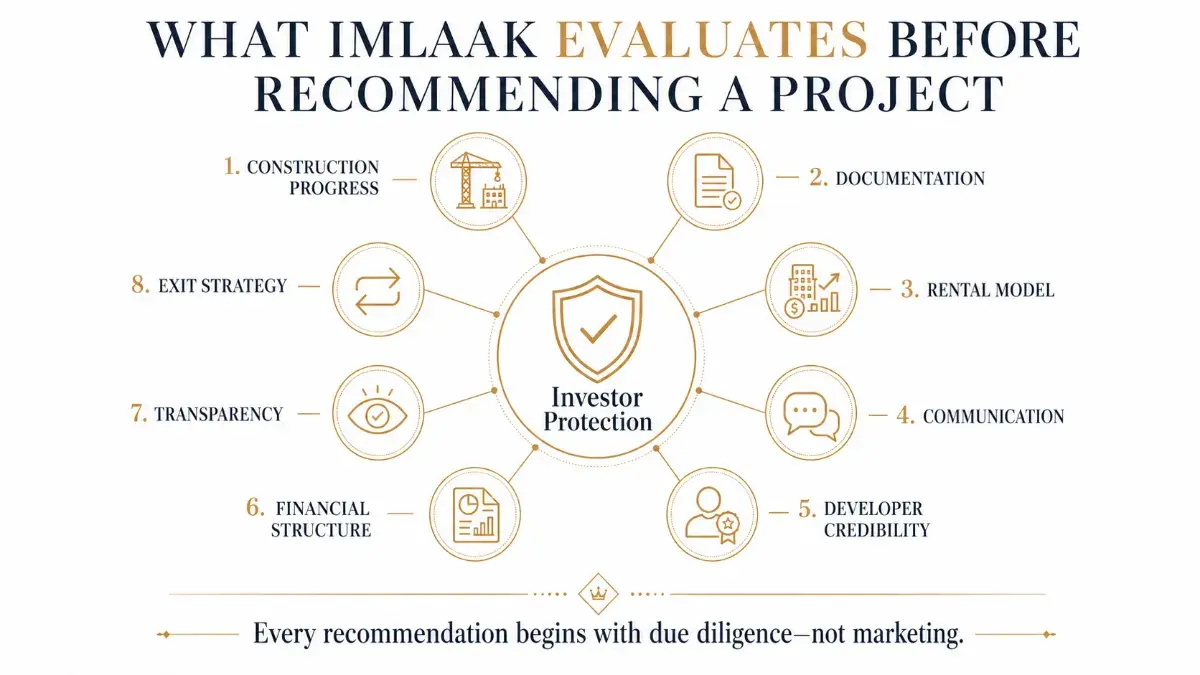
Imlaak considers a combination of factors as part of its Real Estate Investment Advisory approach.
1. The People Behind the Project
Real estate projects are ultimately delivered by people.
We look at the experience, credibility, commitment and professional capacity of the individuals behind the development.
Who are the sponsors?
What is their background?
What have they delivered before?
Are they accessible when important questions arise?
Are they willing to discuss problems openly?
A developer’s attitude toward investors and professional partners can often be as important as the project presentation itself.
2. Construction and Delivery Capacity
An attractive concept has little value if the developer does not have the ability to deliver it.
We therefore consider:
- Construction planning
- Project phasing
- Contractor capacity
- Funding structure
- Development experience
- Practicality of the proposed timeline
- Progress on site
- Ability to complete common areas and promised amenities
The objective is not to claim that delays can never happen.
Large developments can face genuine challenges.
The more important question is whether the developer has a credible plan, communicates honestly and takes responsibility when timelines change.
3. The Commercial Structure
A good-looking property is not automatically a good investment.
The entry price must be considered in relation to:
- The location
- Comparable properties
- Construction stage
- Product quality
- Expected demand
- Rental potential
- Operating costs
- Resale prospects
The projected return must also be commercially realistic.
If the rental projections depend on unrealistic occupancy, exceptionally high room rates or very low operating expenses, the investor may eventually receive a very different result.
Imlaak therefore looks beyond the headline return and considers the business model supporting it.
4. Documentation and Contractual Clarity
The booking form and sale agreement define the investor’s actual rights.
We consider whether the project documentation provides reasonable clarity regarding:
- Payment obligations
- Construction timelines
- Handover
- Default and termination
- Refunds
- Transfer and resale
- Rental operations
- Maintenance charges
- Management rights
- Dispute resolution
No agreement will remove every possible risk.
However, major commercial arrangements should be clearly documented rather than left entirely to verbal assurances.
5. Willingness to Communicate After the Sale
This is one of the most important factors.
Many developers communicate very actively during the sales period but become difficult to reach afterward.
Imlaak prefers to work with developers who understand that investors will continue to need information throughout construction and after completion.
This includes:
- Regular project updates
- Clear payment records
- Responses to investor concerns
- Handover coordination
- Operational updates
- Rental reporting
- Communication during delays or changes
Strong post-sale communication helps prevent confusion and unnecessary conflict.
6. Openness to Investor Representation
A developer may have its own legal, finance, sales and management teams.
Investors should also have the ability to raise concerns through a professional representative.
This does not mean Imlaak’s role is to oppose the developer.
The objective is to create a structured relationship in which investors can receive information, raise common concerns and seek practical solutions.
Developers who are willing to engage with professional investor representation demonstrate confidence in the long-term structure of their projects.
7. Transparency in Managed Rentals
This is particularly important for hotels, serviced residences and rental-pool developments.
In these projects, the investor may depend on an operator for many years.
The operator may control:
- Bookings
- Room rates
- Occupancy
- Revenue collection
- Management fees
- Operating expenses
- Owner distributions
Imlaak looks for developers and operators who are open to stronger reporting and transparency.
Investors should be able to understand how revenue is generated, what expenses are deducted and how their final share is calculated.
The exact system will vary from project to project, but the principle should remain the same:
Owners should not be expected to rely entirely on blind trust.
8. Support for Resale and Exit
An investment should not be evaluated only by how easily it can be purchased.
The investor must also consider how the property may eventually be sold.
We look at:
- Transfer conditions
- Developer NOC requirements
- Resale restrictions
- Existing and future demand
- Unsold developer inventory
- Rental performance
- Availability of comparable transactions
- Access to outside buyers
A project with transparent rental performance and a functioning resale ecosystem is generally better positioned to maintain long-term investor confidence.
The Developers and Projects Imlaak Has Chosen to Work With
Imlaak’s selection philosophy can be seen in the developers and projects it represents.
These relationships include:
- Imperium Developers — Sixty6 Gulberg
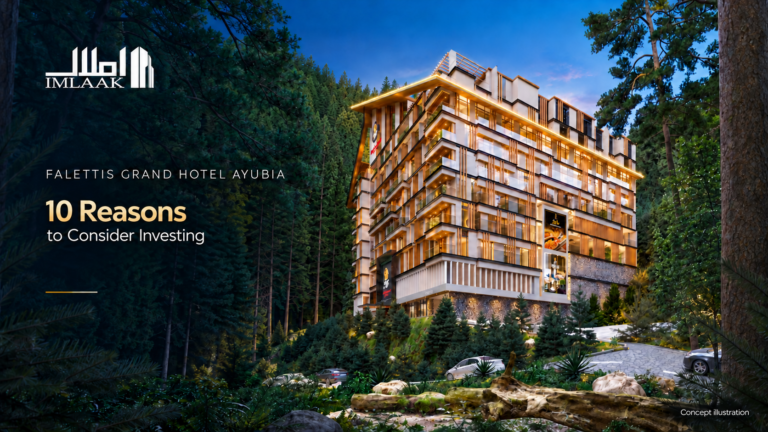
- Abdullah Developers — Faletti’s Grand Hotel Ayubia
- Shairanwala Developers — Mayfair Residencia
- Shairanwala Developers — Hawthorn Suites by Wyndham
- Clematis by The Cloud
These projects differ in location, concept, stage of development and investment structure.
Some are urban residential or mixed-use developments.
Others are hospitality, tourism or managed-rental projects.
However, the common objective is to create a stronger relationship between the developer, Imlaak and the investor.
For Imlaak, working with these projects is not only about marketing and sales.
It is about developing a longer-term Real Estate Investment Advisory framework that can include:
- Better investor communication
- Post-sale coordination
- Construction updates
- Handover support
- Managed-rental oversight
- Income and expense visibility
- Asset-management services
- Collective investor representation
- Resale and exit support
- Integration with the Imlaak Landlord Portal where practical and formally agreed
We appreciate developers who are open to these discussions.
A developer that allows questions, accepts professional oversight and explores stronger reporting systems is helping improve the overall standard of Pakistan’s real estate market.
Imperium Developers and Sixty6 Gulberg
Sixty6 Gulberg is an important example of an urban property investment where the relationship should continue beyond the initial transaction.
For investors, the value of the project will not depend only on the original purchase price.
It will also depend on:
- Timely completion
- Quality of handover
- Building operations
- Rental demand
- Maintenance standards
- Owner communication
- Resale activity
Imlaak’s relationship with Imperium Developers provides an opportunity to support investors through more than the sales process.
The long-term objective is to help investors understand the performance of their assets and receive support through the construction, handover, rental and resale stages.
Where specific asset-management or reporting mechanisms are still being formalized, they should be described accurately as systems being developed rather than completed services.
Transparency must apply to Imlaak’s own communication as well.
Abdullah Developers and Faletti’s Grand Hotel Ayubia
Faletti’s Grand Hotel Ayubia represents a different type of investment.
Hospitality and resort properties require investors to evaluate not only the physical unit but also the complete operating model.
The value of the investment may depend on:
- Tourism demand
- Hotel operations
- Occupancy
- Average room rates
- Revenue-sharing arrangements
- Maintenance and replacement costs
- Operator performance
- Long-term resale demand
This makes asset-management oversight especially important.
Imlaak values its relationship with Abdullah Developers because hospitality projects require close coordination between the developer, operator, asset manager and investors.
The objective should be to create a structure where investors can understand how the property is performing and how their share is calculated.
A hotel investment should not be sold only on the basis of a projected return.
The investor should understand the operating assumptions, expense structure and reporting mechanism behind that return.
Shairanwala Developers, Mayfair Residencia and Hawthorn Suites by Wyndham
Imlaak’s relationship with Shairanwala Developers includes Mayfair Residencia and Hawthorn Suites by Wyndham.
These two projects may serve different investor requirements, but both highlight the importance of structured developer coordination.
Mayfair Residencia requires attention to the complete residential investment journey:
- Construction
- Handover
- Living standards
- Maintenance
- Rental demand
- Resale
Hawthorn Suites by Wyndham adds the complexity of hospitality operations and brand-led management.
For investors in a hotel or serviced-residence model, the strength of the international brand is important, but it is not the only consideration.
Investors must also understand:
- Who operates the property
- How revenue is collected
- How expenses are allocated
- What reporting will be available
- What rights owners have
- How resale works during the management period
Imlaak appreciates developers who are willing to explore stronger systems around these areas.
However, investor trust depends on implementing those systems, not only discussing them.
For that reason, any specific feature, integration or protection should only be communicated once it has been formally agreed and documented.
Clematis by The Cloud
Clematis by The Cloud adds another example of a project where investors should evaluate more than the visual concept and location.
For a tourism or destination-based property, long-term performance depends on:
- Access and location
- Construction quality
- Delivery
- Amenities
- Seasonal demand
- Rental management
- Maintenance
- Resale liquidity
The asset-management structure should therefore be considered from the beginning.
Imlaak’s relationship with Clematis by The Cloud reflects the broader objective of supporting investors throughout the property lifecycle rather than only facilitating the initial booking.
As with every project, the exact services, reporting tools and investor-protection mechanisms must reflect what has been formally agreed between the developer, operator and Imlaak.
Why Developer Openness Matters
Investor protection cannot be imposed by one party alone.
Imlaak can recommend systems and represent investors, but meaningful transparency requires cooperation from the developer and operator.
The developers working with Imlaak deserve recognition for being open to conversations about:
- Better post-sale communication
- Structured rental reporting
- Investor access to information
- Professional asset-management oversight
- Collective representation
- More organized resale support
- Technology-led landlord reporting
This openness matters because the market is changing.
Investors are becoming more informed.
They are asking better questions.
They no longer want only a brochure and a payment plan.
They want to understand construction, operations, income, expenses and exit.
Developers who respond positively to these expectations will be better positioned to build long-term trust.
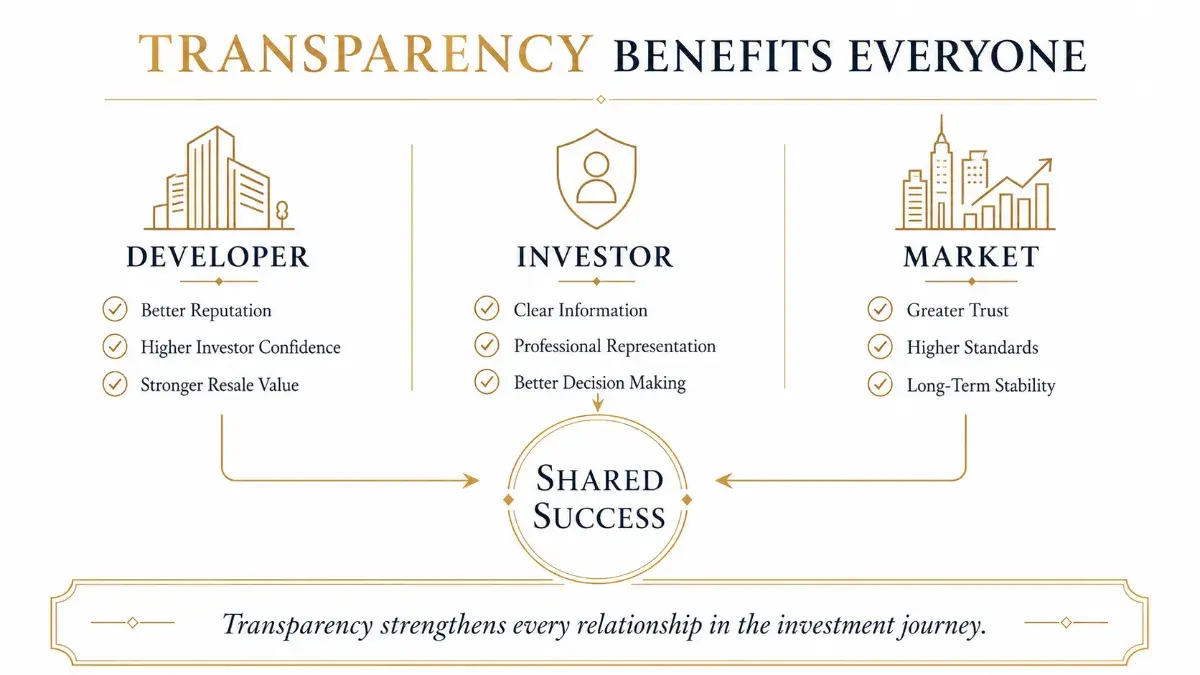
Transparency Benefits the Developer as Well
Investor protection is sometimes misunderstood as something that exists only for the benefit of buyers.
In reality, strong investor systems can also benefit the developer.
Stronger Investor Confidence
Investors are more willing to commit when they understand how the project will be managed after the sale.
Better Project Reputation
Clear communication and transparent operations improve the long-term reputation of the project.
Stronger Resale Values
When rental performance, expenses and transactions are visible, buyers can value units more confidently.
Greater Investor Loyalty
Investors who receive good post-sale support are more likely to reinvest in the developer’s future projects.
Fewer Unnecessary Disputes
Many disputes begin because of incomplete information or inconsistent communication.
A structured system can resolve concerns before they become serious conflicts.
Better Alignment
The long-term success of the project should benefit the developer, operator and investor.
When incentives are properly aligned, all parties have a reason to protect the project’s performance and reputation.
Selectivity Does Not Mean Perfection
It is important to be realistic.
Working with selected developers does not mean that no project will face delays, operational challenges or market risks.
Real estate remains a long-term investment and unexpected issues can arise.
Imlaak also cannot guarantee the future performance of every development or operator.
The purpose of selectivity is not to claim that risk has disappeared.
The purpose is to improve the quality of the projects being presented, create stronger relationships and increase the possibility of resolving problems professionally when they occur.
A responsible advisor should communicate both the opportunity and the risk.
Imlaak’s Responsibility After Selecting a Project
Selectivity also creates responsibility for Imlaak.
If we select a project, introduce investors and build a commercial relationship with the developer, we should not simply disappear after the sale.
Our Real Estate Investment Advisory role should include, where applicable:
- Maintaining communication with the developer
- Organizing investor records
- Sharing verified project updates
- Supporting the handover process
- Monitoring rental and operating performance
- Reviewing reported income and expenses
- Assisting with resale and exit
- Representing shared investor concerns professionally
We should not respond to every future problem by saying:
“We were only the sales agent. Speak to the developer.”
That is not the long-term model Imlaak is trying to build.
Our objective is to evolve from transaction-based property sales toward continuous investor representation and asset management.
How the Imlaak Landlord Portal Supports This Approach
The Imlaak Landlord Portal is intended to strengthen the relationship between investors, projects and asset-management services.
Depending on the project and the cooperation of the developer and operator, the portal may provide access to:
- Ownership and unit details
- Payment records
- Agreements and documents
- Construction updates
- Handover records
- Rental performance
- Occupancy
- Revenue and expenses
- Owner distributions
- Maintenance information
- Resale comparables
- Investor notices
The portal cannot create transparency unless accurate information is provided.
This is why developer and operator cooperation is essential.
The strongest model combines:
- A transparent developer
- A capable operator
- A professional asset manager
- A technology platform
- An informed investor
A Better Standard for Pakistan’s Property Market
Pakistan’s real estate market should not be built only around selling more units.
The next stage of the industry must focus on what happens after the sale.
Investors need:
- Clearer information
- Stronger documentation
- Better communication
- More transparent rental systems
- Reasonable expense control
- Professional representation
- Independent resale support
Developers who are open to these systems are helping build a more mature market.
Imlaak values its relationships with Imperium Developers, Abdullah Developers, Shairanwala Developers and The Cloud because these relationships create an opportunity to improve the complete investor journey.
The exact structure will differ from project to project, and improvements will take time.
But the direction is important.
The goal should be to move from a sales-led relationship toward a long-term investment relationship.
Conclusion
Imlaak does not work with selected developers simply to reduce the number of projects it sells.
We do so because project selection is part of investor protection.
We look at more than location, price and marketing.
We consider the developer, construction capacity, documentation, rental model, communication, reporting, handover, asset management and resale.
We also value developers who are open to transparency and professional investor representation.
The projects Imlaak represents—including Sixty6 Gulberg, Faletti’s Grand Hotel Ayubia, Mayfair Residencia, Hawthorn Suites by Wyndham and Clematis by The Cloud—provide an opportunity to build stronger systems around the investor.
Not every system is identical, and not every feature may yet be fully implemented.
But the objective is clear:
To work with developers who are willing to think beyond the sale and help create a more transparent, accountable and investor-focused real estate ecosystem in Pakistan.
How Imlaak Can Help
Imlaak can assist investors through Real Estate Investment Advisory services, including:
- Project assessment
- Developer and investment selection
- Commercial-structure evaluation
- Post-sale communication
- Construction coordination
- Handover support
- Rental and operator oversight
- Income and expense monitoring
- Collective investor representation
- Resale and exit planning
- Imlaak Landlord Portal services
To understand why Imlaak has selected a particular project—or to have an investment assessed before booking—contact the Imlaak advisory team.
Shahnawaz Yaqub Bhatti
Investment Consultant and CEO at Imlaak
- Mobile: +92 300 3343336 (WhatsApp)
- Mobile: +92 333 1616160 (WhatsApp)
[fc id=’19’ align=’left’][/fc]