
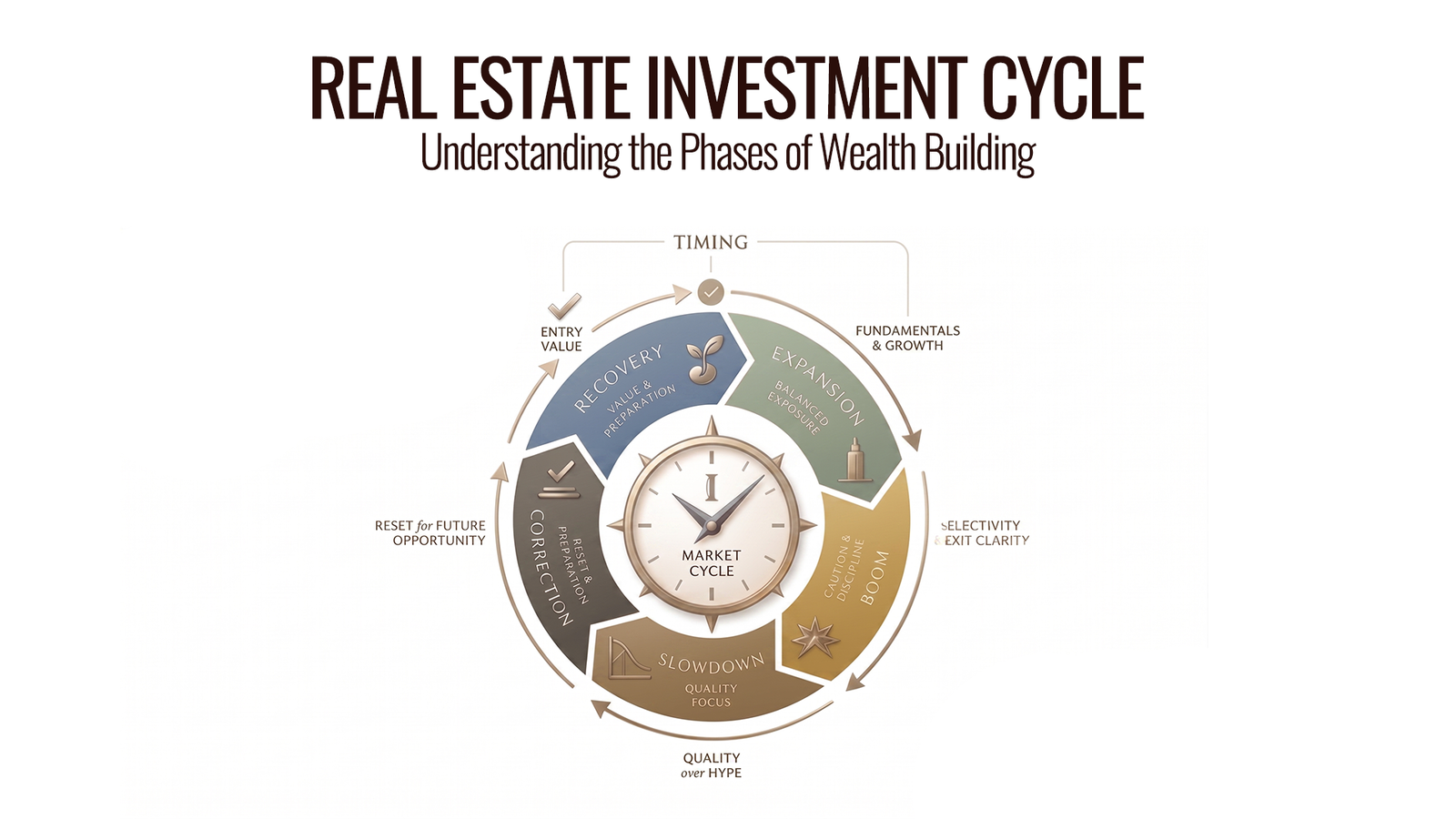
Real estate has always been one of the most trusted ways to build wealth in Pakistan. This real estate cycle investment guide explains why serious investors know that property markets do not move upward in a straight line. They move in phases. They speed up, cool down, stabilize, rise again, and then repeat the cycle.
This is where many investors make costly mistakes.
They enter the market when excitement is already at its peak. They buy because everyone around them is buying. They assume rising prices will continue forever. Then when the market slows, they begin questioning the asset class itself.
In most cases, the problem is not real estate, the problem is entering without understanding timing, market position, and cycle behavior.
At Imlaak, we believe real estate should never be approached blindly. It should be approached with clarity, structure, and strategy. That is why understanding the real estate cycle, as explained in this real estate cycle investment guide, is one of the most important things any investor can learn before allocating capital.
Crowds buy confidence. Serious investors buy value.
If you understand where the market stands, you can make far better investment decisions. You can avoid hype, find value sooner, and build wealth with less emotion and more confidence.
What is the real estate cycle?
The real estate cycle is the natural pattern through which property markets move over time.
No market remains hot forever, and no market remains slow forever. Different factors, such as investor confidence, supply and demand, the economy, construction activity, rental demand, inflation, and general state of mind, cause property markets to go through different phases.
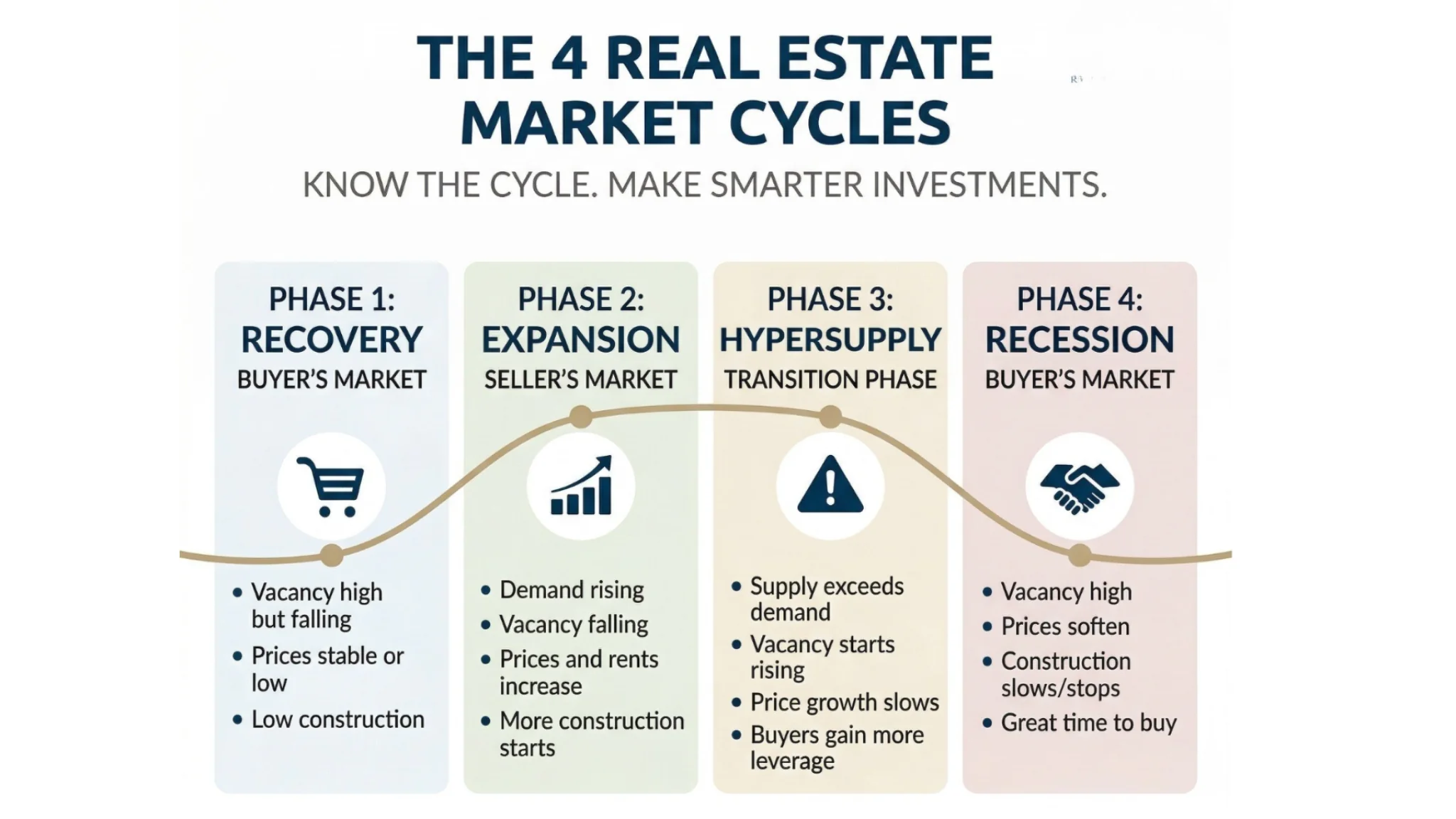
In simple words, the market usually moves through four broad stages:
- Recovery
- Expansion
- Hypersupply
- Recession
After recession, the next recovery begins and the cycle starts again.
This cycle is not just academic theory. It is something that repeats across real markets again and again. The speed and shape may vary, but the pattern remains familiar. A market stabilizes, begins gaining confidence, attracts stronger demand, overheats, slows, resets, and eventually becomes attractive again.
For investors, this matters because the same property can look cheap, expensive, attractive, or risky depending on where you are in the cycle.
That is why serious investing is not just about what you buy. It is also about when you buy.
Real estate is not only about where you invest. It is also about when you invest.
Why this real estate cycle investment guide matters
Most people enter real estate emotionally.
They buy when they see other people making money. They wait for the market to feel safe. They look for validation from crowds, relatives, social circles, and noise. The problem is that by the time a market feels comfortable to everyone, a big part of the upside may already be gone.
This is why the public usually buys confidence, while smart investors buy value.
A real estate cycle investment guide helps answer the questions that actually matter:
- Is this the right time to enter the market?
- Am I buying value or am I buying momentum?
- Should I expect short term appreciation or do I need patience?
- Is this market still growing or already overheating?
- Should I focus on rental income, capital growth, or both?
- Is this a short-term slowdown or a bigger problem with the structure?
At Imlaak, this is one of the core ways we guide investors. A property should not only look attractive on paper. It should make sense in context. That context is often the cycle.
Stage 1: Recovery
The phase where serious investors quietly start positioning.
Recovery is the phase that comes after a market has already gone through weakness, fatigue, or uncertainty.
Sentiment is usually low. Transactions are limited. Public excitement is minimal. Sellers become more flexible. Buyers remain cautious. Media attention is weak. Many people stay on the sidelines because the market does not feel exciting enough.
This is exactly why recovery can be such a powerful stage.
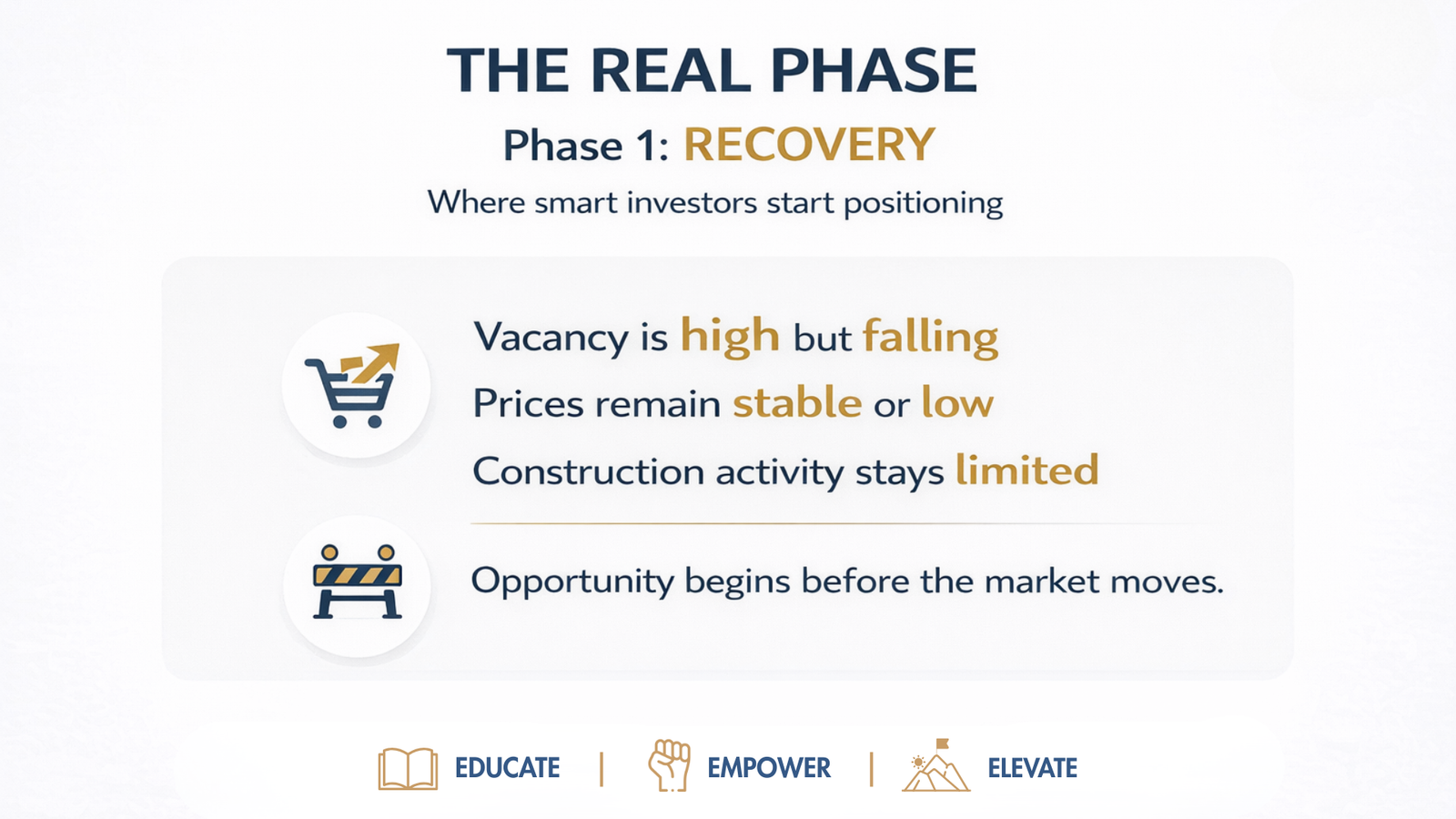
In recovery, prices may not yet be rising aggressively, but the market is starting to stabilize. Weak hands have already exited. Excess hype has disappeared. Competition is lower. Real value begins appearing because fear is still stronger than confidence.
This phase rarely feels dramatic. It often feels boring. But in investing, boring can be valuable.
Disciplined investors understand that recovery is where strong positioning begins. They do not wait for applause from the market. They study quality assets, evaluate downside risk, negotiate carefully, and enter when pricing still reflects uncertainty rather than widespread excitement.
The market rewards patience long before it rewards hype.
Not every slow market is automatically a recovery opportunity. But when fundamentals remain solid and sentiment is weak, recovery can offer some of the best entries in the entire cycle.
Stage 2: Expansion
The phase where confidence returns and momentum becomes healthier.
Expansion is the stage where the market begins waking up more clearly.
Demand improves. Transaction volume starts increasing. People pay more attention to projects that are of higher quality. Prices start to go up more steadily. Buyers are more sure of themselves. Sellers gain more strength. End users re enter. Investors start moving with greater conviction.
This is often the healthiest part of the cycle.
Why? Because the market is no longer deeply uncertain, but it is also not yet irrational. In this phase, growth is usually helped by better fundamentals. Slowly, confidence comes back. Opportunities still exist. The market has started moving, but much of the upside may still lie ahead.
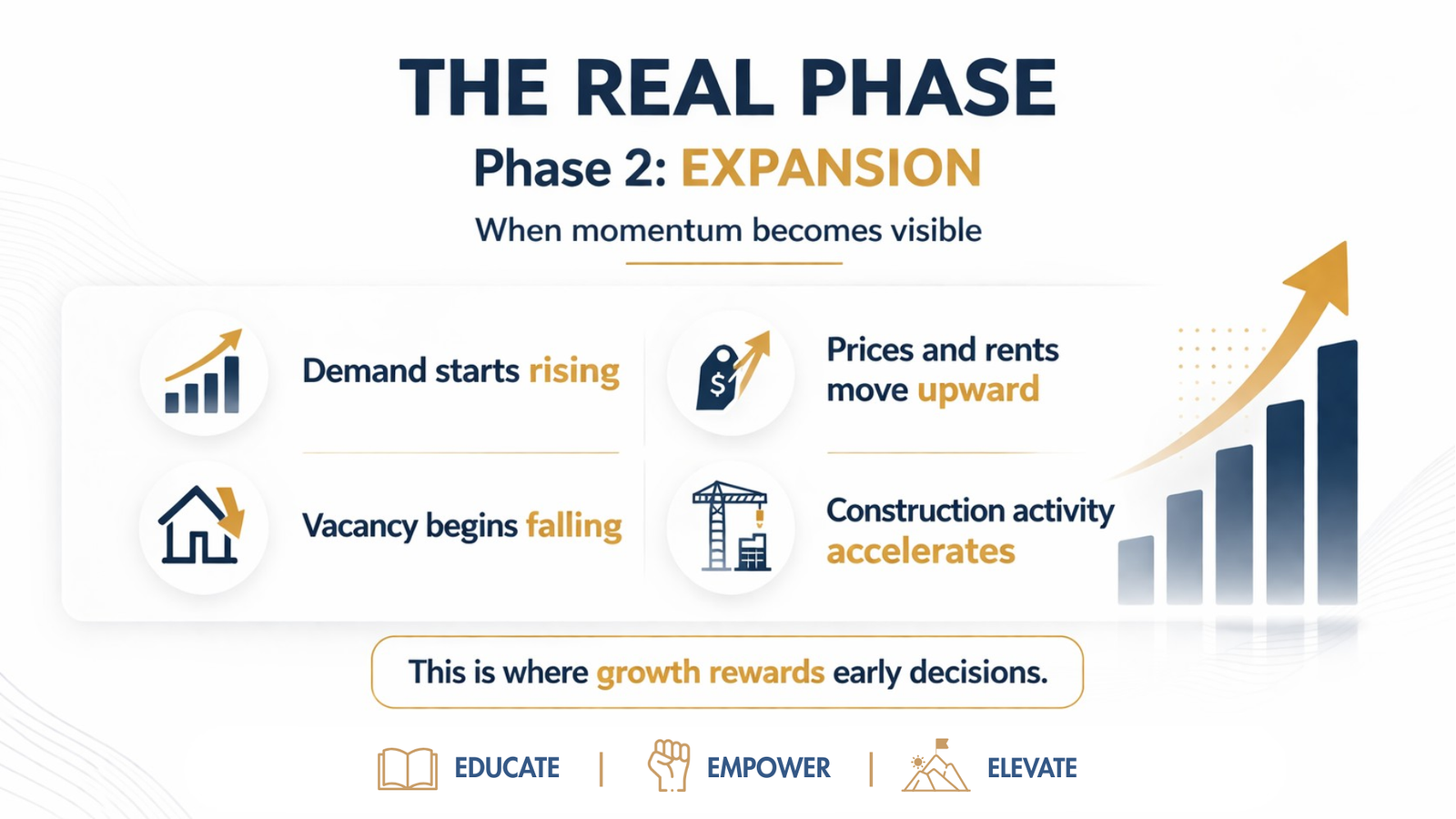
For many investors, expansion offers a very attractive balance between risk and reward. The market is giving clearer signals, yet the full crowd may not have arrived.
This is where smart investors often build meaningful exposure.
At Imlaak, this is also where strategy becomes even more important. In a recovering or expanding market, many assets appear attractive on the surface. But not every asset deserves capital. Some properties are benefiting from real fundamentals. Others are simply floating with rising sentiment.
The difference matters.
Stage 3: Hypersupply
The phase where the market gets louder and discipline becomes critical.
The hypersupply phase is when the market becomes highly visible.
Prices rise quickly. Investors feel urgency. Demand becomes aggressive. Social circles become full of property conversations. Sales teams get louder. People who want to buy start to worry that they will miss out if they don’t act right away.
This phase can be highly profitable, especially for those who entered earlier.
But it is also the phase where many mistakes are made.
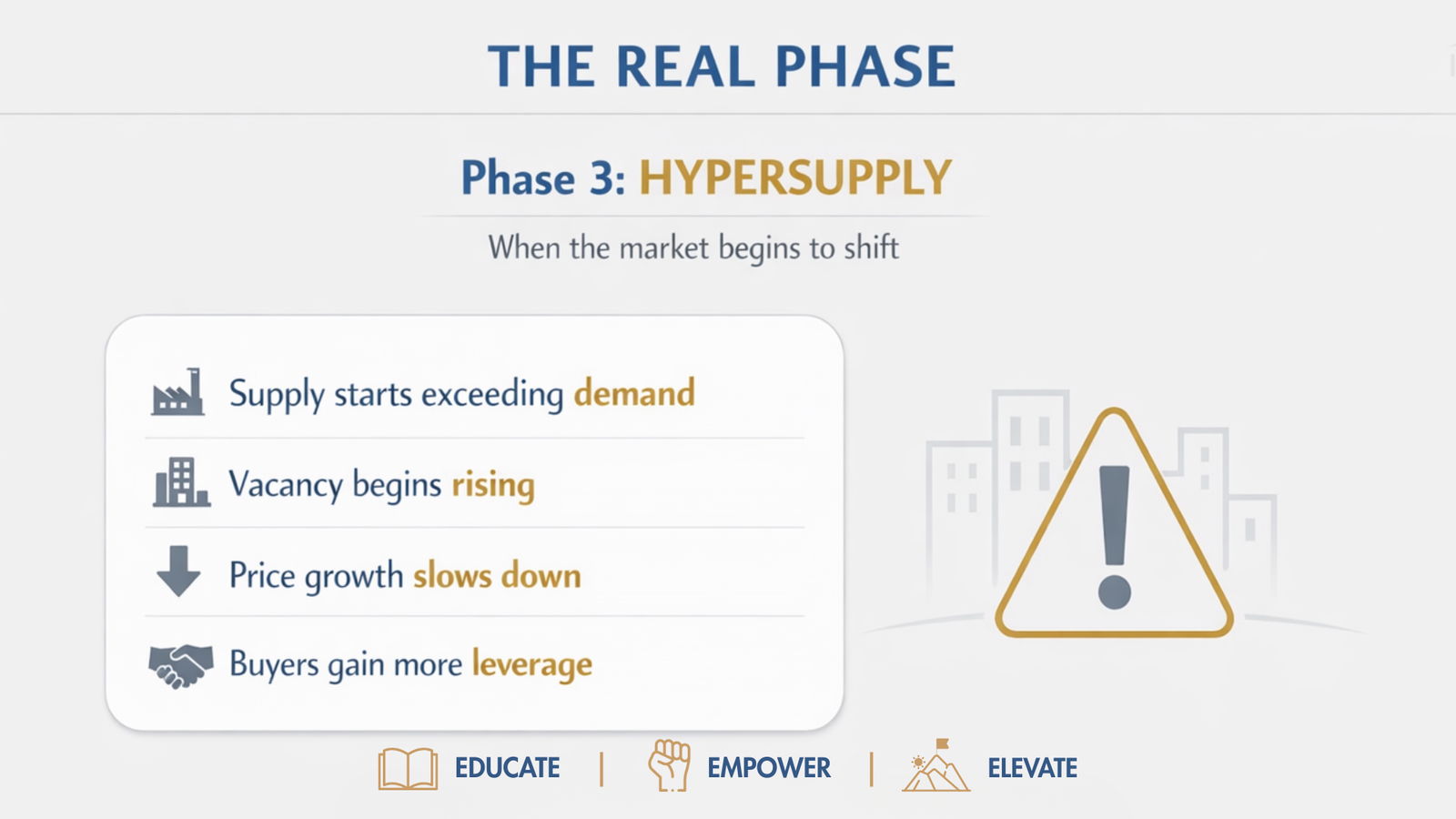
Why? Because hypersupply conditions often reduce discipline. Buyers stop asking hard questions. Poor quality inventory starts selling simply because the market is hot. Emotion starts replacing analysis. People begin assuming that because prices have risen strongly, they will continue rising indefinitely.
This is the dangerous part.
A hypersupply phase does not mean every asset is a good investment. It simply means market enthusiasm is strong. Strong enthusiasm can hide weak fundamentals for a while, but not forever.
This is why experienced investors behave differently during hypersupply conditions. They do not stop investing completely, but they become far more selective. They ask tougher questions. They focus on asset quality, exit clarity, income strength, location depth, and replacement logic.
The public sees hypersupply as proof that real estate is easy money.
Serious investors see hypersupply as proof that caution is now more important than ever.
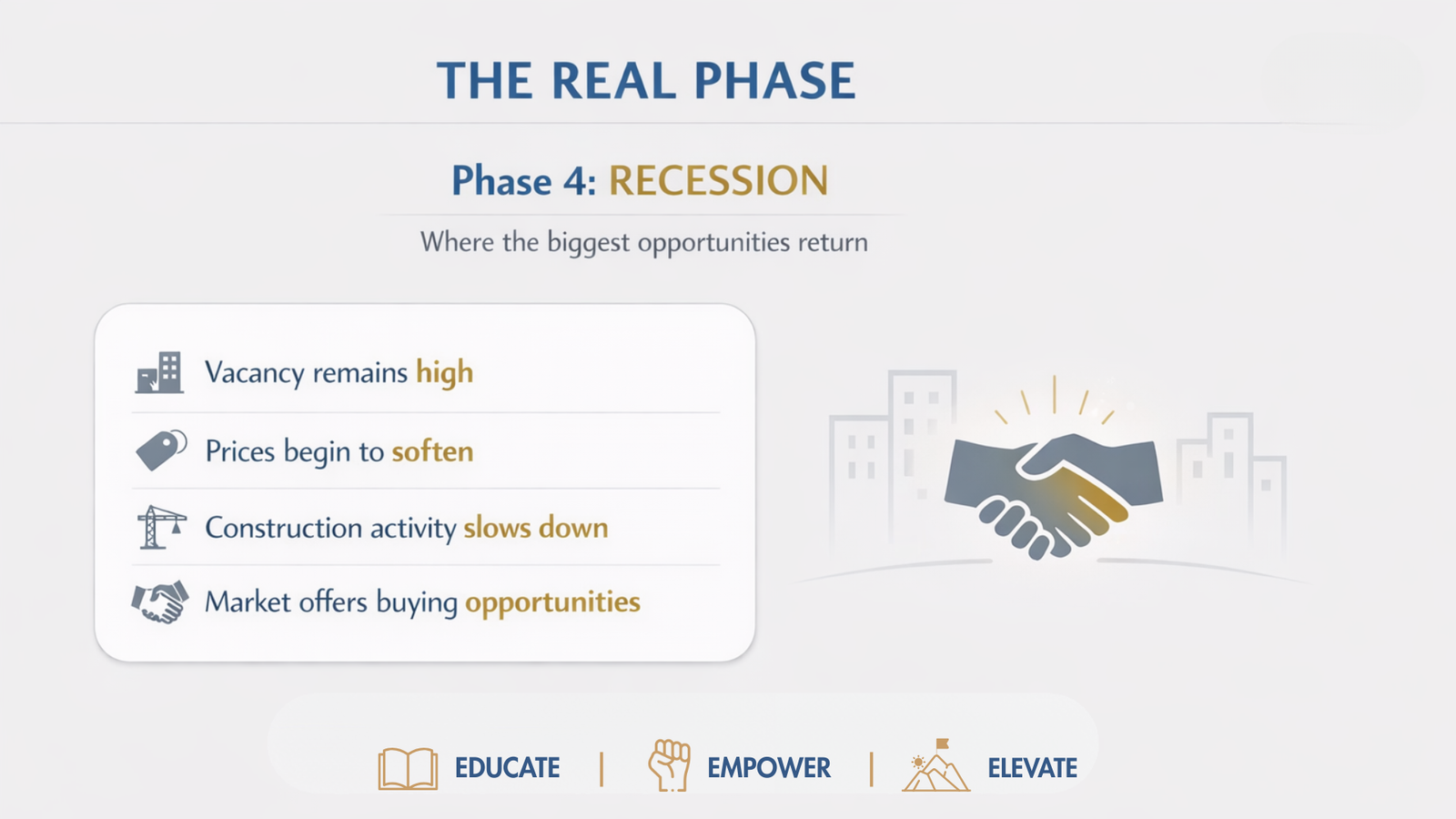
Stage 4: Recession
The phase where the market separates quality from noise, resets, and prepares for the next opportunity.
Recession is where the market begins losing momentum.
Prices may still seem stable, but the rate of growth is slowing down. People who want to buy become more picky. The number of transactions starts to go down. Sellers continue expecting strong prices, but buyers no longer agree blindly. Inventory starts taking longer to move in weaker segments.
The recession phase often starts quietly.
That is why many people miss it.
They assume the previous excitement will continue. They assume the market is simply taking a short pause. Sometimes that is true. Sometimes it is not. What matters is whether the underlying quality of the asset can still justify demand even after excitement cools.
This is where weak projects get exposed.
A strong asset with real usability, strong location, healthy rental demand, solid delivery prospects, and clear end user value may remain resilient. A weak asset supported only by marketing noise often begins struggling.
This is one of the most important reasons why a real estate cycle investment guide is so useful in Pakistan.
At Imlaak, this is where advisory becomes especially valuable. Investors need calm judgment, not market noise. They need to know what still deserves confidence and what only looked attractive when the market was running hot.
Growth slows down a lot or stops. Sometimes, values get weaker. There is no longer a sense of urgency. Confidence goes down.
Speculators exit. Buyer activity reduces. The market becomes quieter again.
Many investors fear this phase. Serious investors study it.
Recession is not always a sign that real estate is broken. In many cases, it is the market removing excess. It resets unrealistic expectations. It punishes weak decisions. It exposes poor projects. It makes room for more rational pricing and stronger future opportunities.
In markets like Pakistan, recession does not always mean a dramatic drop in nominal prices. Sometimes it appears through flat pricing, lower volumes, slower absorption, delayed decision making, or values staying still while inflation catches up in the background.
The exact shape may differ, but the function remains the same. The market cools down and resets.
And from that reset, the next recovery eventually begins.
This is why patient investors do not see recession only as pain. They also see it as preparation for the next stage of opportunity.
The real estate cycle in Pakistan
Why this concept matters even more in our market?
The real estate cycle matters globally, but it becomes even more important in Pakistan because our market is heavily influenced by deeper economic forces.
These include:
- Inflation
- Currency depreciation
- Rising construction costs
- Labor cost increases
- Fuel and energy price increases
- Political uncertainty
- Changing investor confidence
- Limited premium land supply in major urban centers
These pressures shape property values in powerful ways.
Even when transaction activity becomes slower, the replacement cost of building quality real estate often continues rising. Cement becomes more expensive. Steel becomes more expensive. Transport becomes more expensive. Imported fittings and finishing material become more expensive. Labor becomes more expensive. Prime land becomes harder to replace.
This creates long term upward pressure on quality real estate, especially in good locations and well planned projects.
That is why investors in Pakistan cannot judge the market only by short term noise. They must understand the structural drivers beneath the surface.
A market may feel slow temporarily, but the cost of reproducing the same asset may continue rising quietly in the background. When confidence returns, that cost often starts reflecting more clearly in pricing.
This is one of the most important reasons why a real estate cycle investment guide is so useful in Pakistan.
Not all properties move the same way
One of the biggest mistakes investors make is talking about real estate as if it were one single category.
It is not.
Different assets behave differently within the cycle.
- Plots move differently from apartments.
- Commercial units move differently from residential units.
- Completed rental assets behave differently from under construction inventory.
- Near possession assets behave differently from early off plan launches.
- Hospitality driven serviced residences behave differently from standard residential stock.
Each category responds differently to sentiment, liquidity, usability, and demand.
As an example, a finished rental property in a high-end area may be more stable during slow times because it can still make money. As the risk of delivery goes down, a near possession project may see sharp price changes. A weak off plan project in the wrong location may struggle heavily when market confidence softens.
This is why understanding the cycle alone is not enough. Asset selection matters just as much.
At Imlaak, real advisory means studying both. We look at where the market stands and what kind of asset actually makes sense for that phase.
Capital appreciation versus rental income
What type of return should investors focus on?
Not every stage of the cycle favors the same kind of return.
Some stages are stronger for capital appreciation. Others are better for stable income. Some assets offer a blend of both.
This is why investors must first define their objective.
- Do you want long term capital growth?
- Do you want regular rental income?
- Do you want an asset that can appreciate and later produce income?
- Do you want early entry upside or immediate usability?
Early stage and recovery phase investments can offer stronger appreciation potential if chosen correctly, because they are entered before the wider market becomes fully convinced. More mature or completed assets may offer lower explosive upside, but stronger income visibility and greater operational clarity. Neither is universally better.
The best choice depends on the investor’s goals, how long they plan to hold the investment, how much cash they need, and how much risk they are willing to take.
This is why serious investing is always strategic. It is never just about buying what sounds exciting.
Why most investors enter too late
Because visibility feels safer than value.
When the market is quiet, most people hesitate. They think silence means danger. When the market becomes active and everyone starts talking about it, they feel reassured. But by then, the market may already be far ahead of where the best buying opportunities existed.
The crowd buys confidence.
Smart investors buy before confidence becomes obvious.
That does not mean buying every weak market blindly. It means understanding the difference between temporary discomfort and true long term weakness. It means knowing how to identify value before the majority agrees.
This is one of the key reasons why advisory matters. Information is everywhere. Real interpretation is rare.
How smart investors behave in each stage of the cycle?
Investors who build real long term wealth do not react the same way in every phase. A real estate cycle investment guide helps them adjust their strategy with more clarity.
In recovery
They study hard, make good deals, and get in the right place early.
In expansion
They build exposure in assets that have strong upside and good fundamentals.
In hypersupply
They stay disciplined, ask tougher questions, and avoid emotional chasing.
In recession
They focus on quality, real usability, genuine demand, preserve patience, protect capital, and begin preparing for the next opportunity.
- This is the real mindset shift.
- The goal is not to be constantly active.
- The goal is to be strategically right.
The Imlaak approach
Why educational and advisory guidance matters in real estate investing?
At Imlaak, we believe that serious investors deserve more than sales language.
- They deserve context.
- They deserve clarity.
- They deserve structure.
- They deserve due diligence.
- They deserve advice aligned with security, transparency, and long term value.
That is why our approach is rooted in education and advisory, not just transactions.
A serious investor should not only ask what is available in the market. A serious investor should ask:
- Where are we in the cycle?
- What is driving the value here?
- Is this asset supported by real fundamentals?
- What kind of downside risk exists?
- Does this project have long term relevance?
- Is this an appreciation play, an income play, or a balanced asset?
- What happens if the market cools after entry?
These are the questions that protect capital.
In a market like Pakistan, where headlines shift quickly and sentiment can change faster than fundamentals, advisory becomes even more valuable. The right guidance can help investors avoid entering too late, avoid weak projects, and position more intelligently in opportunities that align with both market cycle and personal objective.
Final thoughts
Real wealth in real estate comes from timing, patience, and strategy.
The real estate cycle is one of the most important ideas any investor can understand.
It teaches that markets move in phases, not in straight lines. It teaches that hype can be expensive and silence can hide opportunity. It teaches that strong investing is not about chasing whatever is popular in the moment.
Most importantly, it teaches that property should be approached as a strategic asset, not an emotional decision.
- Average buyers follow excitement.
- Serious investors follow timing, value, and structure.
That is where real wealth is built.
That is why this real estate cycle investment guide is one of the most useful frameworks any investor can follow before allocating capital.
Why investors choose Imlaak
At Imlaak, our focus is not simply on selling property. Our focus is on helping investors understand where the opportunity truly lies.
We combine market awareness, strategic thinking, project understanding, investor education, and long term advisory to help clients make smarter decisions in a changing market.
Whether the objective is capital appreciation, rental income, or balanced asset growth, the right investment begins with the right understanding.
Because capital deserves strategy.
Frequently Asked Questions
What is the real estate cycle in simple words?
The real estate cycle is the natural pattern through which property markets move over time. It usually goes through recovery, expansion, hypersupply, and recession before starting over.
What is the best time to buy real estate?
Recovery and early growth are often good times to invest because prices are usually lower and people haven’t fully regained their trust yet. But the right time also depends on the asset, where it is, and what you want to get out of your investment.
Does Pakistan’s real estate market follow a cycle?
Yes. Pakistan’s market is also cyclical. Investor sentiment, inflation, political conditions, currency depreciation, construction costs, and demand in major urban areas all have an effect on it.
Why do property prices increase in Pakistan over time?
One major reason is rising replacement cost. Land, labor, construction material, transport, and finishing costs tend to increase over time, which creates long term upward pressure on quality real estate.
In a strong market, is every piece of property a good investment?
No. A strong market can temporarily boost weaker inventory, but the long-term success of a project still depends on its location, usability, demand, project quality, and the strength of the underlying fundamentals.
Is it better to get rental income or capital gains?
It all depends on what you want to do. Some investors care more about steady cash flow, while others care more about long-term growth. In a lot of cases, the best assets can give you both over time.
Why do a lot of people lose money when they invest in real estate?
A lot of investors get in too late, buy because of hype, or invest without knowing the market cycle, the type of asset, and the risks that come with it.
Shahnawaz Yaqub Bhatti
Investment Consultant and CEO at Imlaak
- Mobile: +92 300 3343336 (WhatsApp)
- Mobile: +92 333 1616160 (WhatsApp)
[fc id=’19’ align=’left’][/fc]