

Every serious investor eventually reaches the same question.
Where should I put my money if I want to build real wealth over time?
Some people choose savings products because they feel safe. Some prefer gold because it feels stable. Others move toward stocks, REITs, or private businesses in search of stronger upside. Each option has strengths. Each asset class has a role. But when the goal is not just temporary returns, but durable long term wealth creation for the majority of people, one category consistently stands above the rest.
That category is physical real estate.
This is why the discussion around Real Estate vs Other Investments matters so much for serious investors.
This is not because real estate is perfect in every way. It is not the most liquid asset. It is not the easiest to manage in every situation. It is not the fastest moving asset in every market cycle. But when investments are judged properly, across the factors that actually matter in real life, real estate offers the strongest overall balance.
It can preserve capital. It can generate income. It can benefit from inflation. It can be leveraged intelligently. It gives the investor more control than most paper assets. And most importantly, it remains one of the most practical and understandable paths to wealth for ordinary disciplined people.
“The best investment for most people is not the one with the highest theoretical upside. It is the one that combines protection, growth, income, and practicality in the real world.”
That is exactly why physical real estate ranked first in the Real Estate vs Other Investments comparison table.
At IMLAAK, we believe serious investment decisions should not be driven by hype, headlines, or fashionable trends. They should be driven by structure, logic, and long term thinking. The real question is not which asset looks exciting this month. The real question is which asset can help most people build meaningful financial strength over time.
For most people, the answer remains the same.
Real estate.
Why This Real Estate vs Other Investments Comparison Matters
Too many investment discussions are shallow.
People often compare one asset to another based only on potential return. That is not enough. A serious comparison must go deeper. It must ask whether the asset is safe, whether it can produce income, whether it can grow meaningfully, whether it protects against inflation, whether it is liquid, how much control the investor has, whether it can be leveraged, how much effort it requires, and whether it is actually suitable for the majority of people.
Once those questions are asked, the conversation becomes far more useful.
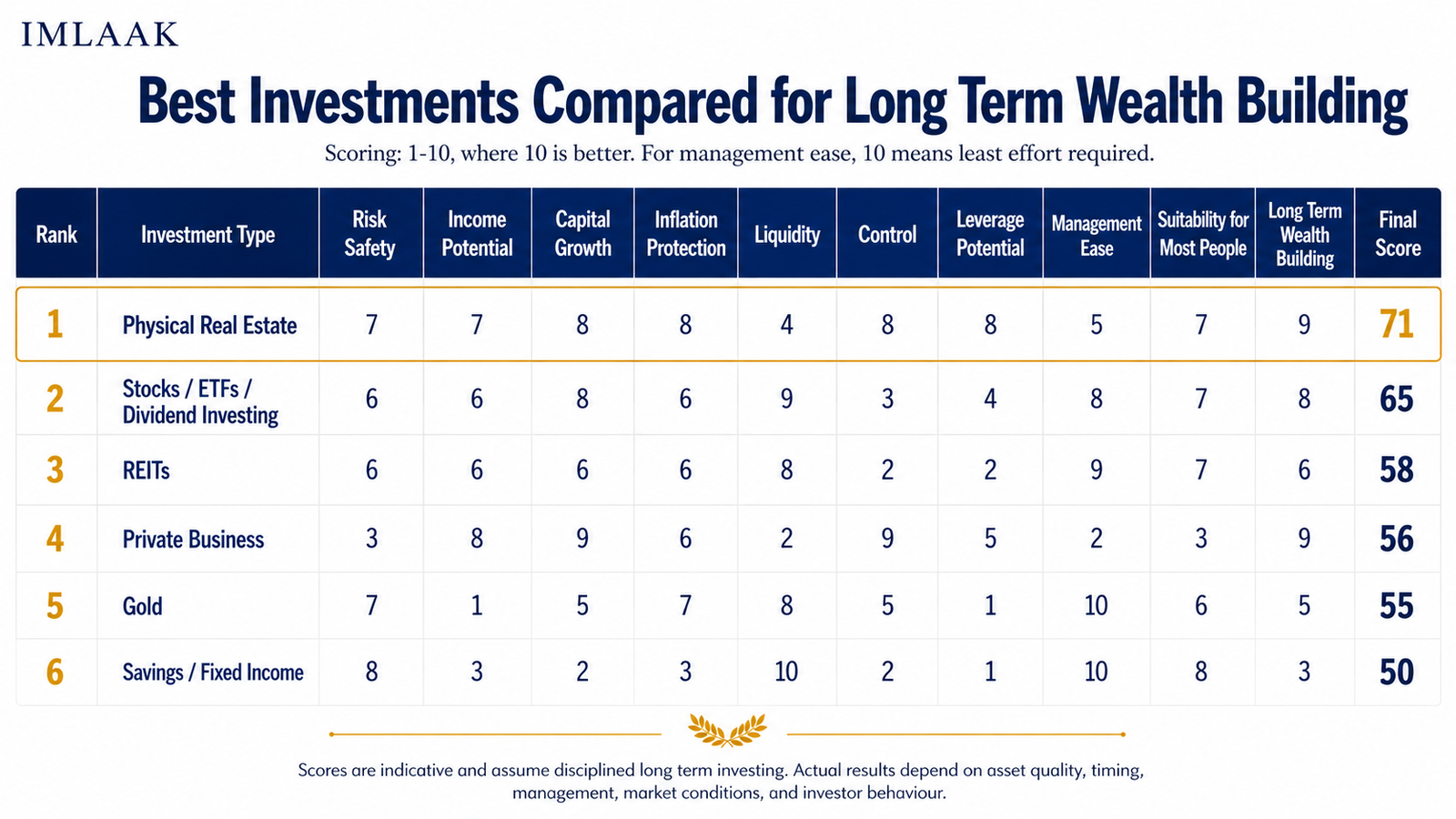
That is why the Real Estate vs Other Investments comparison table was built around ten practical factors:
- Risk safety
- Income potential
- Capital growth
- Inflation protection
- Liquidity
- Control
- Leverage potential
- Management ease
- Suitability for most people
- Long term wealth building
When these factors are examined together, rather than in isolation, the picture becomes much clearer.
Physical real estate ranks first with the highest final score.
That result is not accidental. It reflects the fact that real estate performs strongly across almost every area that matters for long term wealth creation.
Why Physical Real Estate Ranked Number One in Real Estate vs Other Investments
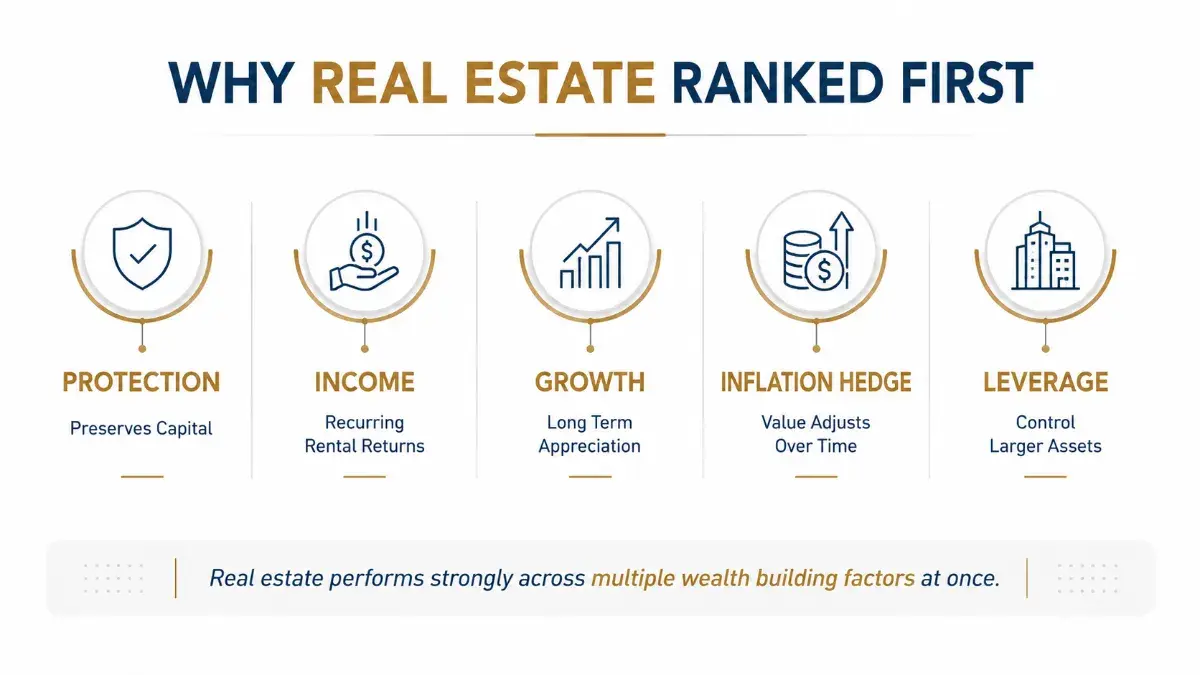
Real estate ranked first because it is one of the very few asset classes that does many important things well at the same time.
It scored highly in risk safety because quality property is backed by real demand. People will always need places to live, work, shop, stay, and operate. It scored strongly in income potential because real estate can produce recurring rental income. It ranked highly in capital growth because well selected property in strong locations tends to appreciate over time. It scored well in inflation protection because land, construction costs, and rental values usually rise over the long term. It ranked high in control because the investor can directly assess the asset, the location, the structure, and the exit strategy. And it scored especially strongly in leverage because few asset classes allow people to control a meaningful appreciating asset through staged capital deployment in the way real estate does.
Most importantly, it ranked very highly in suitability for most people and long term wealth building.
That is the heart of this entire Real Estate vs Other Investments comparison.
“Real estate does not win because it is perfect. It wins because it offers the strongest all round balance for most people.”
The best investment for the majority is not the one that looks most exciting on paper. It is the one that provides a realistic, repeatable framework for preserving wealth, growing capital, and creating income in a way people can actually understand and hold over time.
Real estate does that better than almost any other asset class.
Real Estate Is More Than Just Appreciation
One of the biggest mistakes people make is reducing property to one simple idea.
They think real estate is only about buying something and waiting for the price to rise.
That is an incomplete way to look at it.
The true strength of real estate is that it can serve multiple financial functions at once. A strong property can preserve capital. It can generate rental income. It can benefit from inflation. It can create equity. It can offer resale upside. It can be financed and expanded over time. In other words, it is not just an asset. It can become a complete wealth building system.
This is one of the major reasons so many financially strong families continue to keep a significant portion of their wealth in property. Not because it is glamorous. Not because it is trendy. But because it can perform on several levels at once.
For most people, that matters far more than chasing something that looks impressive for a short period and then disappears.
“The real power of property is not just that it can rise in value. It is that it can protect, pay, and compound in the same journey.”
This is also why Real Estate vs Other Investments is not only a comparison of returns. It is a comparison of protection, control, income, and long term financial strength.
Why Stocks and Dividend Investing Ranked Second
Stocks and dividend investing ranked second in the comparison, and rightly so.
They offer meaningful capital growth potential. They are highly liquid. They can provide dividend income in some cases. They are accessible and can play a very valuable role in long term investing.
But they still fall behind physical real estate for most people.
The first reason is control. When you buy shares, you do not control the underlying business in the same direct and practical way you control a property. The second reason is leverage. While there are ways to use leverage in financial markets, it is often either impractical or dangerous for the ordinary investor. The third reason is behavior. Many people simply do not hold stocks well. They buy emotionally, sell emotionally, panic during downturns, and get carried away during upswings.
Real estate generally creates stronger conviction because it is tangible. People can visit it. They can understand the location. They can study demand more naturally. And because it is less instantly liquid, it often protects people from their own worst habits.
That slower nature can actually be a strength.
In the wider discussion of Real Estate vs Other Investments, stocks remain powerful, but they do not offer the same direct ownership, asset control, and tangible confidence that property can provide.
Why REITs Ranked Third
REITs ranked third because they offer a useful middle ground.
They allow investors to access property related exposure without owning physical real estate directly. They are more liquid than property. They are easier to buy and sell. They tend to demand less engagement. For some people, that makes them attractive.
But REITs still do not replace direct real estate ownership.
They offer less control. They do not give the investor direct possession of a real asset. They provide less strategic flexibility. Their leverage advantage is lower from the investor’s point of view. And while they may provide exposure to property markets, they do not offer the same sense of ownership, decision making power, and asset control as actual physical property.
This is why REITs can play a useful supporting role, but for most people they do not replace the strength of direct real estate as a primary wealth building asset.
In a practical Real Estate vs Other Investments comparison, REITs are useful, but physical real estate still carries a stronger position for investors who value ownership and control.
Why Private Business Ranked Fourth
Private business is one of the most interesting categories in this comparison because it has enormous upside.
It scored strongly in income potential, capital growth, control, and long term wealth building. A successful business can absolutely create extraordinary wealth. Some of the wealthiest people in the world built that wealth through business ownership.
But it ranked lower overall for one major reason.
It is not suitable for most people.
A business is not merely an investment. It is an operating responsibility. It requires execution, resilience, systems, staff management, constant decision making, and the ability to survive pressure, competition, mistakes, and uncertainty. It can demand years of effort before becoming stable. Many businesses fail. Many owners burn out. Many people discover too late that owning a business is very different from owning an asset.
That is why business can be exceptional for builders, entrepreneurs, and operators, but it is not the strongest all round path for the majority.
“A business may be the best vehicle for a builder. Real estate is often the best vehicle for an investor.”
For ordinary investors seeking a more stable and understandable route to wealth, real estate is usually the better fit.
This is another reason the Real Estate vs Other Investments discussion must look beyond upside alone and consider suitability, risk, and practical execution.
Why Gold Ranked Fifth
Gold remains useful, especially in uncertain times.
It offers respectable inflation protection. It is liquid. It requires almost no management. It has psychological comfort because people trust it as a store of value. These are real strengths.
But gold has a major limitation.
It usually does not generate income.
That is a serious weakness when the objective is long term wealth building. An asset that preserves value can be useful. But an asset that preserves value and also pays you while you hold it is far more powerful.
Real estate has the ability to do both.
That is why gold may deserve a place in a defensive allocation, but it is rarely the strongest core asset for people who want to build meaningful wealth over time.
When viewed through the lens of Real Estate vs Other Investments, gold protects, but real estate can protect, pay, and grow together.
Why Savings and Fixed Income Ranked Last
Savings products and fixed income ranked last in the comparison, even though they scored well in areas like risk safety, liquidity, and management ease.
This is an important reminder that comfort is not the same thing as wealth creation.
Yes, such products feel safe. Yes, they are easy to hold. Yes, they can be useful for emergency reserves, short term capital preservation, or stability within a broader portfolio. But they are weak when it comes to income growth, capital appreciation, inflation protection, leverage, and long term wealth building.
This is the quiet trap many people fall into. Their capital is stable, but inflation gradually erodes its real value over time. The numbers may remain the same, but the purchasing power becomes weaker.
That is why savings products are useful for parking money, not for building serious wealth.
In the Real Estate vs Other Investments comparison, savings and fixed income may offer comfort, but they do not offer the same long term wealth building strength.
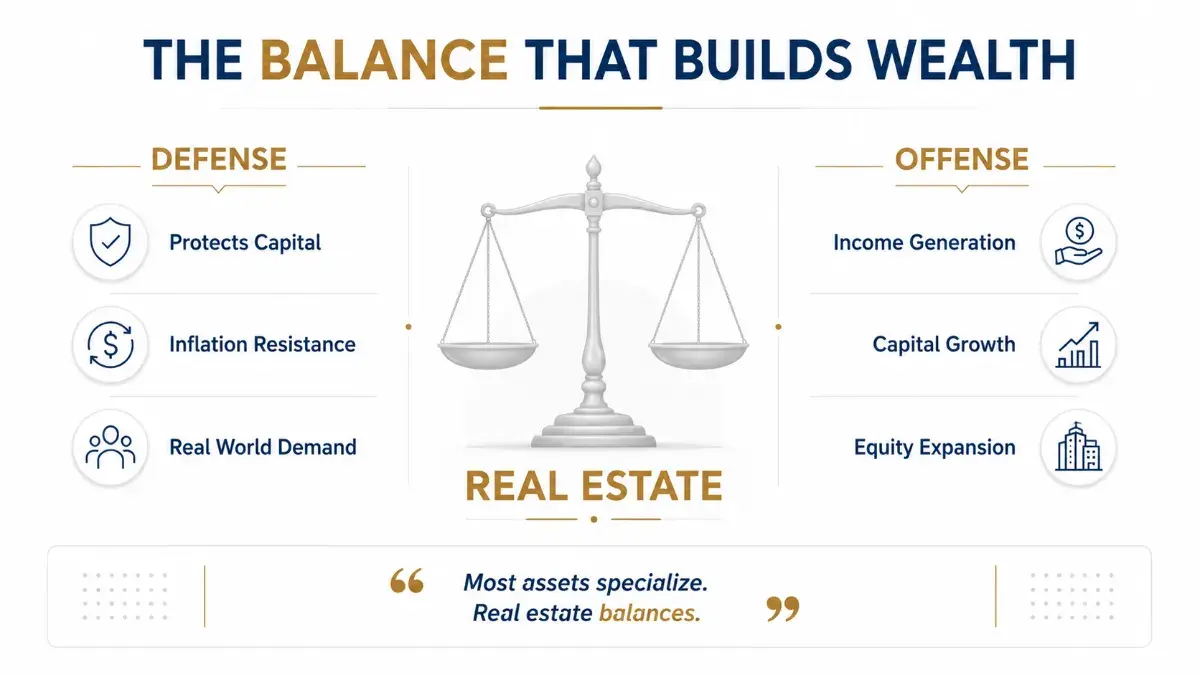
The Real Reason Real Estate Wins
- The deeper reason real estate ranked first is very simple.
- It balances offense and defense better than the other major options.
- It offers more protection than highly speculative assets.
- It offers more growth than savings based products.
- It offers more income potential than gold.
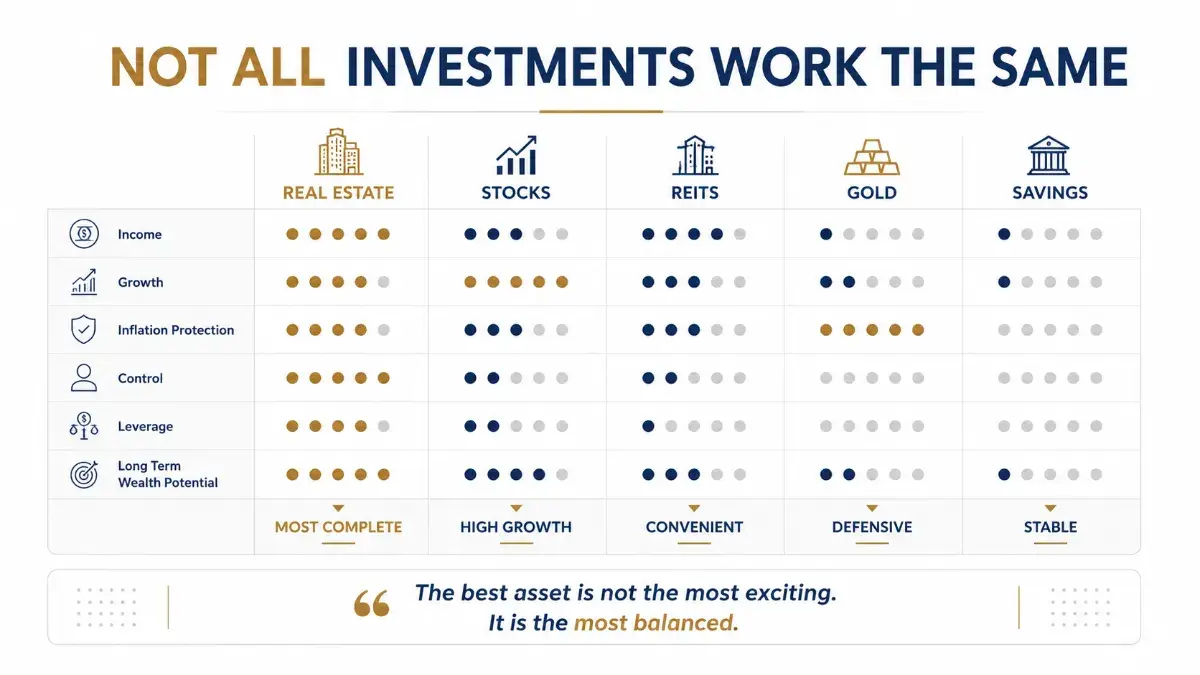
- It offers more control than stocks or REITs.
- It offers more practicality for most people than private business.
- And it offers stronger leverage potential than almost all of them.
- That balance is rare.
Most assets do one or two things well. Real estate does several important things well at once. That is why it has historically helped so many ordinary professionals, families, and investors build genuine financial strength.
Not because it always moves the fastest.
But because it supports a complete wealth building strategy.
“Most assets do one thing well. Real estate can protect wealth, grow capital, create income, and build equity all at once.”
This is the real strength highlighted in any serious Real Estate vs Other Investments analysis.
Why Real Estate Is Especially Powerful for Ordinary Investors
Most people do not become wealthy through constant trading, aggressive speculation, or perfectly timed decisions.
They become wealthy by owning strong assets for long enough.
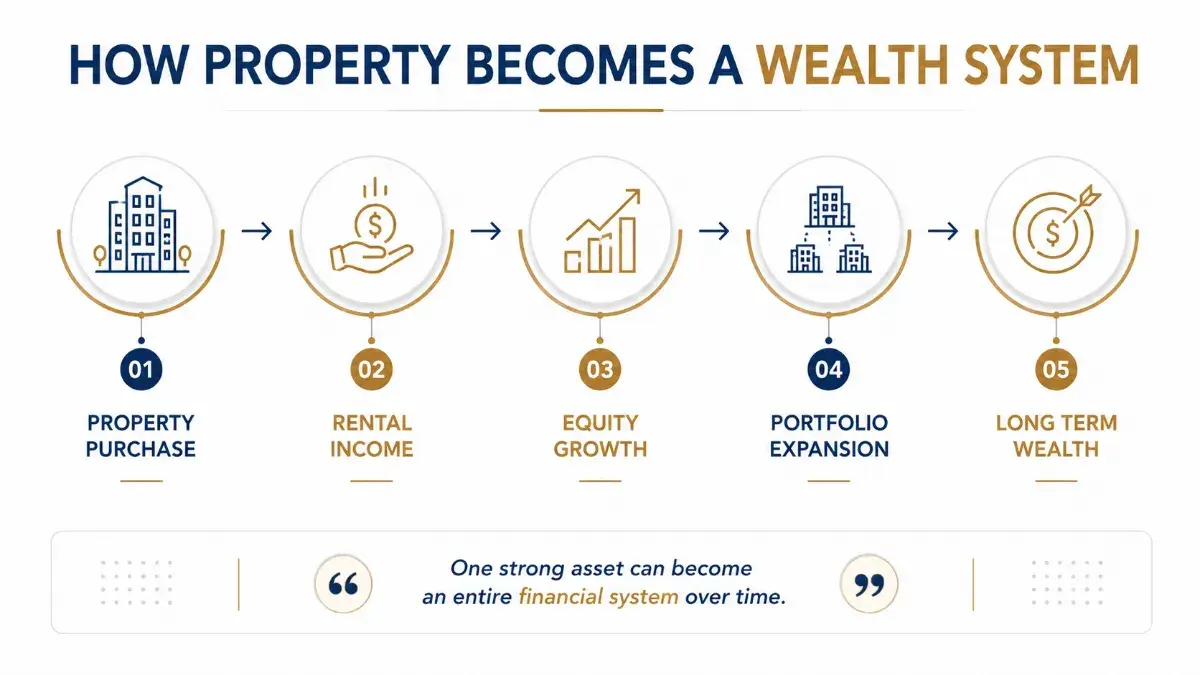
Real estate supports this naturally. It is understandable. It is tangible. It is tied to real demand. It can be financed. It can generate income. It can appreciate. It can be expanded gradually into a portfolio.
This matters because the best investment for the majority is not the one with the highest complexity. It is the one that aligns with how most people can realistically build wealth in the real world.
One property can become two.
Rental income can support the next move.
Appreciation can strengthen equity.
Equity can create options.
Over time, the portfolio begins to work as a system.
This is how many people become financially stronger through property.
That is why real estate is not just a good investment option.
For most people, it is the most complete one.
In the broader Real Estate vs Other Investments debate, this practical simplicity is one of real estate’s greatest advantages.
The Important Warning: Not All Real Estate Is Good Real Estate
This is where maturity matters.
Ranking real estate first does not mean every project deserves trust. It does not mean every property will perform well. It does not mean investors should buy blindly and assume success.
Weak locations, poor planning, bad pricing, oversupply, delayed delivery, unreliable developers, weak legal structures, and unrealistic rental promises can all turn even property into a disappointing investment.
So the lesson is not to buy real estate emotionally.
The lesson is to buy it intelligently.
The strength of property appears when the fundamentals are right. The location must make sense. The pricing must make sense. The demand must be real. The structure must be sound. The long term utility must be clear. The investment story must be believable.
At IMLAAK, this is how we believe real estate should be approached.
- Not as fantasy.
- Not as noise.
- Not as blind salesmanship.
But as a structured wealth decision.
This is why Real Estate vs Other Investments should never be treated as a blind statement that every property is good. The real lesson is that good real estate, selected intelligently, remains one of the strongest wealth building options available.
The IMLAAK Perspective on Real Estate vs Other Investments
At IMLAAK, we do not present real estate as a magical answer to every financial question.
We present it as what it truly is when selected correctly.
One of the strongest wealth building asset classes available to the majority of people.
That is why it ranked first in this comparison.
It gives investors something very few categories can provide together:
- Real ownership
- Real demand
- Real income potential
- Real inflation protection
- Real leverage
- Real long term wealth building strength
That combination is why property continues to sit at the center of serious wealth creation across generations.
Final Thoughts
Investment decisions should not be built on noise.
They should be built on structure.
When the major options are compared across the factors that actually matter, physical real estate comes out on top because it offers the strongest overall balance for most people. It may not be the easiest. It may not be the most liquid. It may not be the fastest in every cycle. But it remains the most complete all round wealth building asset for ordinary disciplined investors.
Stocks can grow.
REITs can simplify.
Business can explode upward.
Gold can preserve.
Savings can stabilize.
But real estate does something rare.
It protects, grows, pays, and compounds in the same journey.
That is the core conclusion of Real Estate vs Other Investments.
“For the majority of people, real estate is not just another investment option. It is still the most complete wealth building asset.”
That is why for most people, real estate is not just a good investment.
It is still the best one.
Frequently Asked Questions
Why is real estate considered the best investment for most people?
Real estate is often considered the best investment for most people because it offers a strong balance of income potential, capital growth, inflation protection, leverage, and direct ownership. Very few asset classes combine all of these advantages in one place.
What does Real Estate vs Other Investments mean?
Real Estate vs Other Investments means comparing physical property with other major asset classes such as stocks, REITs, gold, private business, savings products, and fixed income. The purpose is to understand which option offers the best balance of safety, income, growth, control, and long term wealth building potential.
Is real estate better than stocks for long term wealth building?
For many people, yes. Stocks can deliver strong long term returns, but they are more volatile and easier for average investors to mishandle emotionally. Real estate is more tangible, easier to understand, and often easier to hold with conviction over the long term.
Why did physical real estate rank above REITs in this comparison?
Physical real estate is scored higher than REITs because it provides more control, higher potential for leverage and direct ownership of a genuine asset. The simplicity and liquidity of REITs come with less in the way of strategic options than direct property ownership.
Is gold a better investment than property?
Gold is a great store of value, especially in uncertain times, but it doesn’t create income. Real estate often has a higher potential for developing long term wealth since it can mix appreciation with rental income and leverage.
Are savings accounts and fixed income investments suitable investments?
They can be good for stability, capital preservation and emergency reserves but they are not usually strong long term wealth generators as inflation can erode the real worth of money over time.
Can a private business generate more wealth than real estate?
Yes, a successful private business can create more wealth than real estate in some cases. However, it also involves much higher execution risk, greater management burden, and lower suitability for most people. That is why real estate often remains the stronger all round choice for ordinary investors.
Is all real estate a good investment?
No. The quality of a real estate investment depends on location, pricing, demand, legal structure, developer credibility, and the overall strength of the investment logic. Real estate is powerful, but only when chosen intelligently.
What makes real estate such a strong wealth building asset?
Real estate is powerful because it combines real world demand, rental income potential, long term appreciation, inflation protection, leverage, and portfolio expansion potential. Over time, one property can become the foundation for a much larger asset base.
Should real estate be the only investment in a portfolio?
Not necessarily. Cash reserves, shares or gold may still be used by a balanced investor — depending on personal goals and risk willingness. However, for many, real estate might be the most powerful core asset in a long term wealth building strategy.
Shahnawaz Yaqub Bhatti
Investment Consultant and CEO at Imlaak
- Mobile: +92 300 3343336 (WhatsApp)
- Mobile: +92 333 1616160 (WhatsApp)
[fc id=’19’ align=’left’][/fc]