
What Every Apartment Buyer in Pakistan Should Understand Before Investing
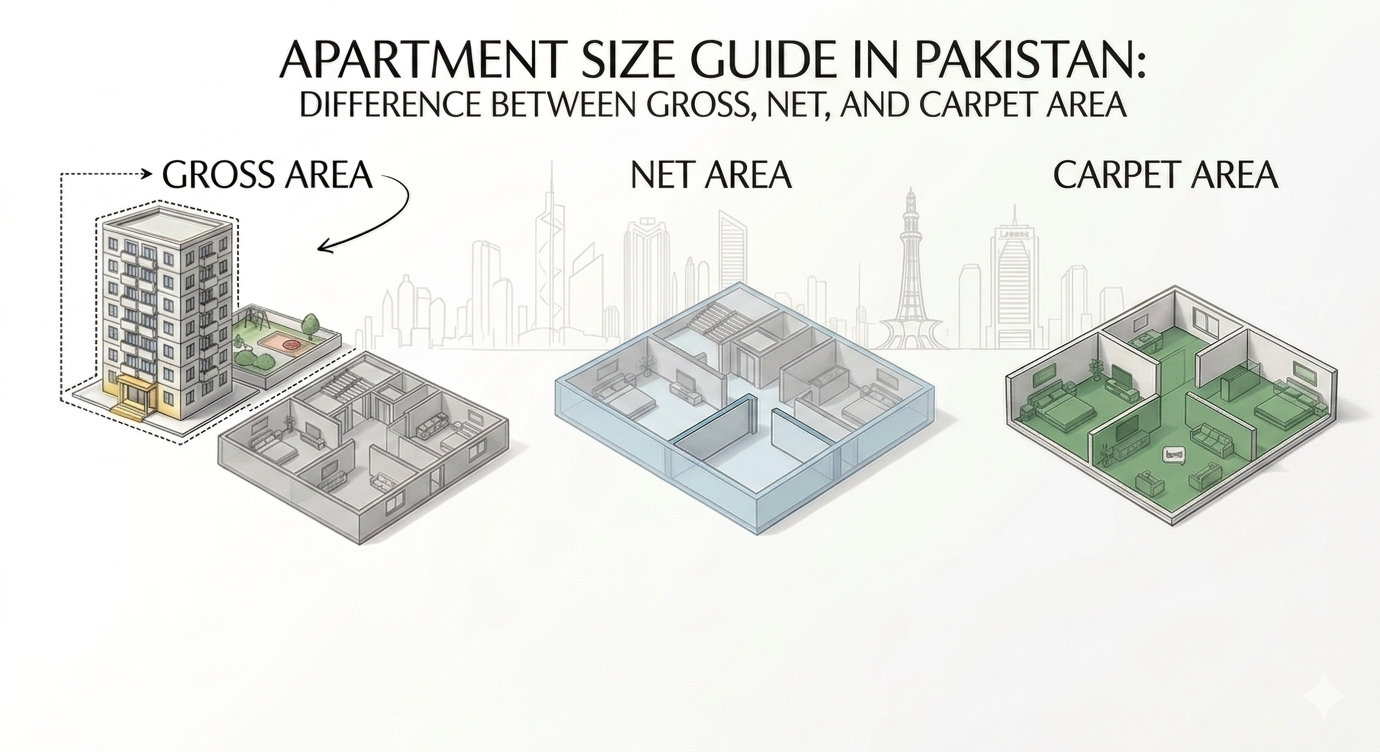
When people buy apartments, they often compare one thing first: the square footage. But the real question is not just how much area is being offered. The real question is what kind of area is being quoted. In real estate, the number shown can refer to gross area, net area, or carpet area, and professional measurement bodies such as IPMS, RICS, and BOMA all recognize that different measurement bases exist and should be stated clearly. Before you compare price per square foot, first ask: Square foot of what exactly? That is where many buyers get confused. A project brochure may show a large number, but that number may not fully represent the private space inside the apartment. In multi unit buildings, part of the area may include walls and, depending on the basis being used, a share of common building space as well. That is exactly why recognized measurement standards stress that the measurement basis should be documented clearly.Why this matters in high rise buildings
A high rise building is not made up of apartments alone. It also includes corridors, lift lobbies, staircases, shafts, and other shared parts that allow the building to function. Measurement frameworks such as BOMA’s floor standards and IPMS exist because these different parts of a building must be identified and measured consistently. In more premium buildings, the picture becomes even broader. There may also be shared lounges, gym areas, pool facilities, business centers, reception spaces, or other amenity zones. That is why the number shown to a buyer can look very different from the actual private space inside the unit. A buyer should never assume that the biggest number on paper equals the biggest private apartment.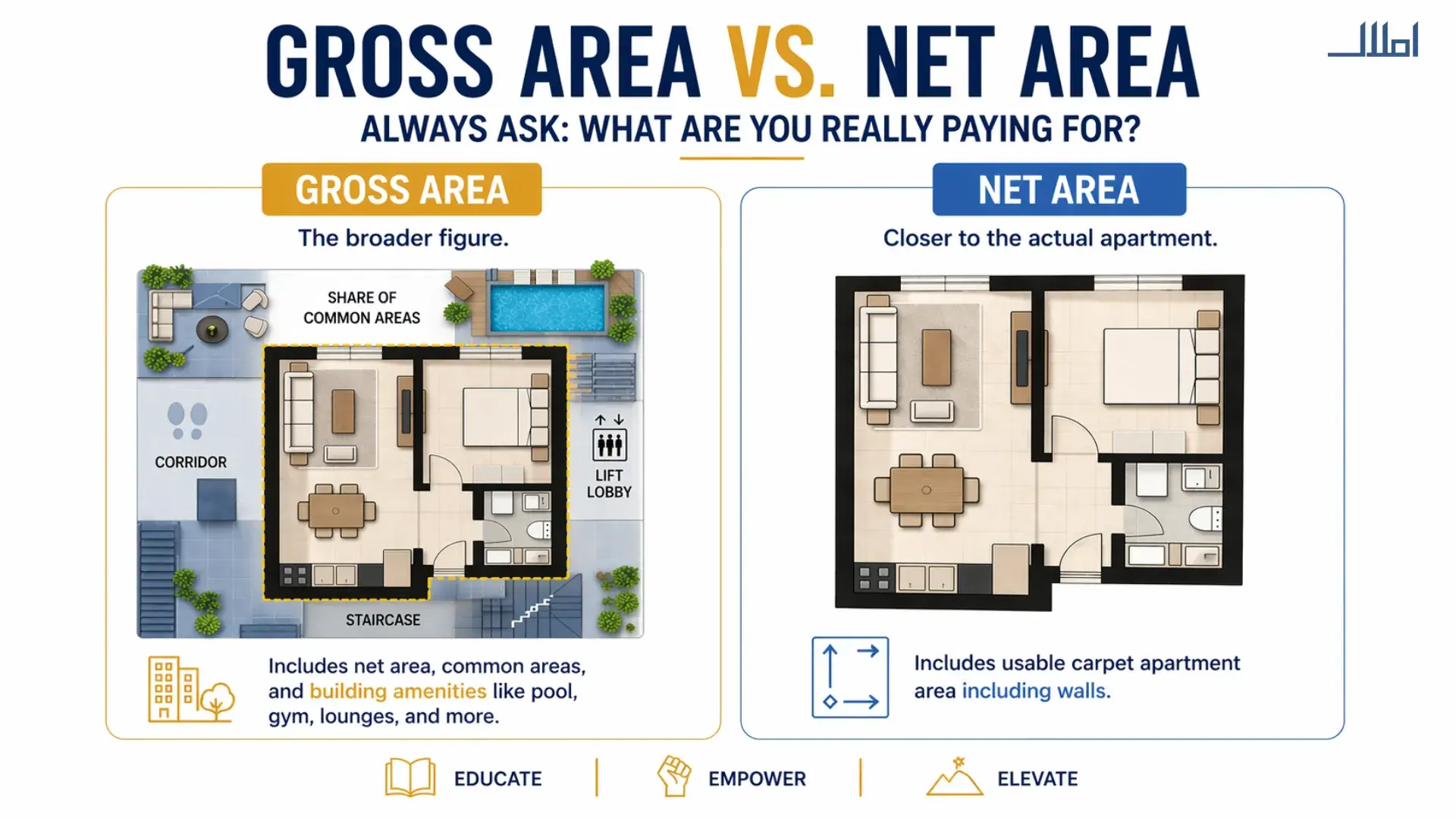
What gross area means
In simple buyer language, gross area is the broader area attached to the unit for selling or measurement purposes. Depending on the method being used in a project, gross style measurements can include the apartment itself, wall thickness, and sometimes broader building components or shared areas. BOMA publishes dedicated gross area standards, and RICS also distinguishes between different broad measurement bases such as gross internal and gross external area. That is why gross area is often the largest number a buyer sees. This does not automatically mean anything is wrong. Gross area is a real and widely used concept. But it does mean the buyer should understand that gross area is not always the same thing as the actual usable apartment space. Gross area is a broader number. It should be understood, not assumed.What net area means
In simple terms, net area refers more closely to the actual apartment area itself. In market practice, this usually means the private apartment space including its internal walls and relevant boundary walls, rather than the wider shared spaces of the building. RICS and IPMS both distinguish broader internal measurements from more selective internal measurements, which is why buyers should always ask exactly which basis a project is using. If a wall is shared between two units, it is commonly treated in practice on a proportionate basis between both sides, but the exact rule can depend on the measurement method being adopted in that project. What matters most for a buyer is that the developer clearly states how the unit area has been measured. Net area is usually much closer to the apartment you actually own.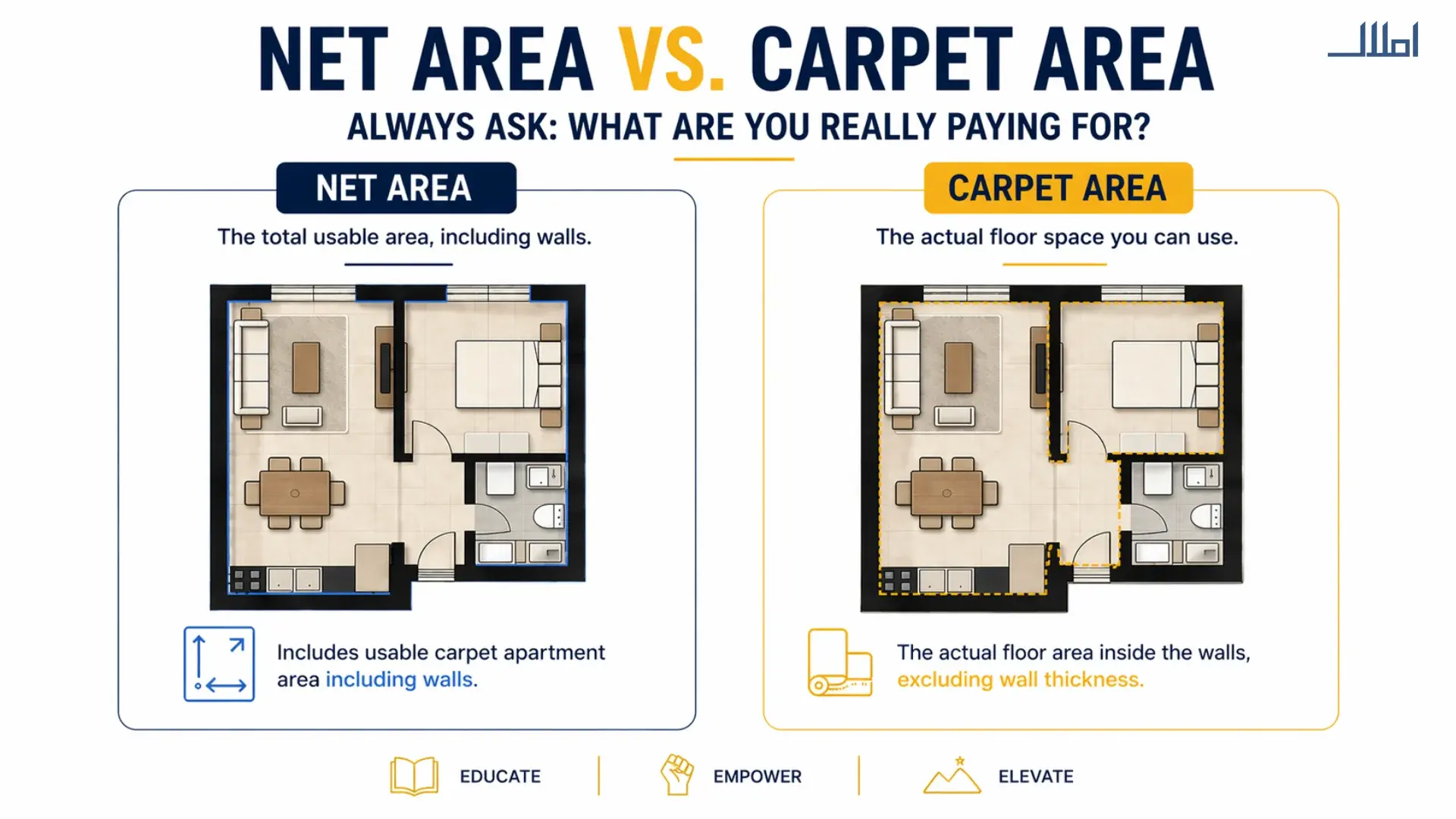
What carpet area means
Carpet area is the easiest concept for most buyers to understand. It means the usable space inside the apartment, without counting the wall thickness. In other words, it is the space where you can actually walk, place furniture, and live. IPMS also distinguishes internal measures that include internal walls from those that exclude them, which supports this practical buyer distinction between built space and usable space. This is why carpet area is often the most helpful number for an end user. It tells you more directly how much real living space the apartment offers. Carpet area is the part of the apartment you actually use every day.What Gross Area Is Reasonable in Residential, Luxury, Serviced Apartments, and Hotel Style Buildings
When buyers in Pakistan look at an apartment, they often make one common mistake. They assume that one simple rule applies to every project.
It does not.
A normal residential building, a luxury residential tower, a serviced apartment project, and a hotel style building are not the same product. They are built differently, they serve different users, and they include different levels of common spaces and services. Even professional measurement systems recognize this. BOMA, which is the Building Owners and Managers Association, publishes separate measurement standards for property types including multi family and hospitality, and it recognizes both gross and net methods of measurement.
One size does not fit all.
You cannot judge every building by the same gross area ratio.
“The smartest buyers don’t ask how big the apartment is. They ask how that size is actually calculated.”
That is the first thing a serious buyer should understand in any Apartment Size Guide in Pakistan.
Why buyers get confused
Most buyers are shown one big number first: the size.
But that size may not mean what they think it means.
In many projects, the quoted area is based on gross area. That means it is not only the private apartment. It may also include wall thickness and a share of the common parts of the building.
That is why two apartments with the same number on paper can feel very different in real life.
One may give you better private space.
Another may give you more lobby, more corridors, more amenity space, or more service areas.
Neither is automatically right or wrong.
The real question is whether that gross area is reasonable for the type of building being sold.
The goal is not to find the project with the lowest gross area.
The goal is to understand whether the gross area makes sense for that project category.
That is one of the most important points in an Apartment Size Guide in Pakistan.
What BOMA, RICS, and IPMS mean in simple words
Sometimes real estate articles mention technical names without explaining them.- BOMA is the Building Owners and Managers Association. In simple words, it is known for publishing measurement standards for different property types, including gross areas, multi family, hospitality, and mixed use buildings.
- RICS is the Royal Institution of Chartered Surveyors. In simple words, it is a globally recognized professional body that publishes guidance on how property should be measured and valued, and it says the basis of measurement used should be documented.
- IPMS means International Property Measurement Standards. In simple words, it is an international effort to create more consistent ways of measuring buildings around the world.
You only need to understand the main point:
Different kinds of buildings naturally carry different amounts of gross area.
What is reasonable in a normal residential building
A standard residential building is usually the simplest category. Its main purpose is private living.
That means the common spaces are usually limited to the basics, such as entrance lobby, corridors, lift lobby, stairs, and service shafts. Because it is not trying to function like a hotel and is not heavily dependent on luxury shared spaces, the gross area should usually stay more controlled.
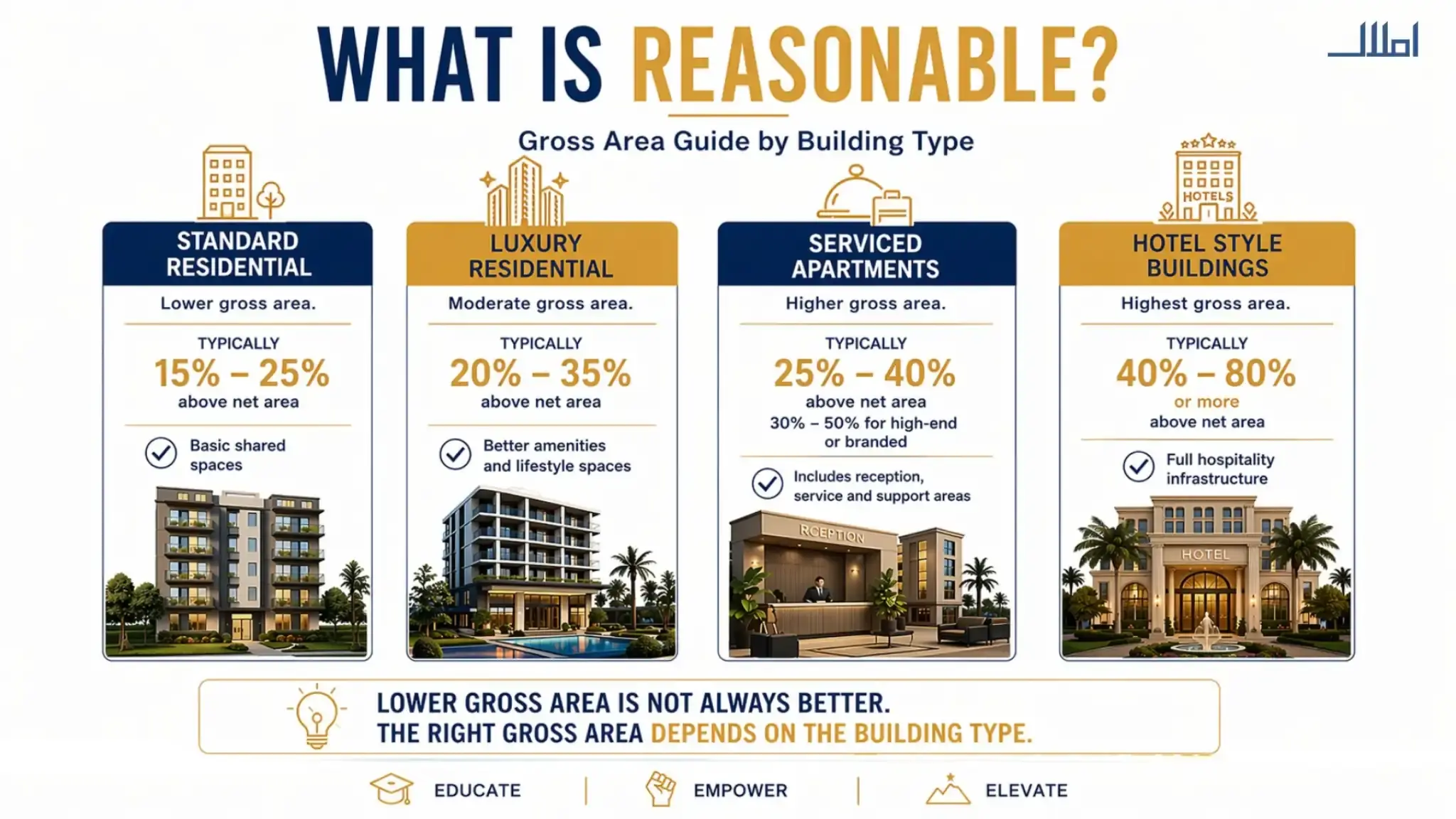
A practical expectation is that in a normal residential building, the gross area may often be around 15 percent to 25 percent above the net area.
That means the net area may often fall around 80 percent to 87 percent of the gross area.
This is not a hard law. But it is a sensible expectation for many straightforward residential towers.
In a normal residential building, buyers should usually expect lower gross area because the building is mainly for living.
If a simple residential building has much more gross area than this, the buyer should ask why.
This is an important benchmark in any Apartment Size Guide in Pakistan.
What is reasonable in a luxury residential building
A luxury building is not selling only the apartment. It is also selling presentation, comfort, image, privacy, and lifestyle.
That may include larger lobbies, resident lounges, gym, spa, pool, roof spaces, business lounge, and stronger shared arrival areas. Because of this, a luxury building will usually have more gross area than a basic residential project.
A practical expectation is that in a luxury residential building, the gross area may often be around 20 percent to 35 percent above the net area.
That means the net area may often fall around 74 percent to 83 percent of the gross area.
This should not automatically worry a buyer. In this category, a somewhat higher gross area can be fair because the building is offering more than just basic living space.
A luxury building can have higher gross area and still be a fair project, if the shared spaces are real and genuinely add value.
The real question is simple: are you actually getting that better lifestyle product, or just a bigger number on paper?
“Luxury buildings do not only sell space. They sell lifestyle, services, and shared experiences.”
What is reasonable in serviced apartments
Serviced apartments sit between residential and hospitality.
They are often designed for short stays, corporate users, relocations, and investors who want managed rentals. Because of that, these projects usually need more common and support spaces than a normal apartment building.
That may include reception, concierge, waiting space, lounge, service areas, housekeeping support, and business use support spaces.
In simpler or mid level serviced apartment projects, a practical expectation is that the gross area may often be around 25 percent to 40 percent above the net area.
But in high end serviced apartments, branded serviced residences, or projects designed closer to proper hospitality standards, the gross area can reasonably rise to around 30 percent to 50 percent above net area, and in some cases even more can be justified if the project is genuinely operating to hospitality standards.
That means the net area may often fall around 67 percent to 77 percent of the gross area, and in some higher service projects it may be lower.
In branded or high end serviced apartments, more gross area can be fair if the building truly offers a proper hospitality style experience.
That is the key point.
If the building includes proper reception, concierge, guest handling, service support, housekeeping systems, shared lounges, and a real managed stay environment, then a higher gross area may make sense.
If it is only using the words serviced or branded as a marketing label, then buyers should be careful.
This distinction matters a lot in an Apartment Size Guide in Pakistan.
“Hospitality-driven buildings always need more space behind the scenes than buyers usually expect.”
What is reasonable in hotel style buildings
Hotel style buildings are a separate category.
Here, the building is not just supporting rooms or suites. It is supporting a full hospitality system. That means it may include front office, lobby lounge, restaurants, meeting rooms, event support, spa, pool, housekeeping, linen handling, staff movement areas, service corridors, and back of house spaces.
This is why hotel style projects naturally have the highest gross area.
A hotel design guideline published by Sri Lanka Tourism shows that guest rooms, bathrooms, corridors, and room service often account for only about 50 percent to 60 percent of the total hotel area, while the rest goes into public areas, catering, events, wellness, administration, service areas, and building services.
HVS hotel benchmarks also show this pattern. One of its hotel development references lists gross area per key at around 70 square meters for midscale hotels, 80 square meters for upscale, 100 square meters for upper upscale, and 115 square meters for luxury hotels.
That is why, in practical buyer terms, hotel style buildings can easily have gross area that is 40 percent to 80 percent or more above pure usable room area, depending on class, services, and facilities. Older HVS budget hotel references also show that simpler hotels can be much tighter, while more upscale hospitality products need materially more building area per room.
A hotel should never be judged like a simple apartment building.
It is a different product with different space needs.
A simple comparison buyers can understand
Here is the easy way to think about it.
Standard residential building
Usually the lowest gross area of the four categories.
A practical expectation is often 15 percent to 25 percent above net area.
Luxury residential building
Usually more gross area than standard residential because it includes more shared lifestyle spaces.
A practical expectation is often 20 percent to 35 percent above net area. This is a market based planning expectation rather than a single official global number.
Serviced apartments
Usually more gross area than residential because managed stays need more support spaces.
A practical expectation is often 25 percent to 40 percent above net area in simpler serviced apartment projects. For high end, branded, or hospitality style serviced apartments, 30 percent to 50 percent above net area, and sometimes even more, can be justified if the building genuinely meets proper hospitality standards. This range is a market judgment informed by how hospitality style operations use space, rather than a single formal standard.
Hotel style buildings
Usually the highest gross area because hospitality requires much more common and service space.
A practical expectation is often 40 percent to 80 percent or more above pure usable room area, depending on hotel class and facilities.
Lower gross area is not always better.
The right question is whether the gross area is reasonable for the type of project you are buying.
That is the core idea of this Apartment Size Guide in Pakistan.
Why proper evaluation matters
This is exactly why buyers should not judge a project too quickly.
A high gross area in a simple residential project may be a warning sign.
The same level of gross area in a branded serviced apartment or hotel style asset may be completely normal if the project genuinely carries the facilities and service standards to support it.
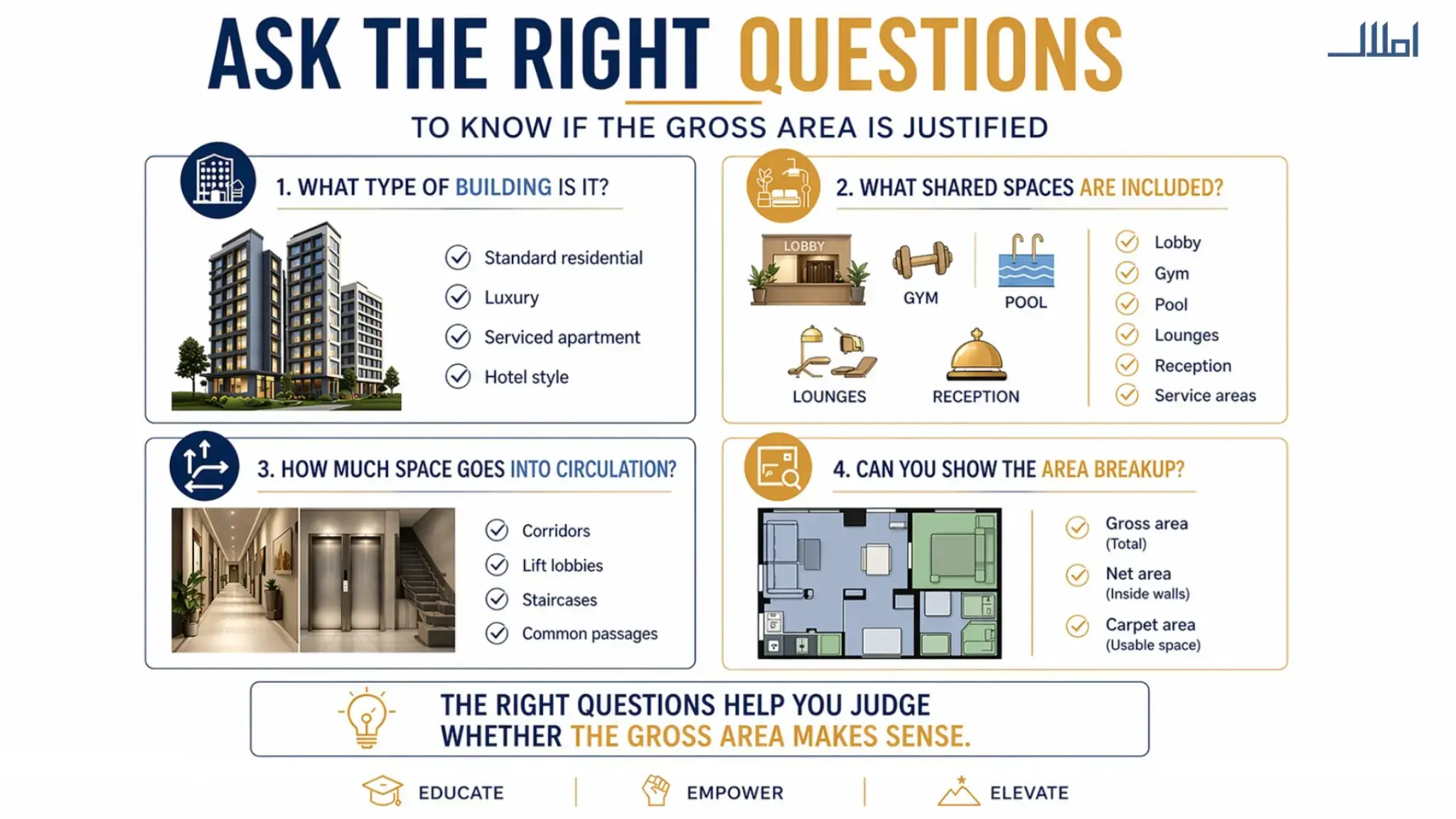
So before deciding whether a project is fair, you need to evaluate:
- What type of building it is
- What common spaces are included
- What service level it promises
- Whether the building actually delivers that promise
- How much of the area is gross
- How much of it is net
- How much of it is truly usable
A project cannot be judged properly by one number alone.
It must be evaluated in context.
That is what separates a casual buyer from a serious investor.
Why a consultant matters
This is also why a good consultant matters.
Most buyers do not spend their lives studying building layouts, common spaces, hotel planning, or area calculations. A good consultant does.
A proper consultant helps you see what is behind the brochure number. He helps you understand whether the project is being measured fairly, whether the common spaces make sense, whether the category justifies the gross area, and whether you are actually paying the right price for the right kind of product.
A serious buyer does not only need a seller.
A serious buyer needs someone who understands how to evaluate the project properly.
That is where real advisory becomes valuable.
Because sometimes the issue is not that the project is bad.
The issue is that the buyer is comparing it with the wrong benchmark.
This is exactly why an Apartment Size Guide in Pakistan is useful for serious buyers and investors.
Final thought
The smartest property buyers in Pakistan do not ask only this:
How big is the apartment?
They ask something better:
How much gross area is normal for this kind of project, and does this project justify it properly?
That is the real way to judge value.
A normal residential building should usually have lower gross area.
A luxury tower can reasonably have more.
A serviced apartment can have even more, especially if it is branded or built closer to hospitality standards.
A hotel style building will naturally have the most, because hospitality needs much more space behind the scenes.
One size does not fit all.
Every project must be evaluated properly.
And that is exactly why expert advice matters.
Shahnawaz Yaqub Bhatti Investment Consultant and CEO at Imlaak“Serious investors do not compare properties blindly. They compare them in the right category.”
- Mobile: +92 300 3343336 (WhatsApp)
- Mobile: +92 333 1616160 (WhatsApp)
[fc id=’19’ align=’left’][/fc]