
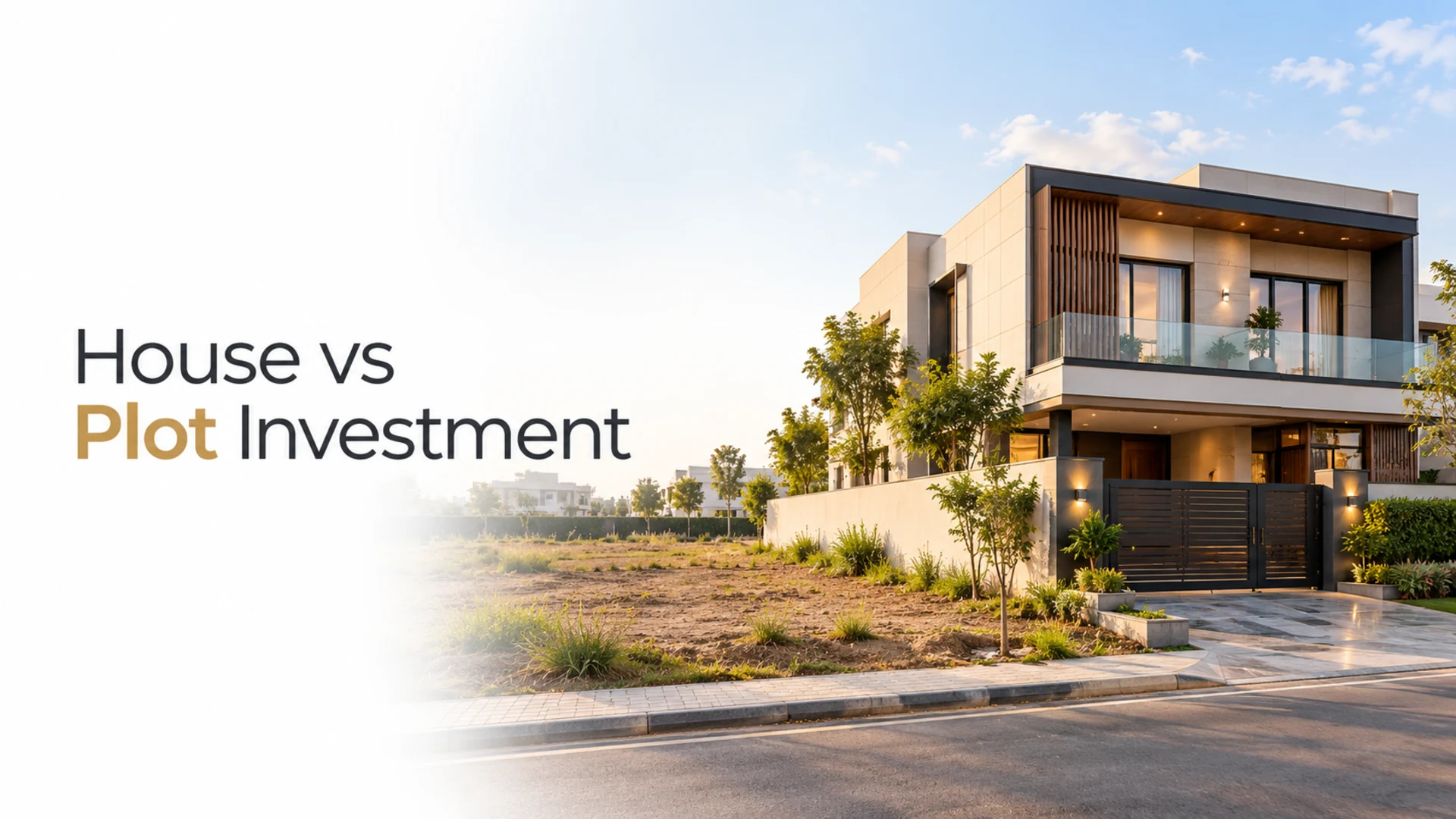
A house worth less than two plots can still leave its owner with more total wealth. That is the central question in Imlaak’s house vs plot investment in DHA Lahore case study: what happens when rental income is included, and then reinvested, over a long holding period?
The comparison starts with approximately PKR 3.5 crore in 2013. One investor buys a rental house in DHA Lahore Phase 6. Another buys two plots in the same phase with the same capital. Around 13 years later, the video places the plots at approximately PKR 14 crore combined and the house at approximately PKR 10 crore.
Property values alone favour the plots. The video’s modeled rental income and reinvestment pool changes the comparison to approximately PKR 17 crore for the house strategy versus PKR 14 crore for the plots. Understanding where that difference comes from is more useful than simply choosing the larger headline.
Source and scope: This article explains Imlaak’s October 9, 2026 video. Historical prices are the presenter’s approximate case-study estimates. Rent and reinvestment are modeled, and the final figures are not audited net proceeds or guaranteed future returns.
Watch the Full House vs Plot Comparison
Watch House vs Plot Investment in DHA Lahore: 17 Cr vs 14 Cr, part of Imlaak’s One Crore Challenge 2.0. The complete eight-minute discussion covers the starting allocation, estimated property values, rental income and compounding assumptions.
Same Starting Capital, Same DHA Phase
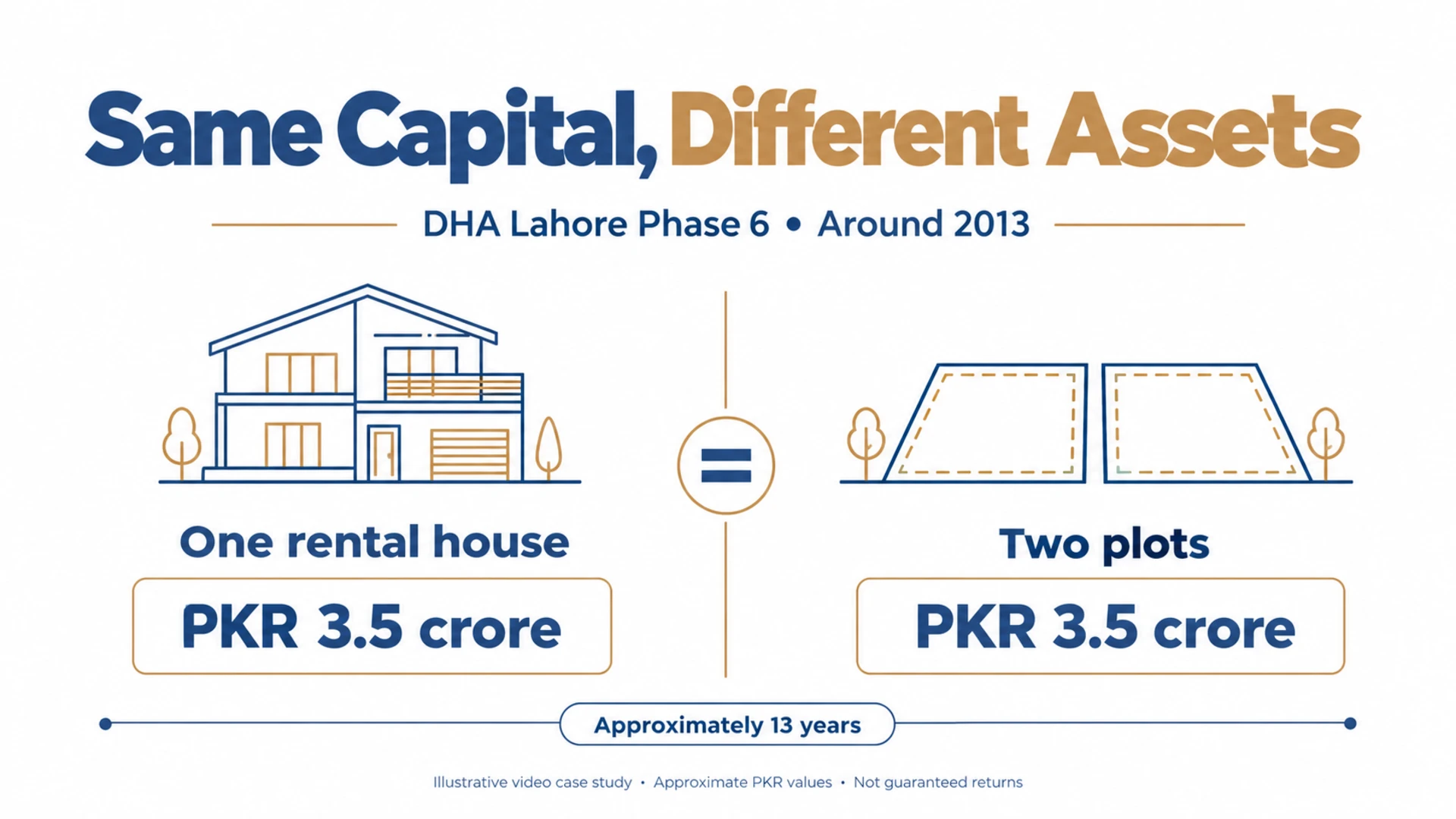
A useful comparison begins by holding the starting investment constant. In the video, Investor A allocates PKR 3.5 crore to one house intended for rent. Investor B allocates the same amount to two plots. Both investments are considered within DHA Lahore Phase 6, beginning around 2013.
This removes one common distraction: comparing a prime-location rental property with land in an entirely different market. However, sharing a phase does not make the assets identical. Plot position, access, orientation, construction quality and the condition of the house can still affect values and demand.
The exercise also compares long-term holding strategies. It does not model a trader repeatedly buying and selling plots, or a developer constructing and selling houses. Those activities introduce different costs, work, cash-flow timing and risks. The relevant question is what each asset contributes while the original investor continues to hold it.
Capital Appreciation Initially Favours the Plots
The video estimates the two plots at approximately PKR 7 crore each, or PKR 14 crore combined. It assigns approximately PKR 10 crore to the older house, comprising an estimated land component and a lower value for the existing structure.
| Case-study measure | One rental house | Two plots |
|---|---|---|
| Starting allocation, around 2013 | PKR 3.5 crore | PKR 3.5 crore |
| Approximate ending property value | PKR 10 crore | PKR 14 crore combined |
This first comparison looks only at the properties. It leaves rental income and the proposed reinvestment of that income outside the calculation. The video uses it to show why a property’s ending valuation does not, by itself, describe the complete investment strategy.
That is a meaningful result. A building ages and may need repairs or refurbishment, while its land can appreciate. Rental-property analysis should recognise those differences rather than assume the house must win every part of the comparison.
Rental Income Adds a Second Return Source
A vacant plot held without development generally relies on its eventual exit value. A rented house can also produce cash during ownership. That income creates choices: the owner can spend it, retain it as cash, pay property expenses or invest it elsewhere.
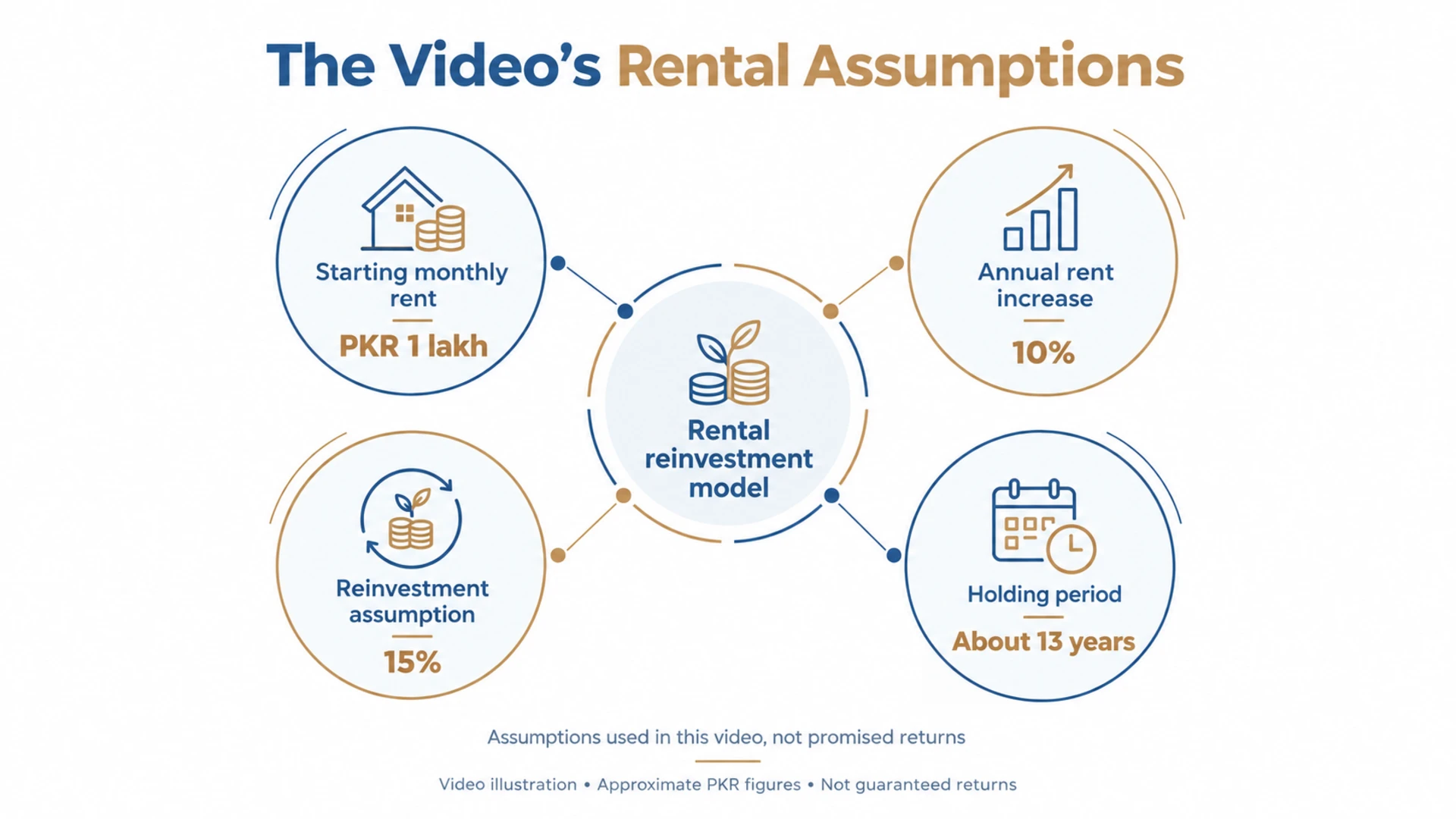
The video starts monthly rent at approximately PKR 1 lakh and assumes 10% annual increases. Over roughly 13 years, it describes cumulative rent of approximately PKR 3 crore.
The assumption is important. Ten percent annual rental growth is a modeling input, not a claim that every lease increases at that rate. Actual collections depend on occupancy, the lease, tenant payments and market conditions. The case study does not provide a complete record of actual rent received for a specific property.
The rental income matters because the house continues to provide it during the holding period. In the presenter’s argument, that recurring cash is the feature a simple house-price versus plot-price comparison misses. The case study therefore moves from comparing two ending property values to examining what the income-producing strategy has accumulated alongside the house.
Reinvestment Changes the Ending Wealth
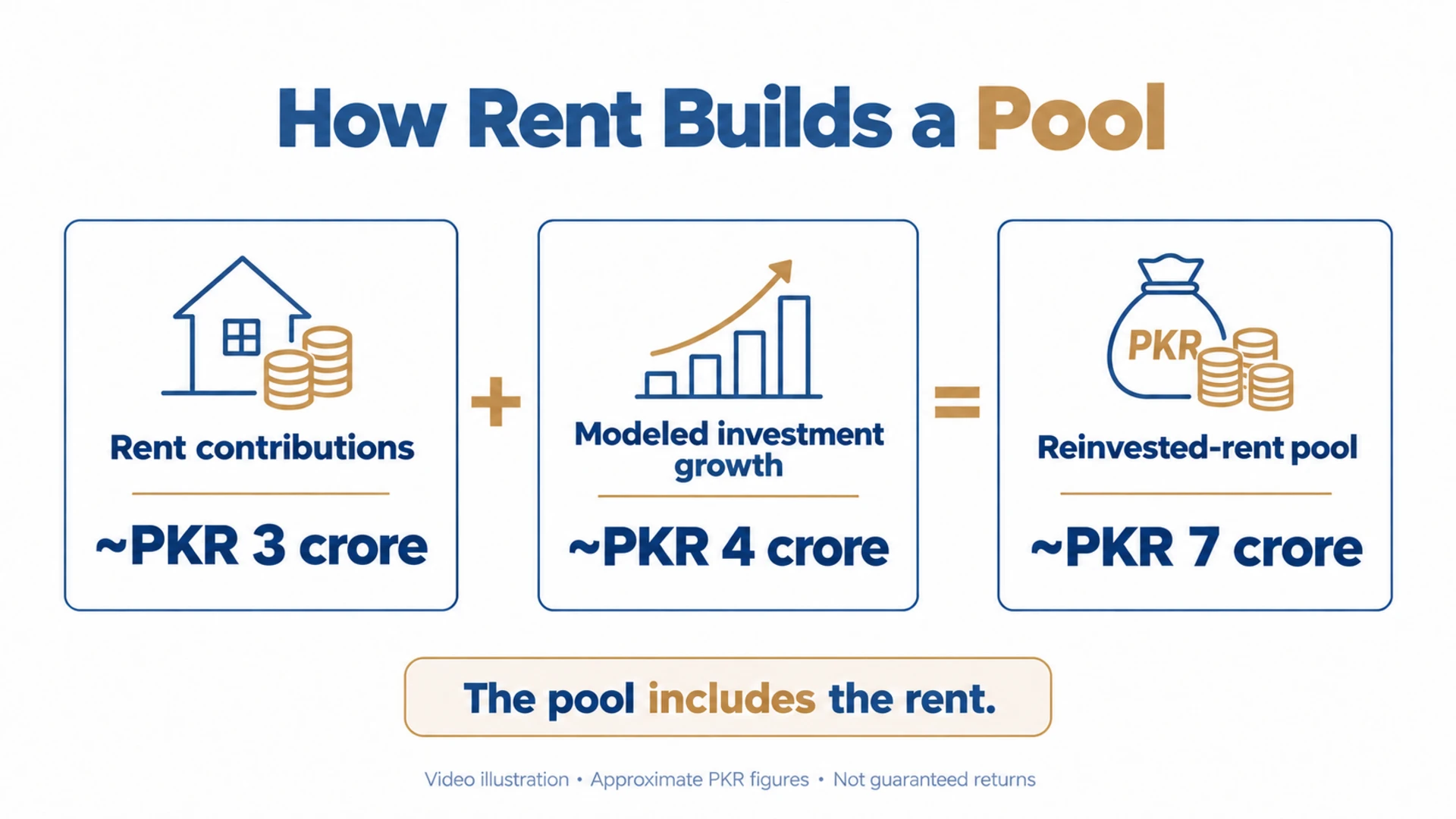
The next step is the decisive one. The house investor does not spend the modeled rent. Instead, the video assumes that each rental receipt is reinvested and applies a 15% return assumption to that reinvestment process.
The presenter rounds the cumulative rental contributions to PKR 3 crore and the additional investment growth to PKR 4 crore. Together, they form an approximately PKR 7 crore investment pool. Adding the estimated PKR 10 crore house value produces the headline PKR 17 crore.
The PKR 7 crore pool already includes the rental contributions. Adding PKR 3 crore of rent again would double-count the same money. The correct structure is house value plus the ending value of the reinvested-rent pool.
This is the practical role of compounding in the video: rental income is invested, and the resulting investment growth is retained alongside it. The presenter treats reinvestment as part of the house strategy throughout the holding period. The ending pool consequently represents both the money contributed and the growth attributed to those contributions.
What the PKR 17 Crore Figure Includes
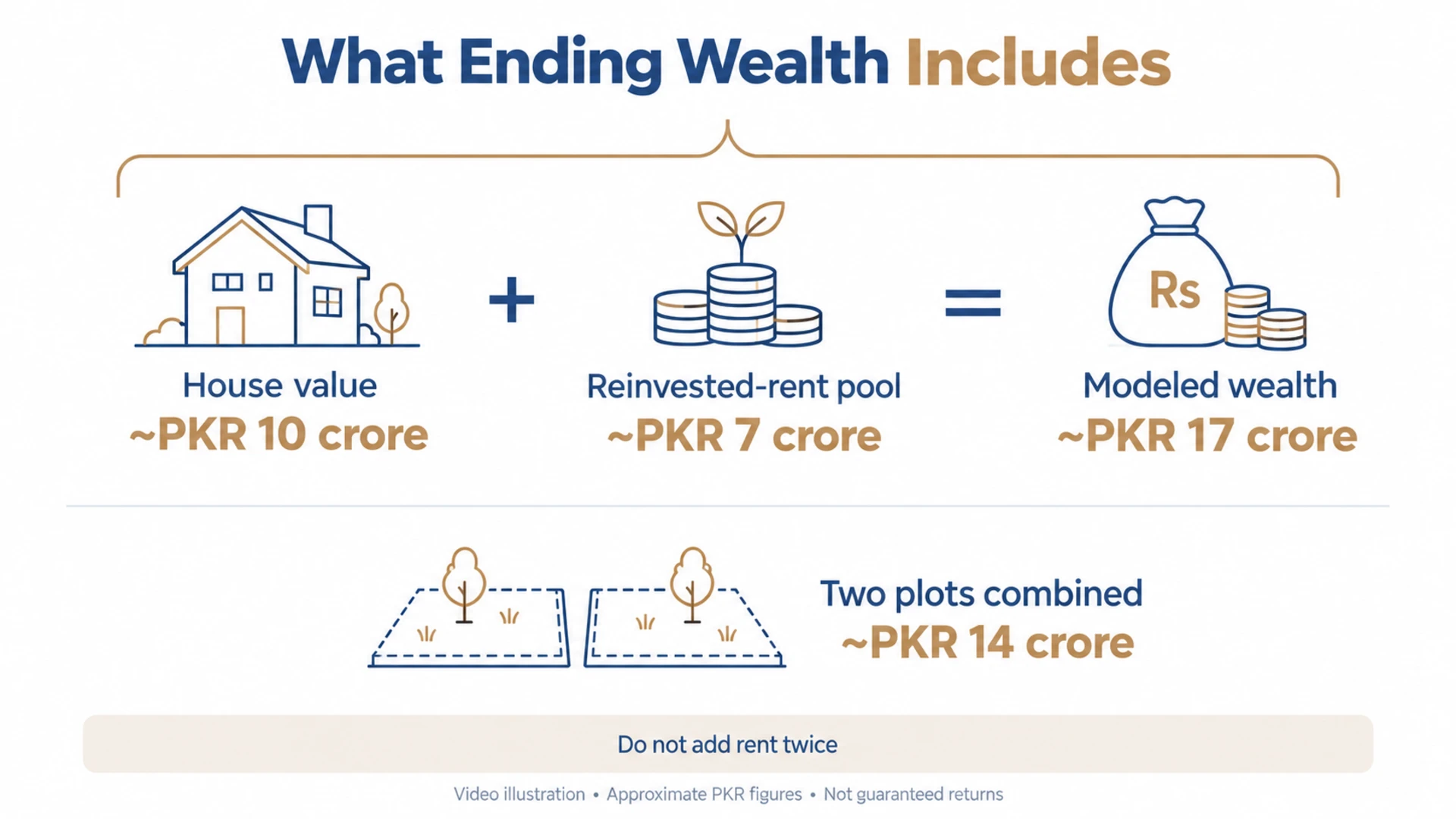
| Rounded video model | House strategy | Plot strategy |
|---|---|---|
| Estimated property value | PKR 10 crore | PKR 14 crore |
| Reinvested-rent pool, including contributions | PKR 7 crore | None modeled |
| Total modeled ending wealth | PKR 17 crore | PKR 14 crore |
The house strategy finishes approximately PKR 3 crore ahead in the video’s rounded illustration. Its advantage comes from cash generated during ownership and the assumed growth of that cash, despite the house having a lower ending property valuation.
Both totals include property that may remain unsold. They should therefore be read as estimated wealth, not cash already received from a completed exit. Selling costs, taxes and the price a buyer actually agrees to pay can change the amount ultimately available to the owner.
Why Holding and Reinvestment Belong Together
The video follows the investments from around 2013 to 2026. Its argument is about what happens during that long period of ownership, rather than a single purchase followed immediately by a sale. The house investor retains the property while also putting the rental income to work.
That makes reinvestment a necessary part of the stated result. The PKR 17 crore figure does not describe a house owner who receives rent and spends all of it. It describes the presenter’s combined property-and-reinvestment strategy. Removing the reinvestment element would change the comparison the video is making.
The source rounds both the accumulated rent and the resulting investment pool. It does not provide a dated receipt-by-receipt ledger. This article therefore preserves the video’s approximate figures without presenting a separate reconstruction as if it were the presenter’s actual record.
From Gross Rent to Investable Cash
The money available to compound is what remains after the property’s costs. A realistic rental-house model should allow for vacant periods, repairs, maintenance, tenant turnover, management expenses and applicable taxes. Major refurbishment can require substantial cash at an inconvenient time.
Those deductions affect two parts of the calculation. They reduce the amount reinvested today and the future growth that amount could have generated. The timing of a large repair therefore matters as well as its size.
This distinction is an editorial limitation on the headline, rather than a new numerical scenario. No expense percentages or alternative outcomes are added here. The figures remain those used in the video, and the absence of an itemised cost record limits what those figures can establish.
The video’s headline figures do not establish an after-cost, after-tax return. The article explains the comparison as presented, without converting its rounded estimated wealth into a claim about the net amount an investor would receive.
Stress-Test the Reinvestment Assumption
A 15% reinvestment return has a large influence over a 13-year period. It should be tested rather than treated as an entitlement. The opportunities available, their risks, the time required to deploy rent and any investment losses will affect the final pool.
The 10% rental-growth input and 15% reinvestment input perform different roles. The first increases the assumed rent over time. The second describes the assumed growth earned after rental money is invested. Neither should be relabelled as the house’s guaranteed annual rental yield.
Keep spending separate from reinvestment. Rent used for family expenses has provided a genuine benefit, but it cannot also remain in the ending investment pool. An income-focused household and an investor seeking maximum terminal wealth may reasonably choose different uses for the same rent.
Choosing Between a House and Plots
The video frames the choice around two different sources of wealth: a change in the property’s estimated value and income generated during ownership. The plots perform better on the first part in this illustration. The rental house moves ahead only when the modeled reinvestment pool is included.
The presenter also distinguishes long-term plot holding from plot trading and development. He does not treat every use of a plot as the same strategy. His comparison concerns holding the plots across the case-study period; it does not calculate the outcome of repeatedly trading them or building on them for sale.
The speaker’s central preference in this example is for an asset that can produce recurring income while it is held. The case study connects that preference to reinvestment: income becomes another part of the investor’s accumulated wealth instead of remaining outside the comparison.
The strongest lesson from this DHA Phase 6 comparison is to evaluate the complete ownership period. Appreciation matters, but income, costs and reinvestment determine how much wealth the strategy can ultimately support.
Frequently Asked Questions
Is a house better than a plot investment in DHA Lahore?
It depends on the property, price and strategy. The rental house produces higher modeled ending wealth in this case because income is reinvested. Different valuations, costs, occupancy or reinvestment performance could narrow or reverse the result.
Does PKR 17 crore mean the house itself is worth that much?
No. The video estimates the house at PKR 10 crore. Its PKR 17 crore total includes an approximately PKR 7 crore reinvested-rent pool. The two components must remain separate.
Is the 15% return guaranteed?
No. It is the video’s reinvestment assumption, not a guaranteed rental yield or investment product return. The actual outcome depends on where and when money is invested, costs and performance.
Can I use these figures as today’s DHA Phase 6 prices?
The figures are approximate values used in the October 2026 case study. They are not current quotations for a particular house or plot. Obtain comparable transaction evidence and property-specific valuations before acting.
Build a Comparison Around Your Own Goals
The video’s message is to consider the income an asset produces as well as its eventual valuation. In this DHA Phase 6 illustration, the combined house and reinvested-rent pool exceeds the estimated value of the two plots. That conclusion belongs to the assumptions and rounded figures presented in this particular comparison.
For further reading, explore Imlaak’s guide to real estate compounding and explanation of IRR versus ROI. These are optional related resources; their case-study figures are not used here. You can also learn about Imlaak’s real estate consultancy.
Primary source: Imlaak, House vs Plot Investment in DHA Lahore | 17 Cr vs 14 Cr, published October 9, 2026. Useful sections: starting comparison, rental income, reinvestment and ending wealth.