
Rooms, Presidential Suites and Sky Villas
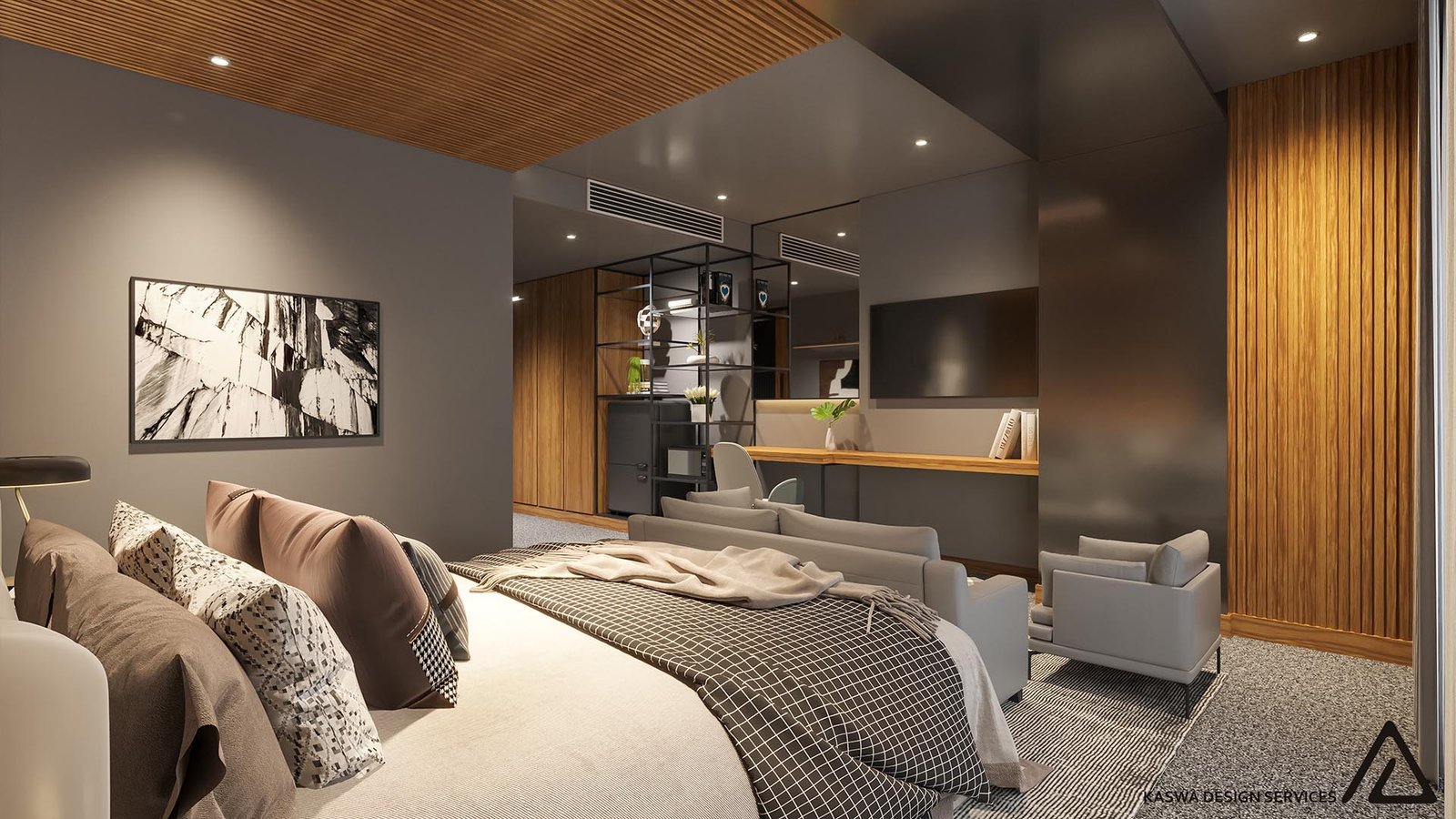
Falettis hotel-room concept render. Final layout and specification follow the selected unit.
A lovely mountain view is a good start. But if you are buying for rental income, you will probably ask a more practical question: after the guests pay and the bills are covered, how much is left for me?
Let’s make Falettis Grand Hotel Ayubia rental income easy to understand. We will work through a room, a Presidential Suite and a three-bedroom Sky Villa. You will see what guests could pay, what running the property could cost, and how the remaining profit is shared.
Start with the kind of property you want to own, then look at the numbers. Our reasons to consider Falettis explain the wider project. Here, we will focus on the rental income.
Start with the nightly rate and booked nights
Occupancy simply means how often the property is booked. In a 30-day month, 70% means 21 nights, 60% means 18 nights, and 50% means 15 nights. We assume PKR 30,000 a night for the room, PKR 50,000 for the Presidential Suite and PKR 150,000 for the three-bedroom Sky Villa.
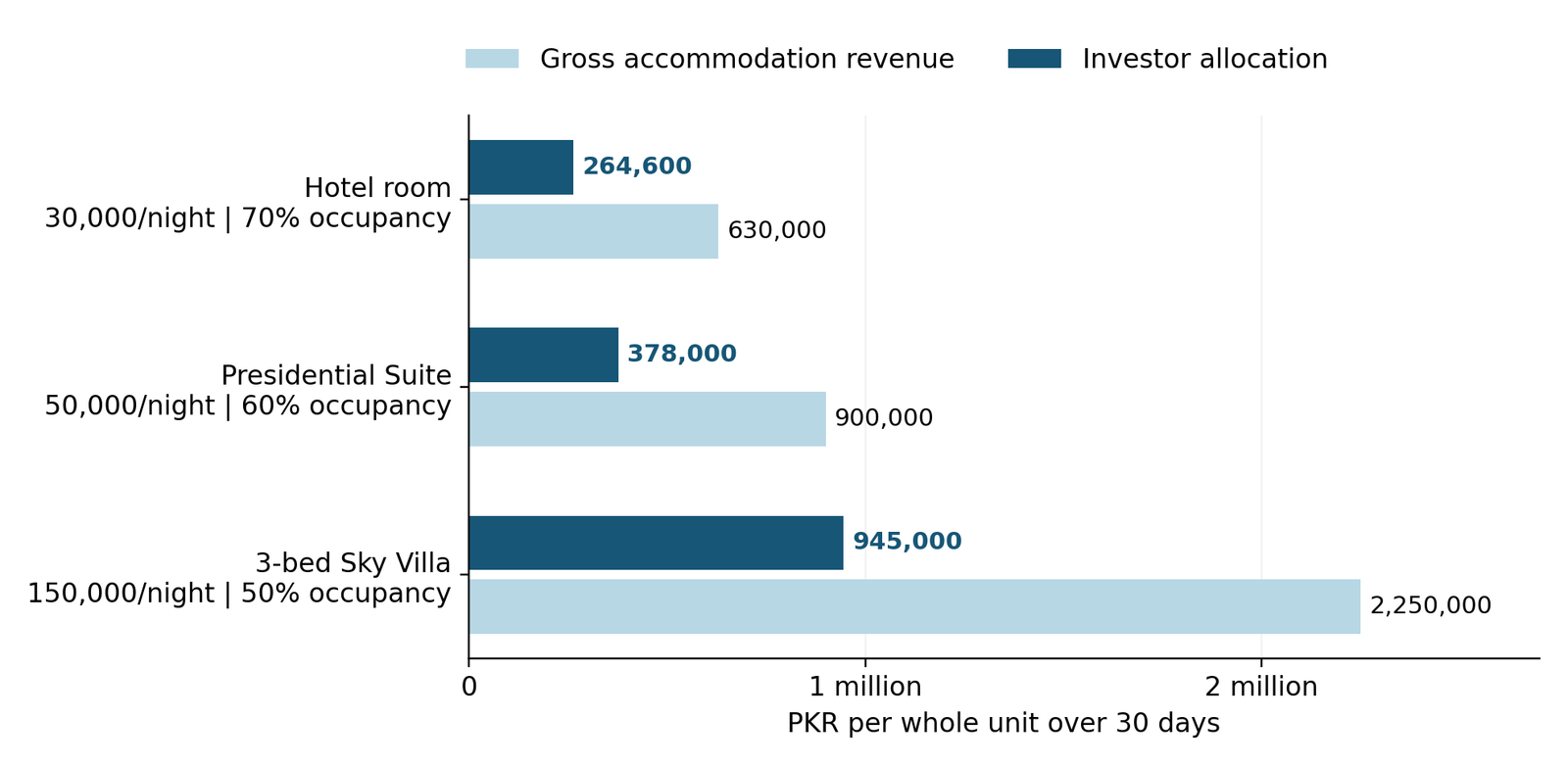
What guests pay and what investors could receive over 30 days. Figures are for each whole unit.
| Planning assumption | Hotel room | Presidential Suite | Three-bedroom Sky Villa |
|---|---|---|---|
| Average nightly rate | PKR 30,000 | PKR 50,000 | PKR 150,000 |
| Occupancy | 70% | 60% | 50% |
| Occupied nights in 30 days | 21 | 18 | 15 |
| Gross accommodation revenue | PKR 630,000 | PKR 900,000 | PKR 2,250,000 |
| Assumed operating cost: approx. 40% of revenue | PKR 252,000 | PKR 360,000 | PKR 900,000 |
| Net rental profit after expenses | PKR 378,000 | PKR 540,000 | PKR 1,350,000 |
| Investor allocation: 70% of net profit | PKR 264,600 | PKR 378,000 | PKR 945,000 |
| Management allocation: 30% of net profit | PKR 113,400 | PKR 162,000 | PKR 405,000 |
These projections are based on assumed nightly rates, occupancy and operating costs. Actual rental income and returns may vary.
How the money reaches the investor
First, add up what the guests pay. This is gross rental revenue. For this illustration, we assume operating costs are approximately 40% of that revenue, not a fixed charge. What remains is net rental profit. Investors receive 70% of that profit and management receives 30%.
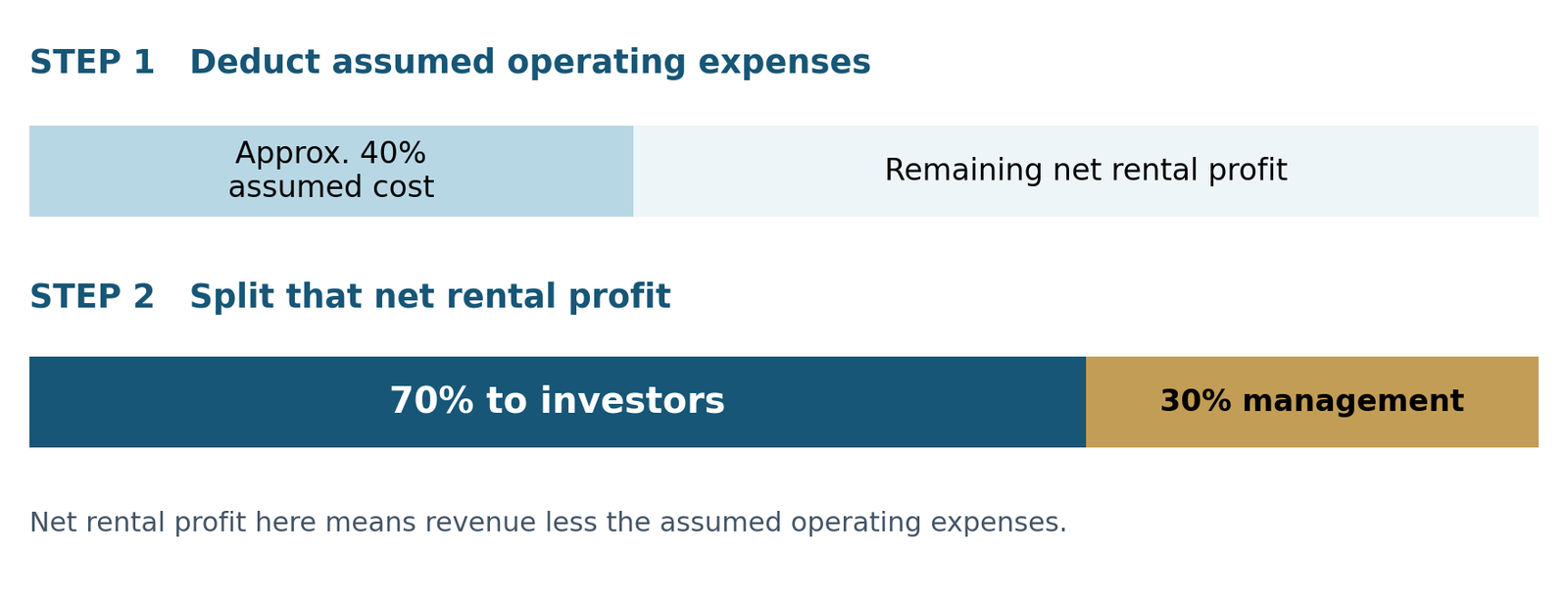
Pay operating expenses first. Then split the remaining net rental profit 70/30.
Let’s follow the money for one room
The room is booked for 21 nights at PKR 30,000. Guests pay PKR 630,000 in total. Take out PKR 252,000 for the assumed operating expenses and PKR 378,000 remains. The investor’s 70% is PKR 264,600, roughly PKR 2.65 lakh for those 30 days. Management’s 30% is PKR 113,400.
Now use the same steps for the suite and villa
For the Presidential Suite, the investor’s projected income is PKR 378,000 over 30 days. For the complete three-bedroom Sky Villa, it is PKR 945,000. That villa figure belongs to the whole unit, not to each share buyer. We explain the share calculation below.
What goes into the running costs
Think of housekeeping, staff, utilities, booking fees and maintenance. Approximately 40% of revenue is assumed to cover operating costs in this projection. Actual costs can vary; it is not a fixed charge or a confirmed list of charges. The operating agreement should say what it covers, including how taxes, reserves for future repairs and any other owner charges are handled. Anything outside that allowance changes what you keep.
A useful statement should make the calculation easy to follow: money collected, costs deducted, profit left and your share paid.
What could that mean over a year
Now keep the same rates, occupancy and expense assumptions, but use 365 days. Divide the annual income by 12 to get the monthly average shown below.
| Annual planning scenario | Hotel room | Presidential Suite | Three-bedroom Sky Villa |
|---|---|---|---|
| Gross annual revenue | PKR 7,665,000 | PKR 10,950,000 | PKR 27,375,000 |
| Annual investor allocation | PKR 3,219,300 | PKR 4,599,000 | PKR 11,497,500 |
| Monthly average of annual investor allocation | PKR 268,275 | PKR 383,250 | PKR 958,125 |
Why not just multiply the monthly figure by twelve
You can, but twelve 30-day months give you 360 days. A full year has 365. For the whole Sky Villa, the first method gives PKR 11,340,000. The 365-day model gives PKR 11,497,500. The difference is five extra days in the calculation.
Think about the guest as well as the property
Rooms, suites and larger villas suit different trips and group sizes. Look at the planned amenities and lifestyle too. When estimating income, use the average nightly rate you expect to collect across busy and quieter periods, rather than the highest holiday price.
What if fewer nights are booked
Let’s lower occupancy to 60% for the room, 50% for the suite and 40% for the villa. Keep the same nightly rates and the approximate 40% operating-cost assumption. Projected investor income over 30 days falls to PKR 226,800, PKR 315,000 and PKR 756,000 respectively. In practice, some bills stay the same even when bookings fall.
A bigger income figure needs a fair comparison
To work out an annual rental yield, divide annual investor income by the total cost of buying and getting the property ready to rent, then multiply by 100. A villa may bring in more rupees than a room, but it also costs more to buy. Compare both sides before choosing.
How a Sky Villa share fits into the picture
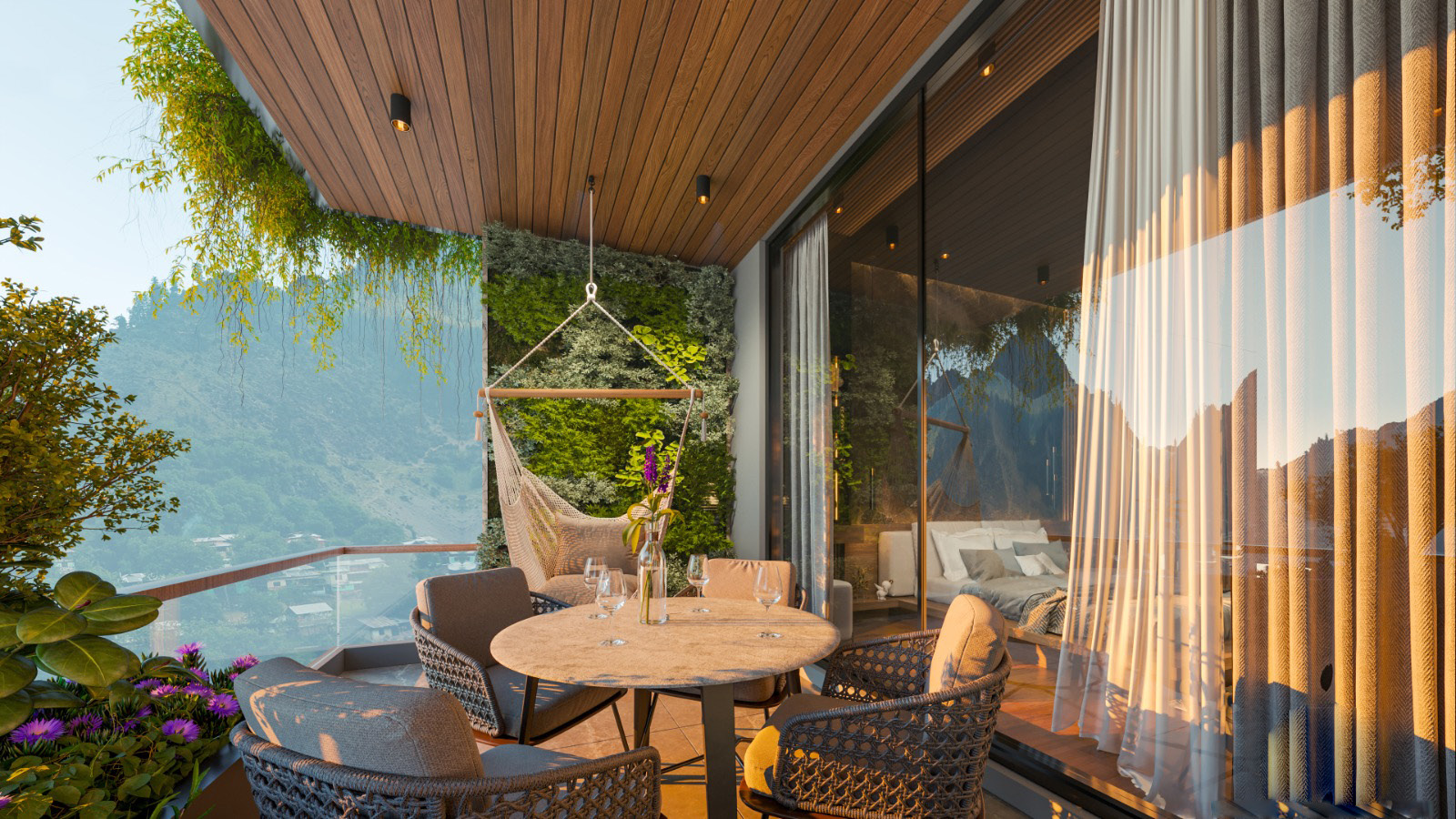
Falettis Sky Villa terrace concept render.
You do not use the whole villa’s income when calculating a share. In this example, a 200-square-foot share in a 1,600-square-foot Sky Villa receives one eighth of the investor rental income. The maths is simple: 200 ÷ 1,600 = 12.5%.
The whole villa’s projected investor income is PKR 945,000 over 30 days. Divide that by eight and the share receives PKR 118,125.
This is the example for that particular villa and entitlement. Your agreement should show which unit or rental pool your share belongs to, your portion of the income, and how personal stays or other adjustments are treated.
Which option makes sense for you
Start with your budget and what you want from the property. Would you prefer a room, a suite, a whole villa or a share? Put the purchase cost beside the projected income, then consider the payment plan and any personal-use rights.
Tell Imlaak which option you are considering. We can walk through the numbers with you so you can compare the property, the payments and the rental income on the same page.
A few questions you may be asking
Does management take 30 percent of what guests pay
No. Running costs come out first. Management takes 30% of the net rental profit left after those costs. Investors receive the other 70%.
Will I receive the same amount every month
Bookings and costs can change from month to month. Our 30-day figures make the options easy to compare. Your agreement sets when statements and payments are due, and how later adjustments are handled.
When would my rental income start
Check the handover, readiness for guest bookings and income start conditions in your purchase and operating agreements. Buying a unit and having it ready to earn rent are separate steps.
What happens if I stay there myself
Nights you use may no longer be available to paying guests. Check the rules for owner bookings, charges and the effect on your own income or any shared rental pool.
What should my rental statement tell me
How many nights were available and booked, how much guests paid, any refunds, and each cost deducted. It should also show repair reserves, management’s share, your share and the payment made to you.
Can I add a rental guarantee to this income
Only if the signed terms provide for both in the same period. A guarantee has its own covered property, payer, calculation method, dates and conditions. Do not count the same income twice.
Does every share receive the villa figure in the table
No. The table shows the whole villa’s investor income. In our specific 200-square-foot example, the share gets one eighth. Other shares follow the entitlement for their own unit or pool.
Keep exploring your options
Accommodation choices at Falettis