

For anyone assessing rental property investment in Lahore, a forecast is useful only when its rates, costs and occupancy assumptions are visible. The Sixty6 Gulberg rental income forecast for 2027–2029 shows how a short-term rental operation could develop as occupancy and nightly rates improve. Under the planning assumptions examined here, the owner’s average monthly share moves from approximately PKR 1.34–1.79 lakh in 2027 to PKR 2.40–2.87 lakh in 2028, reaching approximately PKR 3.58 lakh in 2029.
Those figures depend on a specific operating model. They are projections, not rental commitments, achieved results or a promise that the building will follow this timetable.
For an investor, the useful question is how that progression would happen. How many nights must be sold? What rate must guests actually pay? How much remains after hospitality expenses and the operator’s share? And what changes if operations start later or demand develops more slowly?
This article brings together the three-year assumptions in Imlaak’s feasibility graphic and the operating framework discussed alongside its 4 October 2026 Sixty6 Gulberg video. It recalculates the model consistently so you can examine the income pathway before making an investment decision.
Sixty6 Gulberg rental income forecast assumptions
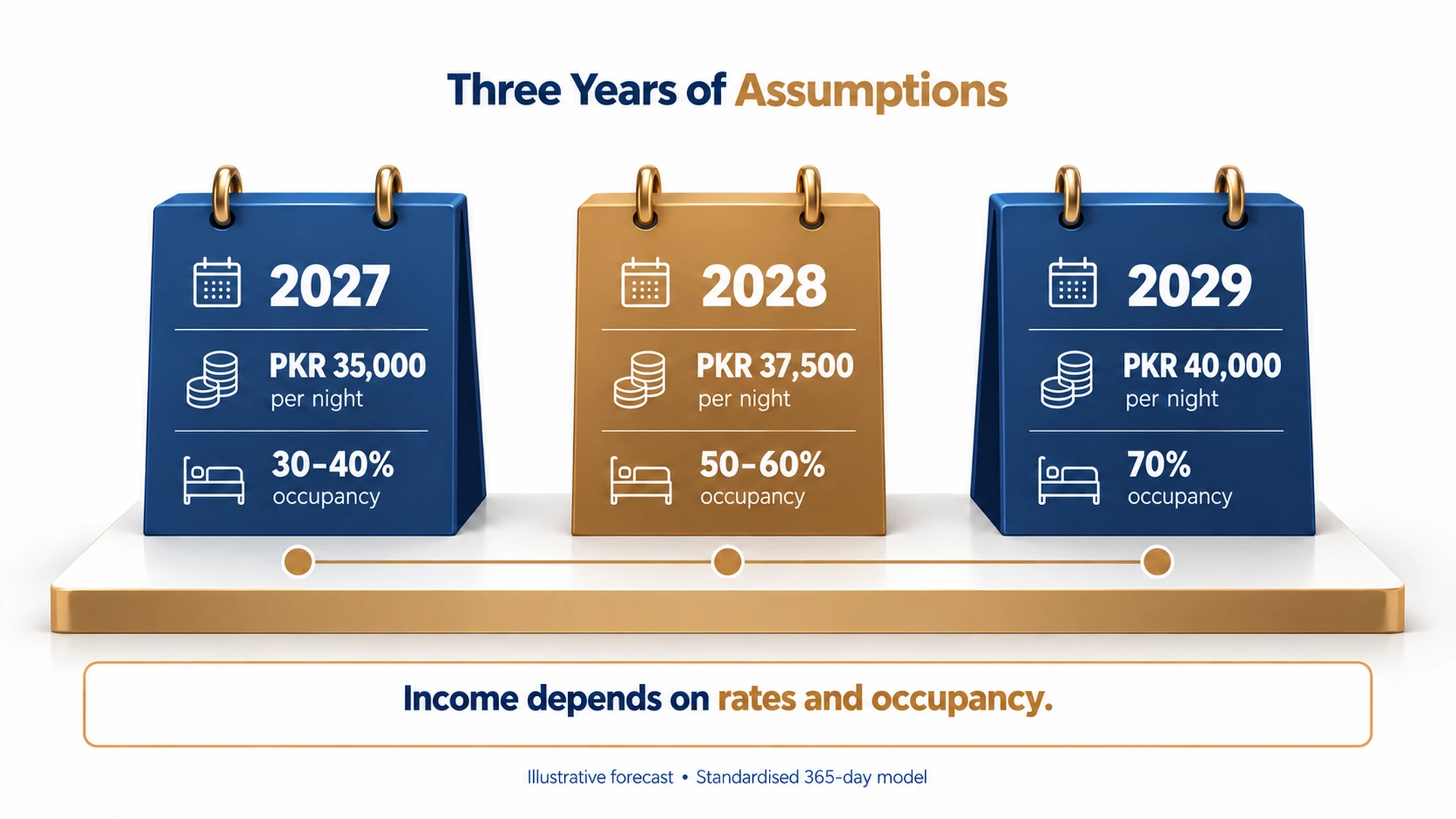
The forecast pairs an improving occupancy rate with a higher average nightly rate:
- 2027: PKR 35,000 per occupied night and 30–40% occupancy.
- 2028: PKR 37,500 per occupied night and 50–60% occupancy.
- 2029: PKR 40,000 per occupied night and 70% occupancy.
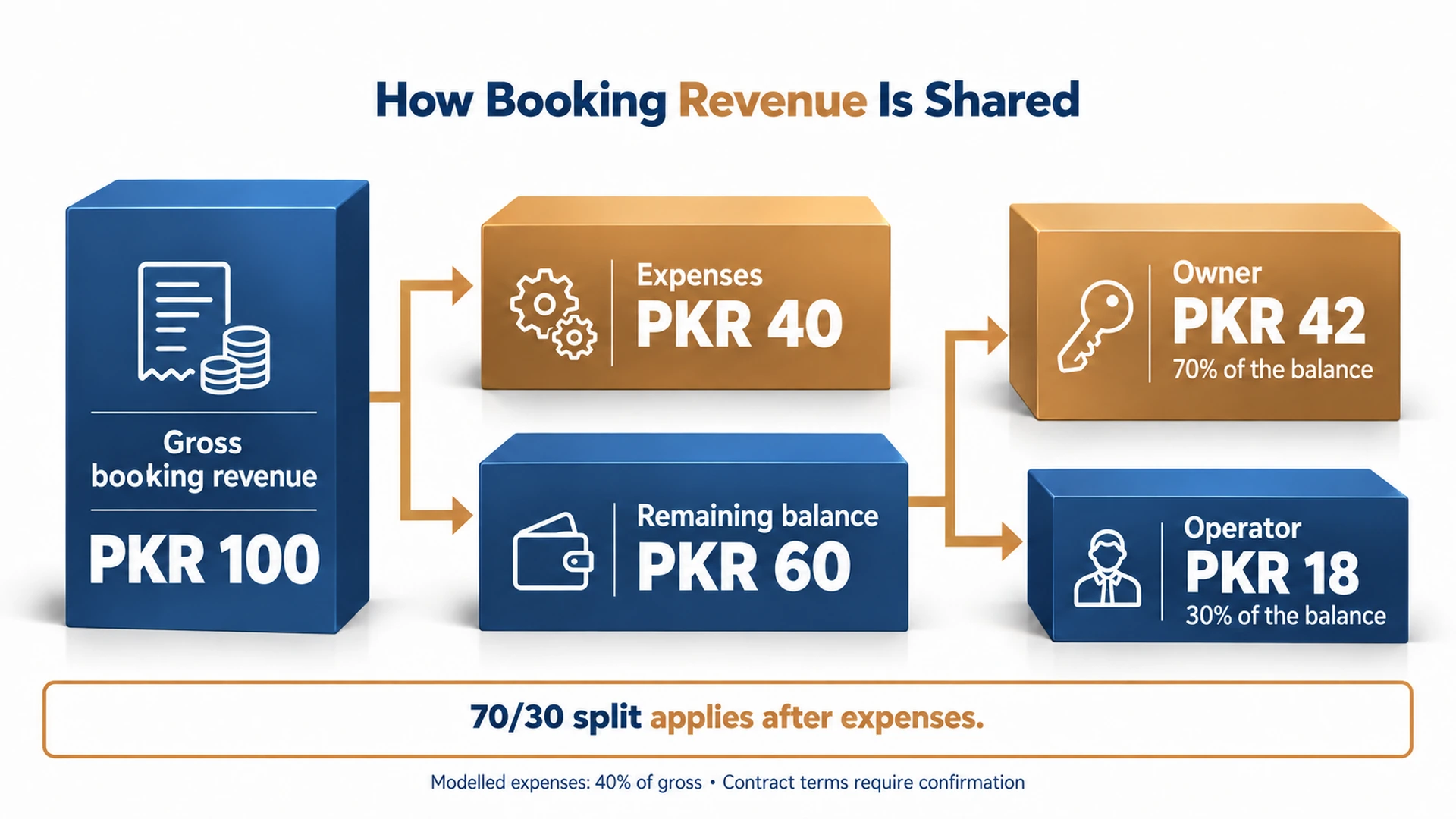
Across all three years, the calculation allows 40% of gross booking revenue for operating expenses. The remaining balance is divided 70% to the owner and 30% to the operator. The resulting owner allocation is 42% of gross revenue.
These assumptions describe an illustrative apartment-income model. They do not establish the terms applicable to every unit. Apartment category, rental-pool rules, availability for bookings and the signed management agreement all require confirmation.
We use a standardised 365-day year throughout, including the 2028 scenario, to keep the source model comparable. Monthly figures are annual totals divided by 12. They represent averages rather than equal monthly payments.
Projected rental income from 2027 to 2029
2027 establishing the operation
The first scenario uses 30–40% annual occupancy. On a 365-day basis, that is approximately 110–146 occupied nights. At PKR 35,000 per night, modelled annual gross revenue ranges from PKR 38.33 lakh to PKR 51.10 lakh.
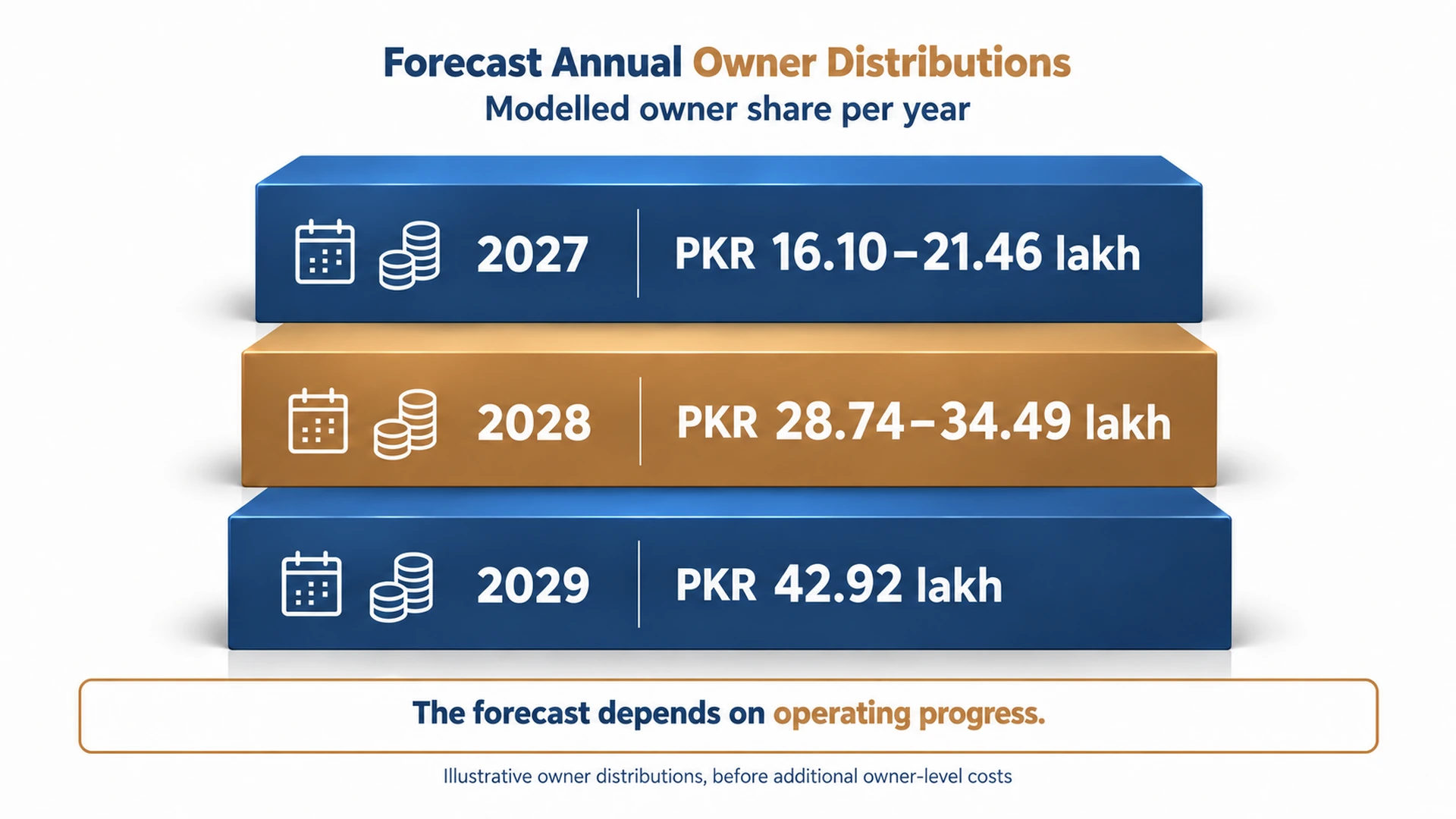
After the assumed deductions, the owner’s annual share is approximately PKR 16.10–21.46 lakh. Dividing by 12 gives the headline monthly average of PKR 1.34–1.79 lakh.
The practical focus is rental readiness: a prepared apartment, functioning guest services, live booking channels and an operator able to deliver a consistent stay. A forecast labelled 2027 does not itself confirm when those conditions will be met.
For budgeting, ask for the proposed start date and a separate opening-period plan. If the apartment is available for fewer than 365 days, the first calendar year needs its own calculation. The lower occupancy assumption is also a scenario, not a guaranteed floor.
2028 building occupancy and pricing
The second year assumes 50–60% occupancy at PKR 37,500 per night. That produces approximately PKR 68.44–82.13 lakh in annual gross bookings and PKR 28.74–34.49 lakh in modelled owner distributions.
The average monthly owner share becomes PKR 2.40–2.87 lakh. This improvement requires more booked nights as well as a higher achieved rate. A price increase alone does not explain the forecast.
The question for an owner is what supports the change: stronger repeat demand, effective distribution, guest reviews, corporate bookings or another measurable source of business. These are items to investigate with the operator, rather than outcomes assumed to occur automatically after the first year.
It is worth tracking the two inputs separately. The assumed nightly rate rises by about 7.1% from the first year, while the occupancy range increases by 20 percentage points. Most of the modelled income improvement therefore comes from selling more nights. An operator update that discusses higher advertised prices without showing bookings would leave the main driver untested.
2029 testing the mature operating target
The third scenario uses 70% occupancy and an average nightly rate of PKR 40,000. On the standardised model, this means 255.5 occupied nights and PKR 1.022 crore in annual gross revenue.
The owner’s 42% allocation is PKR 4,292,400 annually, or PKR 357,700 a month on average. Rounded into lakh, those figures are PKR 42.92 lakh annually and PKR 3.58 lakh monthly.
These are the mathematical outputs of the stated inputs. Reaching them requires the operation to achieve the rate, occupancy and cost structure together. A 70% occupancy target should remain a target until supported by actual performance.
| Scenario year | Monthly owner share | Annual owner share |
|---|---|---|
| 2027 | PKR 1.34–1.79 lakh | PKR 16.10–21.46 lakh |
| 2028 | PKR 2.40–2.87 lakh | PKR 28.74–34.49 lakh |
| 2029 | PKR 3.58 lakh | PKR 42.92 lakh |
Monthly amounts are annual averages. Figures are rounded after calculation. One lakh equals PKR 100,000; one crore equals PKR 10 million.
How booking revenue becomes owner income
A gross booking figure needs to pass through the operating model before it becomes an owner distribution.
For each PKR 100 collected in this example, PKR 40 is allocated to hospitality expenses. That leaves PKR 60. The owner receives 70% of that balance, which is PKR 42; the operator receives PKR 18.
Annual owner share = nightly rate × 365 × occupancy × 60% × 70%.
The video discusses expenses such as electricity, booking charges, utilities and staff costs. A written budget must confirm their treatment and identify any items payable separately. The 40% allowance is a modelling assumption, not an audited operating margin.
Owner distributions should also be distinguished from final personal cash flow. Financing payments, applicable taxes, replacement spending and other owner obligations may affect what an investor retains. Confirm which costs are already included so that none are omitted or counted twice.
What the three year total actually means
Combining the lower 2027 and 2028 scenarios with the stated 2029 target produces approximately PKR 87.76 lakh in cumulative owner distributions. Combining the higher first- and second-year scenarios with that same third-year target gives approximately PKR 98.88 lakh.
This is a sum of three annual cash-distribution scenarios. It assumes the specified operating conditions throughout each modelled year. It excludes any reinvestment, interest on distributions or capital appreciation.
The range is not a probability forecast, a payback promise or a net profit figure. The original investment remains tied to the property, and selling it introduces a separate set of price, timing and transaction-cost questions.
Timing can also change the total materially. A later opening shortens the initial earning period, while a slower occupancy build may move a target into a later year. Keep a cash-flow calendar showing when capital is paid, when guests can be accepted and when owner distributions are expected. Do not simply add three full-year estimates to a plan that starts partway through the first year. Seasonal demand and fixed costs may also make a straight-line adjustment too optimistic or too pessimistic.
An investment yield also requires a clear denominator. Use the full amount committed to the apartment and its rental readiness, including applicable acquisition costs, setup items and required capital contributions. The same income can produce a different percentage for an earlier buyer and a new buyer.
For the separate question of how occupancy and entry price affect a 15% threshold, see our short-term rental yield analysis. Here, the focus is the three-year operating pathway rather than a universal yield claim.
Stress testing the 2029 income target
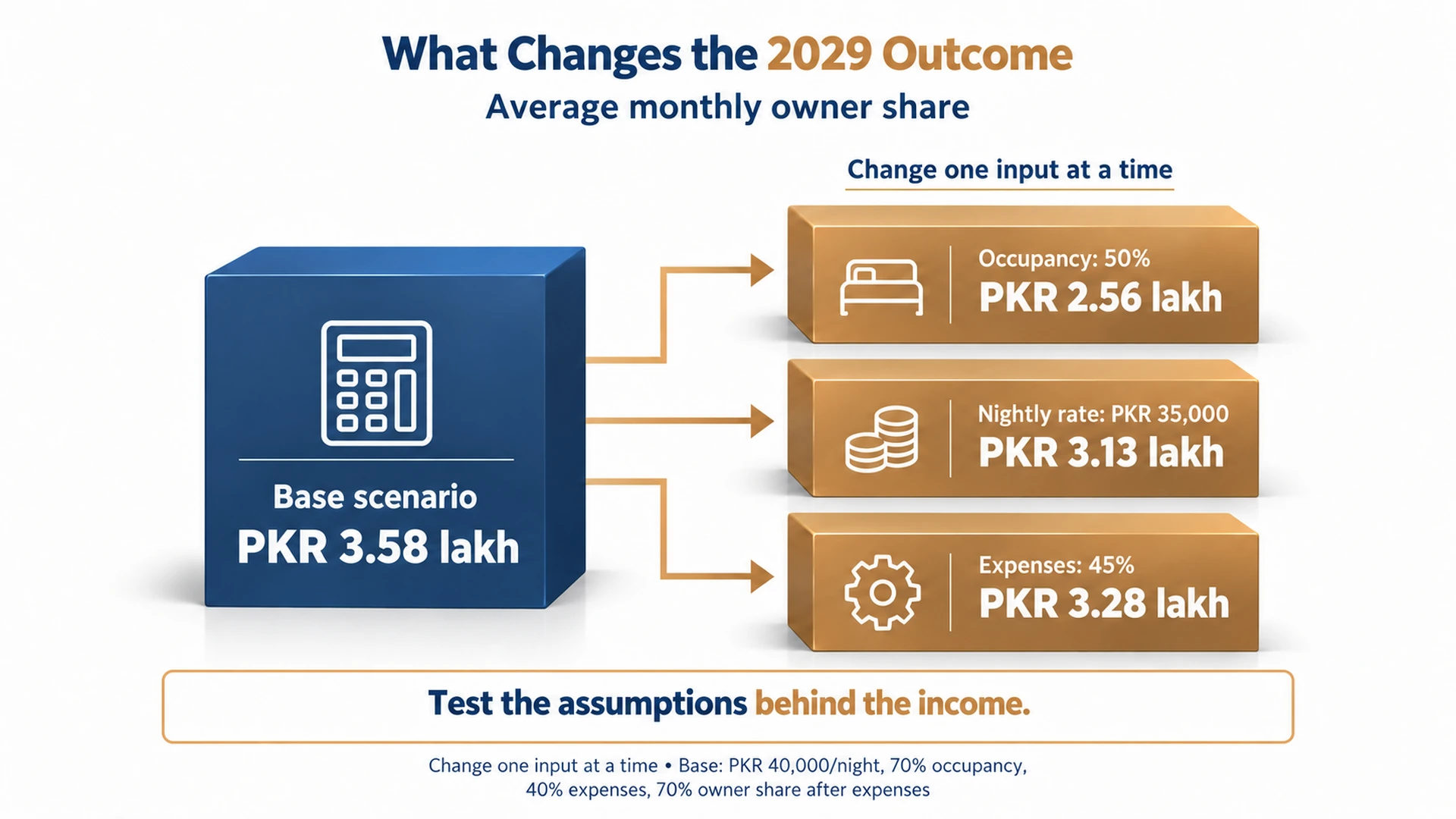
The PKR 3.58 lakh monthly outcome is sensitive to changes in all three main inputs. To see the effect, change one assumption at a time while leaving the others at their 2029 model values:
- Occupancy at 50%: at PKR 40,000 per night and the original deductions, the monthly owner average falls to approximately PKR 2.56 lakh.
- Nightly rate at PKR 35,000: with 70% occupancy and the original deductions, the monthly average becomes approximately PKR 3.13 lakh.
- Expenses at 45% of gross: at the original rate and occupancy, a 70% owner share of the remaining balance produces approximately PKR 3.28 lakh monthly.
These are additional sensitivity calculations, separate from the source forecast. They show why occupancy cannot be reviewed in isolation. Discounting may fill more nights while reducing the average rate, and some expenses may remain fixed when bookings slow.
A useful update should therefore report occupied nights, the achieved average rate, gross receipts, itemised expenses and distributions together. Comparing those figures with the plan will reveal whether progress is coming from genuine operating improvement or simply from a changed assumption.
How to assess a rental investment in Lahore
Whether you already own an apartment or are comparing rental property investment in Lahore, request a unit-specific written illustration. Five questions help turn a general forecast into a usable plan:
- When can the unit accept guests? Confirm possession, furnishing, operator mobilisation and rental readiness separately. Ask how a delayed or partial first year changes distributions.
- What exactly is being priced? Match the nightly-rate assumption to the apartment category and achieved guest revenue, including the treatment of discounts and booking charges.
- How does the pool allocate income? Confirm participation rules, owner-use restrictions, unavailable nights and the basis for each apartment’s distribution.
- Which costs sit outside the allowance? Obtain an itemised budget, reserve requirements and any separate owner contributions or obligations.
- How will performance be checked? Ask for the reporting format, payment timetable, reconciliation process and the procedure for questioning an expense or distribution.
The Sixty6 Gulberg project page describes rental management after possession and rental readiness, with income dependent on occupancy, costs and the investor’s agreement. Use the current agreement and a current quotation when assessing a specific purchase.
Frequently asked questions
Are the 2027 to 2029 figures guaranteed
No. They are planning scenarios based on assumed rates, occupancy, expenses and revenue sharing. Actual income can be higher or lower, and the operating timetable requires confirmation.
How much monthly rental income is forecast for 2029
PKR 40,000 × 365 × 70% occupancy × 42% owner allocation ÷ 12 equals PKR 357,700. This article shows that consistent calculation rather than treating rounded promotional ranges as exact arithmetic.
Will the same amount arrive every month
The model provides a monthly average. Booking patterns, seasonal demand, costs, reserves and contractual payment terms can change the amount and timing of actual distributions.
Does the cumulative total include property appreciation
No. The PKR 87.76–98.88 lakh range covers modelled owner distributions only. A change in the property’s value must be assessed separately.
Build a forecast around your apartment
The Sixty6 Gulberg rental income forecast is a starting point for a more specific conversation. Its value comes from making the operating assumptions visible and checking how they fit your unit, investment amount and time horizon.
Request a Sixty6 rental income illustration from Imlaak, including current project information, rental-management terms and a unit-specific cash-flow estimate. Review the expected income alongside the full cost, opening timetable and downside scenarios before deciding.
Source and calculation note: The operating discussion and published description of Imlaak’s Rental Property Investment in Lahore | Sixty6 Gulberg Forecast, published 4 October 2026, are read alongside Imlaak’s three-year rental-feasibility graphic. The year-specific inputs reproduced above follow the separate Three-Year Rental Feasibility graphic, including its PKR 37,500 second-year rate; they are not presented as a verbatim spoken table. All income totals and sensitivity examples are recalculated on a standardised 365-day basis. Forecasts are illustrative and do not establish current prices, availability, contractual guarantees or verified operating results.