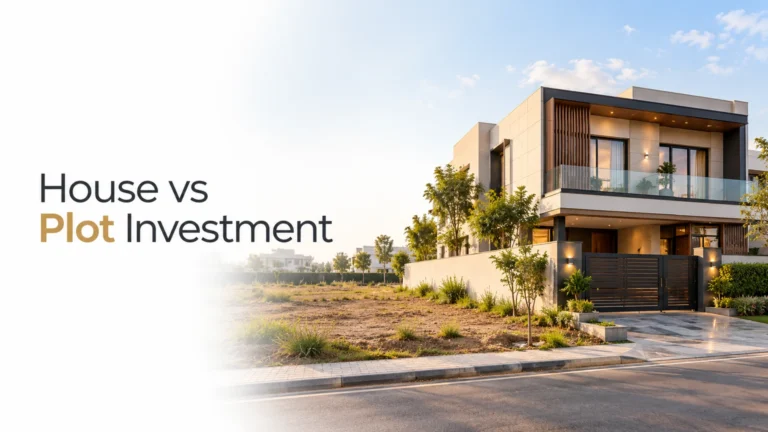

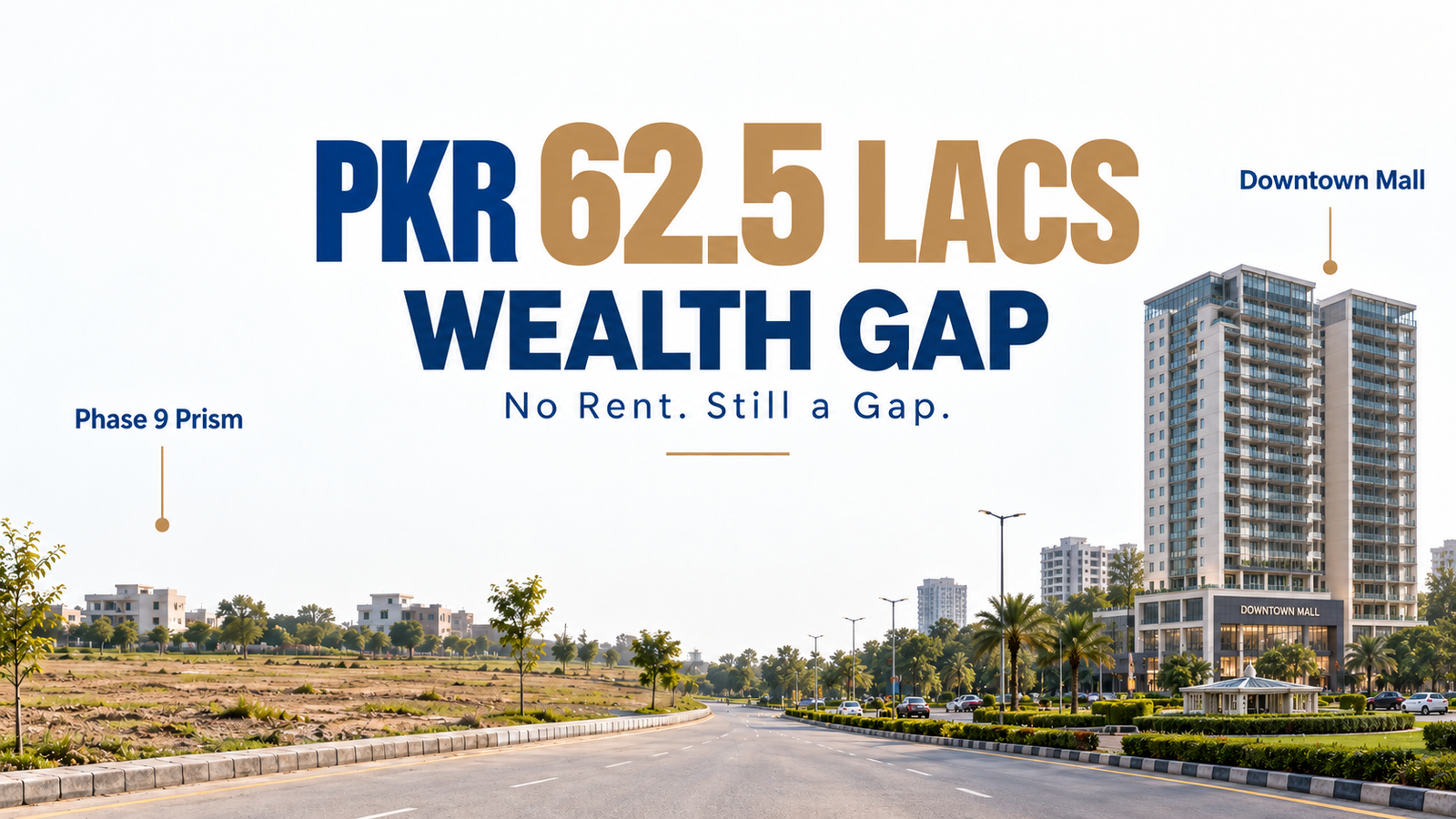
In 2020, two equivalent PKR 1.50 crore allocations took very different routes. One was deployed upfront into a Phase 9 Prism plot. The other was spread across four years into an approximately 625-square-foot, one-bedroom equivalent at Downtown Mall.
By June 2026, neither side of the comparison included a single rupee of rental income. Downtown’s possession had also been delayed. Yet the two investments produced sharply different calculated outcomes in both PKR and US dollars.
That contradiction makes this installment property investment in Pakistan case study especially useful. Unlike a comparison where rent helps one asset pull ahead, this case isolates two less visible forces: when capital was deployed and what happened to the underlying valuation.
This is Case Study 3 in IMLAAK’s One Crore Challenge 2.0 series. It compares Phase 9 Prism with Downtown Mall from 2020 to June 2026 using the payment schedule, exchange rates and reference values in IMLAAK’s presentation. Where the transcript rounds a figure, the slide value takes priority.
This is not a recommendation to buy Downtown Mall today or an argument against plots. It asks a narrower question: despite delayed possession and no rent, what did each PKR 150 lacs decision produce by June 2026?
Phase 9 Prism vs Downtown Mall: Setting Up the Comparison
The starting allocation is PKR 150 lacs on each side. Phase 9 Prism represents an upfront plot purchase in 2020. Downtown represents an approximately 625 sq ft, one-bedroom equivalent funded through installments.
Equal allocation does not mean identical properties or listed prices. It assigns the same PKR capital to two investment structures, making payment timing more important than unit size.
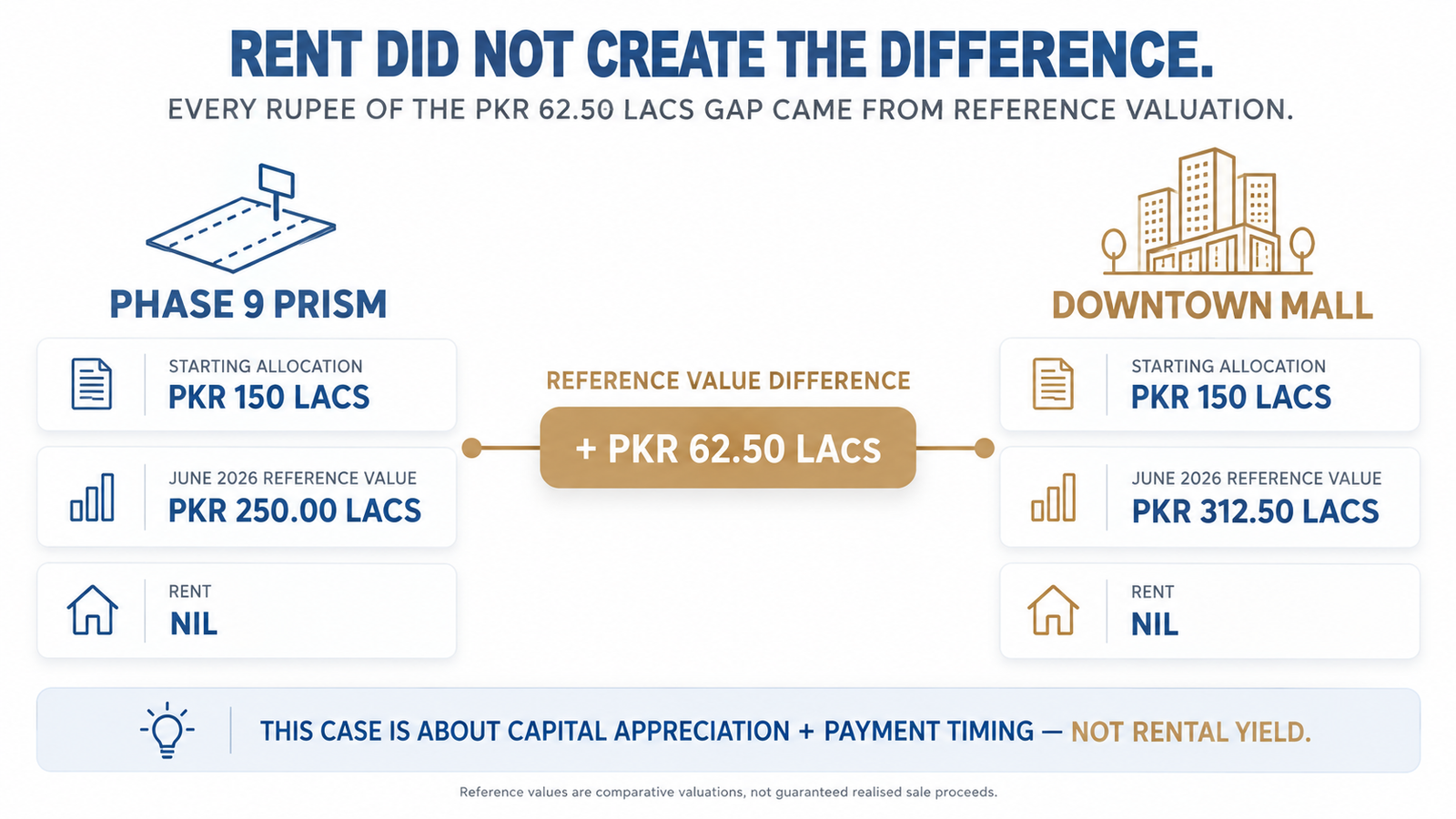
The measurement date is June 2026. Phase 9 Prism is valued at PKR 250 lacs, while Downtown is assigned a reference value of PKR 312.50 lacs. Neither side receives rent. Downtown is treated as delayed, with no income included before possession.
These are reference valuations, not guaranteed sale proceeds. Until an asset sells at an achievable price, appreciation is not realised cash.
Investment insight: Equal PKR allocations can require very different amounts of foreign currency when their payment dates differ.
Upfront Payment vs Four Years of Installments
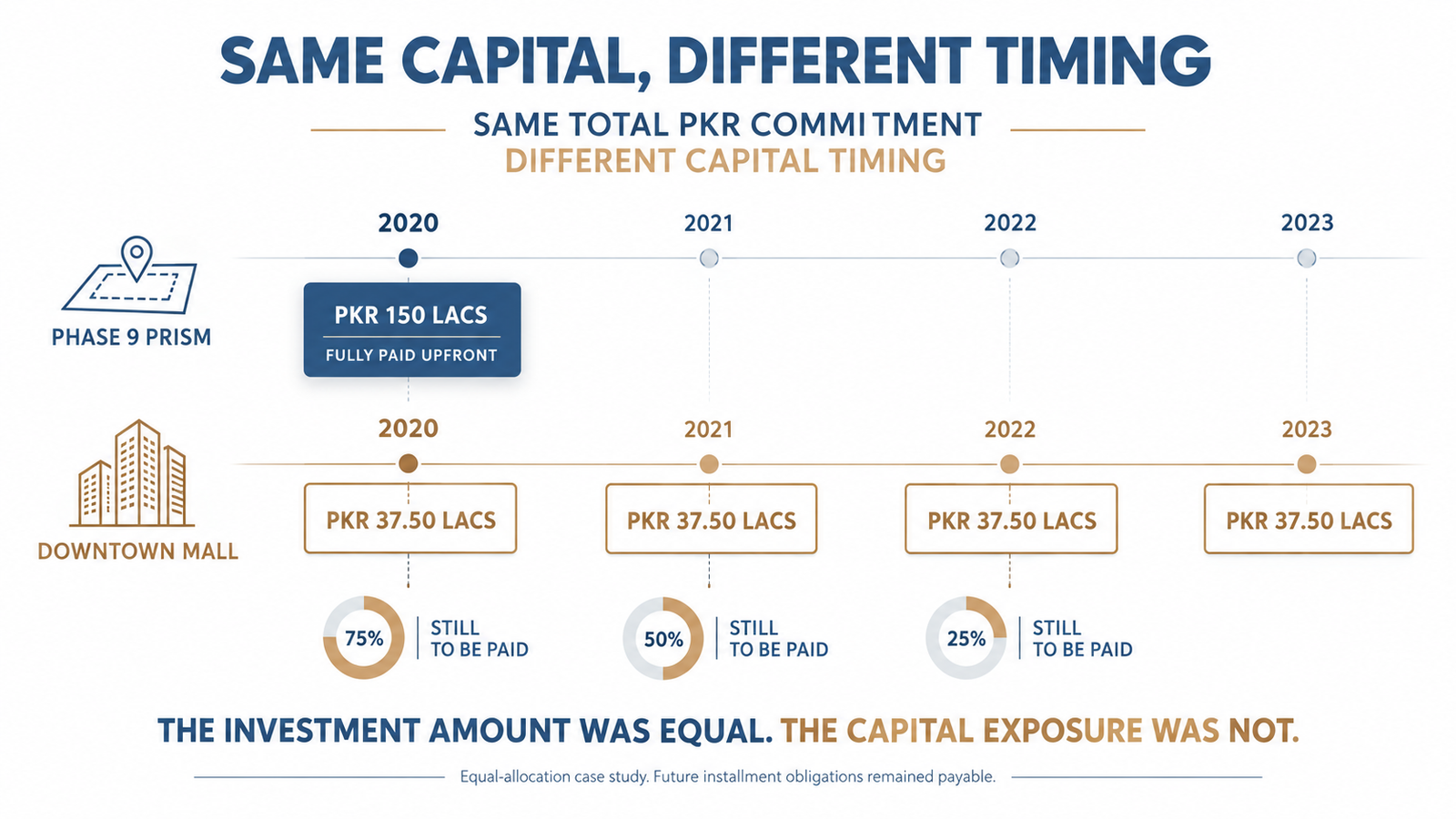
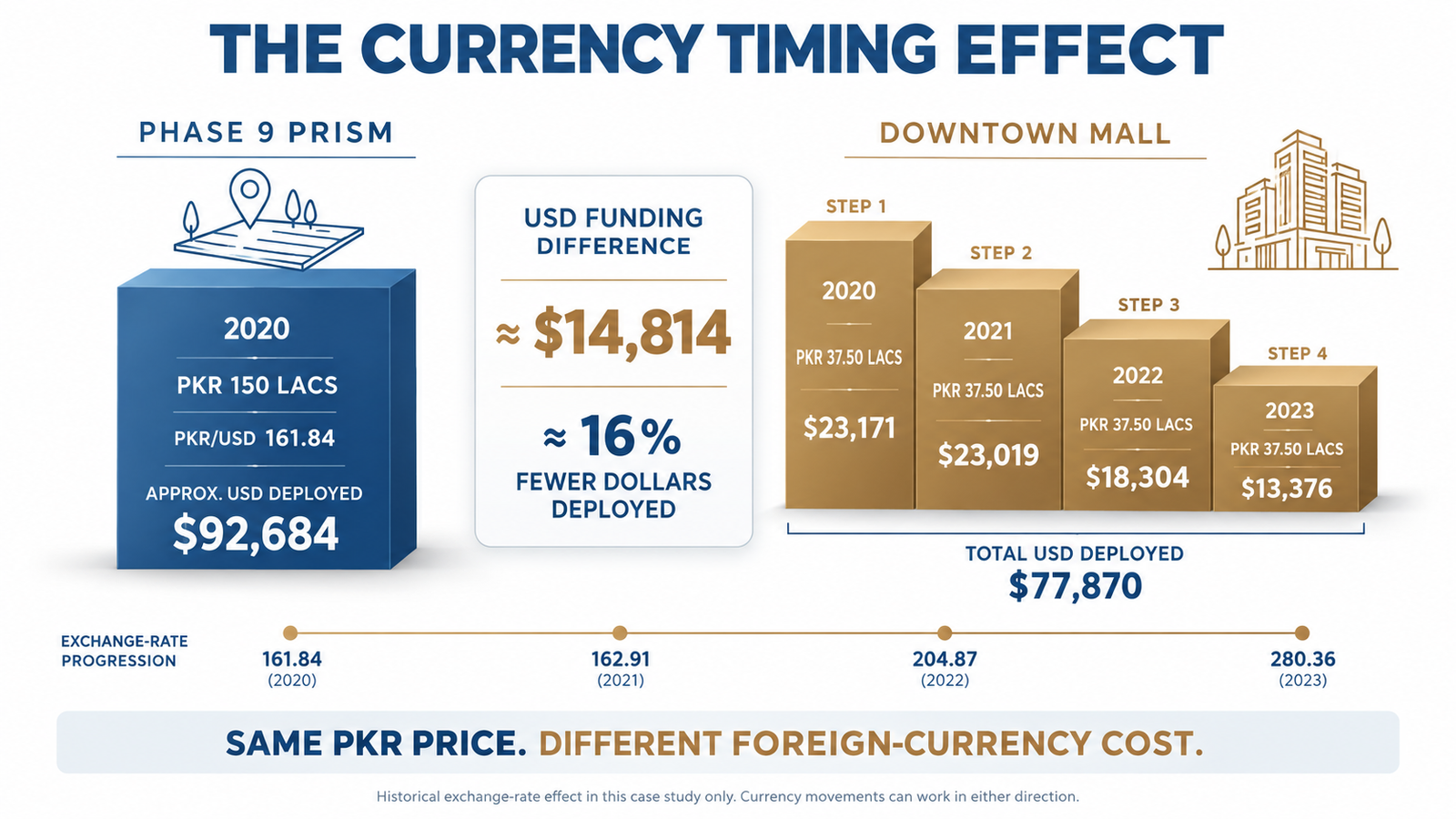
The Phase 9 Prism investor deployed the entire PKR 150 lacs in 2020. At the exchange rate used in the presentation—PKR 161.84 per dollar—that represented approximately $92,684 paid upfront.
Downtown divided the same PKR 150 lacs into four annual payments of PKR 37.50 lacs between 2020 and 2023. The rupee weakened during that period, so the number of dollars needed to fund each fixed-PKR installment declined.
This does not change the contractual PKR price. Both allocations still total PKR 150 lacs. It changes the historical foreign-currency cost of meeting that commitment.
The distinction matters to both overseas and local investors. Gradual payments preserve liquidity for longer and affect annualized performance, but future installments remain obligations. Project delay can also leave capital committed before the property is usable, rentable or easy to sell.
How Downtown Used 16% Fewer Dollars
The payment table shows how the currency effect accumulated.
| Year | Phase 9 Prism payment | Downtown payment | PKR/USD | Approx. Downtown USD paid |
|---|---|---|---|---|
| 2020 | PKR 150 lacs upfront | PKR 37.50 lacs | 161.84 | $23,171 |
| 2021 | — | PKR 37.50 lacs | 162.91 | $23,019 |
| 2022 | — | PKR 37.50 lacs | 204.87 | $18,304 |
| 2023 | — | PKR 37.50 lacs | 280.36 | $13,376 |
| Total | PKR 150 lacs | PKR 150 lacs | — | $77,870 |
The plot required approximately $92,684 upfront. Downtown required approximately $77,870 over four years. The difference is $14,814, or approximately 16% fewer dollars under the case-study methodology.
The transcript rounds this gap to $16,000–$17,000 and describes it as an initial advantage. The slide calculation is more precise. It should not be described as instant profit: no money had yet been earned or realised from Downtown. Rather, staged payments lowered the historical dollar cost of funding the same PKR allocation by $14,814.
That advantage depended on the exchange-rate path. A strengthening rupee could have made later installments require more dollars. Payment timing creates exposure; it does not guarantee a benefit.
Investment insight: An installment plan is not only a payment convenience; it can change how much foreign currency an investor ultimately deploys.
This Time, Rental Income Cannot Explain the Result
Case Study 3 is deliberately different from the earlier comparisons. No rent is credited to either asset.
| Rental status | Phase 9 Prism | Downtown Mall |
|---|---|---|
| Asset status | Plot asset | Delayed/no income yet |
| Rent to June 2026 | Nil | Nil |
| Rent included in returns | Nil | Nil |
| Rent reinvested | Not applicable | Not applicable |
The Phase 9 Prism plot produced no rent during the period. Downtown had not started producing income within the comparison window, so its rent is also nil. No projected post-possession income has been added, and no hypothetical rent has been used to improve its ROI.
This case therefore measures capital appreciation and capital deployment timing only—not completed income performance. Downtown’s advantage comes from a lower historical USD funding requirement and a higher June 2026 reference valuation, not rent.
That also means the analysis does not answer what Downtown’s income performance will be after possession. Any future rent belongs to a separate forward-looking assessment, not this historical calculation.
Investment insight: No rental income was needed to create the calculated gap in Case Study 3.
What Happened to PKR 1.50 Crore?
Viewed only in rupees, both investments appreciated. Phase 9 Prism increased from PKR 150 lacs to PKR 250 lacs, adding PKR 100 lacs in capital value. Downtown increased from the same allocation to PKR 312.50 lacs, adding PKR 162.50 lacs.
Property value is only one part of performance. Investors must also consider when the money was paid, whether the value can be realised and what the outcome looks like in their reference currency.
Phase 9 Prism vs Downtown Mall in PKR
| Metric | Phase 9 Prism | Downtown Mall |
|---|---|---|
| Equal allocation | PKR 150.00 lacs | PKR 150.00 lacs |
| June 2026/reference value | PKR 250.00 lacs | PKR 312.50 lacs |
| Rental income | Nil | Nil |
| Total wealth | PKR 250.00 lacs | PKR 312.50 lacs |
| Net capital profit | PKR 100.00 lacs | PKR 162.50 lacs |
| Total PKR ROI | 66.7% | 108.3% |
| Approx. annualized return | 8.2% | 15.5% |
Because rent is nil, total wealth equals the property’s reference value on both sides. Phase 9 Prism produces a 66.7% total PKR ROI and an approximate 8.2% annualized return. Downtown produces a 108.3% total PKR ROI and an approximate 15.5% annualized return.
The figures show Downtown ahead under IMLAAK’s methodology, not that its path was smoother. Possession delay postponed use and income, while the result remained dependent on valuation.
Where Did the PKR 62.50 Lacs Difference Come From?
The reconciliation is unusually simple:
| Capital-wealth calculation | Amount |
|---|---|
| Downtown June 2026 value | PKR 312.50 lacs |
| Less: Phase 9 Prism June 2026 value | PKR 250.00 lacs |
| Calculated wealth difference | PKR 62.50 lacs |
There is no rental component. Every rupee of Downtown’s PKR 62.50 lacs advantage comes from the difference between the two June 2026 reference valuations.
The result therefore depends on exit conditions. If either asset sells above or below its reference value, the realised gap will change. Reference values support comparison; they do not remove market-price risk.
Why Annualized Return Matters More Than Headline Appreciation
Simple ROI measures total gain against the original PKR allocation. Phase 9 Prism’s PKR 100 lacs profit divided by PKR 150 lacs produces 66.7%. Downtown’s PKR 162.50 lacs gain divided by PKR 150 lacs produces 108.3%.
Annualized return adds time, expressing a multi-year result as an approximate yearly measure. Downtown’s schedule matters because capital left the investor over four years rather than on day one.
The presentation reports approximate annualized returns of 8.2% for Phase 9 Prism and 15.5% for Downtown. The transcript loosely refers to an internal rate of return, but the slides use “annualized return” and do not provide exact dated cash flows needed to independently establish a formal IRR. The more accurate editorial term is therefore annualized return.
Investment insight: Headline ROI describes the size of the gain; annualized return helps explain the role of time and capital deployment.
The Dollar Comparison Reveals Another Layer
For an investor who originally earned or measured wealth in dollars, the PKR result is incomplete. USD-adjusted property returns add another measurement lens.
| Metric | Phase 9 Prism | Downtown Mall |
|---|---|---|
| USD invested | $92,684 | $77,870 |
| Current/reference USD value | $89,986 | $112,482 |
| Rental income | Nil | Nil |
| Total USD wealth | $89,986 | $112,482 |
| USD profit/loss | -$2,698 | +$34,612 |
| Total USD ROI | -2.9% | +44.5% |
| Approx. annualized USD return | -0.5% | +7.2% |
The Phase 9 Prism allocation represented $92,684 in 2020. Its PKR 250 lacs June 2026 value translates to $89,986 under the presentation’s methodology. That creates a calculated -$2,698 result, -2.9% total USD ROI and an approximate -0.5% annualized USD return.
Downtown required $77,870 across the installment years. Its PKR 312.50 lacs reference value translates to $112,482, creating a calculated gain of $34,612, +44.5% total USD ROI and an approximate +7.2% annualized USD return.
No rent appears in either column. The dollar gap comes from capital timing and valuation alone.
How Can PKR Profit Become a USD Loss?
There is no contradiction once the unit of measurement is clear.
Suppose a property is purchased for PKR 100 when one dollar equals PKR 100. It costs $1. If its value later rises to PKR 180 while the exchange rate moves to PKR 200 per dollar, the asset is worth only $0.90. It gained 80% in PKR but lost 10% against the dollar.
The Phase 9 Prism result follows the same broad principle. PKR 150 lacs became PKR 250 lacs—a clear nominal PKR gain. But the rupee weakened sufficiently that PKR 250 lacs in June 2026 represented slightly fewer dollars than the original PKR 150 lacs did in 2020.
This does not make the PKR gain false. PKR and USD property returns answer different questions. A Pakistan-based investor with rupee liabilities may focus on local purchasing power. An overseas investor funding the purchase from foreign earnings may reasonably ask whether the property preserved wealth in that earning currency.
Investment insight: PKR appreciation and foreign-currency wealth are two different measurements of the same asset.
Why Installment Timing Matters to Overseas Pakistanis
An overseas Pakistani property investment may be funded from USD, GBP, AED, SAR or EUR income. For such an investor, the PKR price alone does not reveal how much personal capital was deployed.
The practical calculation begins with each remittance. How many dollars, pounds, dirhams, riyals or euros were converted for the booking and every installment? What is the current property value after translating it back into the investor’s reference currency? What taxes, transfer costs and selling expenses would reduce the exit proceeds?
In this case, a fixed annual PKR payment became cheaper in dollar terms as the rupee depreciated. The 2020 installment required $23,171, while the same PKR 37.50 lacs payment required $13,376 in 2023. That pattern created Downtown’s lower cumulative USD cost.
The correct benchmark depends on the investor: USD, AED, GBP or another earning currency. The principle is to measure capital actually converted, not only the rupee amount on the payment plan.
But Downtown’s $34,612 Gain Is Still Unrealized
The presentation states this directly: “Downtown’s USD gain remains unrealized until exit.”
The calculation subtracts $77,870 of historical USD funding from a June 2026 reference value of $112,482. The resulting $34,612 is an unrealized valuation gain. It is not proof that every investor has received $34,612 in cash.
Realisation requires an exit at an achievable price. Buyer availability, possession or transfer status, taxes, commissions and transfer charges can all affect net proceeds. Currency may also move before completion.
This distinction applies to the plot as well. Its -$2,698 USD result is valuation-based unless it was sold at the stated reference value. Both columns are comparative calculations, not universal investor bank statements.
Investment insight: A valuation gain is evidence of calculated wealth—not the same thing as cash realised from a completed sale.
What Did the Possession Delay Cost?
The transcript does not hide the issue: Downtown’s possession was delayed and referenced around 2026. The question is whether the original 2020 Downtown Mall investment still produced the stronger financial result despite that delay.
Delay has economic consequences even when a project appreciates. Use and potential rent are postponed, capital remains exposed to developer execution, resale may become harder, and the investor bears opportunity cost.
A valuation table also cannot measure uncertainty, disrupted plans or a need for liquidity before completion.
The correct reading is therefore balanced. Downtown shows the stronger calculated return through June 2026, but the delay reduced utility, postponed income and increased risk. Stronger numbers do not retroactively make the delay irrelevant.
Capital Efficiency Does Not Eliminate Project Risk
Off-plan property investment Pakistan opportunities can offer gradual payment structures, but investors exchange some upfront capital pressure for execution risk.
Developer finances, approvals, contractors and material availability can affect completion. Possession may be delayed, and the finished project may differ from early expectations. After possession, service and maintenance charges affect carrying costs.
A quoted value does not guarantee a buyer will pay it within the preferred timeframe. A rushed seller may accept a discount, while transaction costs and taxes further reduce proceeds.
There is also payment risk on the investor’s side. An installment vs upfront property payment structure requires future liquidity and discipline. Currency depreciation may reduce the foreign-currency cost, as it did here, but it can also increase local financial pressure for an investor whose income does not keep pace.
This is why a property installment plan Pakistan investors consider should be assessed alongside developer capability, legal documentation, construction progress, possession terms, resale rules and realistic exit demand—not only the attractive size of the installments.
Does Installment Property Investment in Pakistan Always Beat Upfront Property?
No. The advantage is conditional, not automatic.
Downtown benefited here because several elements aligned: later fixed-PKR payments required fewer dollars, its June 2026 reference valuation exceeded the plot’s, and the annualized calculation recognised staged deployment. Another installment project could be delayed without appreciating sufficiently, fail to reach completion, have weak resale demand or impose costs that reduce the return.
An upfront property may also outperform if it is purchased below market value, appreciates faster, offers better liquidity or benefits from a different currency cycle. A plot can suit an investor seeking land ownership, future construction, simpler holding requirements or a particular location thesis.
Payment method is one input. Project quality, entry price, completion, demand, investor currency, holding period and exit terms determine whether the structure creates value.
The Real Lesson From Case Study 3
The most useful lesson is not that Downtown Mall “won” and Phase 9 Prism “lost.” It is that capital timing is part of investment performance.
Both sides began with PKR 150 lacs. Yet one required $92,684 upfront, while the other required $77,870 across four years. Both produced positive nominal PKR appreciation, but their annualized and USD-adjusted outcomes diverged. Neither received rental income, so the gap cannot be explained by yield.
In this historical installment property investment in Pakistan case study, Downtown reached PKR 312.50 lacs of reference value versus PKR 250 lacs for Phase 9 Prism. In USD terms, the comparison produced +44.5% versus -2.9%. Downtown’s advantage nevertheless remains unrealized until exit, and its delayed possession is a material part of the investment story.
Investors should therefore ask when each rupee is due, how much foreign currency each payment represents, whether the return includes income or only valuation, what annualized performance shows, when possession is realistic and how easily the gain can be realised.
If you are comparing an upfront property purchase with an installment-based investment, IMLAAK can help you examine the payment schedule, currency exposure, project execution risk and potential exit before committing capital.
FAQS
1. Are installment properties a good investment in Pakistan?
Installment properties can be suitable when the payment schedule matches the investor’s cash flow and the project has credible execution, documentation and resale potential. Staged payments may reduce upfront capital pressure and, for overseas investors, can change the foreign-currency cost of funding.
They also create construction, developer, delay and future-payment risk. In this installment property investment in Pakistan case study, staged payments improved the calculated outcome, but that does not mean every installment project will outperform an upfront purchase.
2. Why did Downtown Mall require fewer dollars than Phase 9 Prism?
Phase 9 Prism required the full PKR 150 lacs in 2020, equivalent to approximately $92,684 at PKR 161.84 per dollar. Downtown divided PKR 150 lacs into four PKR 37.50 lacs payments from 2020 to 2023.
As the rupee depreciated, later installments required fewer dollars. The four payments totalled approximately $77,870, making Downtown’s historical USD funding requirement $14,814—or about 16%—lower under the case-study methodology.
3. How did Downtown outperform without rental income?
No rental income was included for either investment. Downtown’s calculated advantage came from two sources: its staged payment schedule required fewer historical dollars, and its June 2026 reference valuation was higher.
Downtown was valued at PKR 312.50 lacs versus PKR 250 lacs for Phase 9 Prism, creating a PKR 62.50 lacs capital-wealth gap. Because the Downtown value had not necessarily been realised through sale, the calculated gain remains subject to possession, buyer demand, resale price and exit costs.
4. How can property gain value in PKR but lose value in USD?
A property can appreciate in rupees while the rupee depreciates faster against the dollar. Phase 9 Prism rose from PKR 150 lacs to PKR 250 lacs, so it clearly gained value in PKR.
However, the initial allocation represented $92,684 in 2020, while the June 2026 reference value translated to $89,986. It therefore produced a calculated -2.9% USD ROI despite a positive 66.7% PKR ROI. The two returns use different currency benchmarks.
5. What are the risks of buying under-construction property on installments?
The main risks include construction delays, developer execution, missed possession dates, changing project specifications, future installment obligations and uncertain resale liquidity. Delayed possession can postpone use and rental income while creating opportunity cost.
A reference valuation may also be difficult to realise if buyer demand is weak or the investor needs a quick sale. Investors should review approvals, contracts, construction progress, payment obligations, transfer rules, service costs and exit demand before investing.
Shahnawaz Yaqub Bhatti
Investment Consultant and CEO at Imlaak
- Mobile: +92 300 3343336 (WhatsApp)
- Mobile: +92 333 1616160 (WhatsApp)