An investor who allocated PKR 1.30 crore to Phase 9 Prism in 2018 could look at a June 2026 value of PKR 250 lacs and reasonably say the property had appreciated. In rupee terms, it had. Yet the same calculation produces a loss after translating the investment and ending value into US dollars.
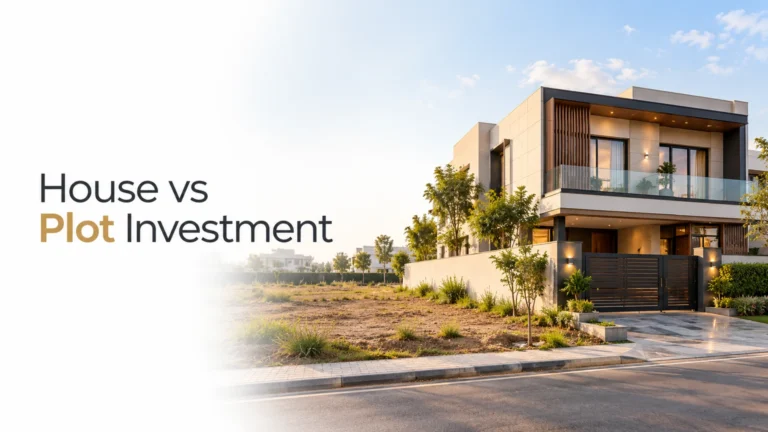
That apparent contradiction is the starting point for this rental property vs plot investment in Pakistan case study. The comparison places the same PKR 130 lacs allocation into two different structures: a Phase 9 Prism plot paid upfront and an approximately one-bedroom equivalent in Goldcrest Mall funded over four years.
Using the values shown in IMLAAK’s One Crore Challenge 2.0 analysis, the plot produces strong nominal PKR growth but no holding-period income. Goldcrest combines staged payments, a higher June 2026 reference valuation and a modeled rental stream beginning in 2022. The resulting gap is substantial in both PKR and USD.
This is Case Study 2 in a wider series, but the comparison here is strictly Phase 9 Prism versus Goldcrest Mall from 2018 through June 2026. Investment dates, exchange rates and reference valuations come from the slides. Rent is explicitly modeled. ROI and annualized returns are calculated outputs—not promises of future performance.
Setting Up a Fair PKR 1.30 Crore Comparison
Both sides begin with an equal allocation of PKR 130 lacs. Phase 9 Prism represents the plot allocation. Goldcrest represents an approximately one-bedroom property equivalent.
This is not a unit-for-unit comparison. Nor does it claim both assets carried an identical official listed price. The presentation is explicit: “The comparison uses equal allocation—not a claim that the two assets had identical listed prices.”
Investors do not choose between equal square footage of fundamentally different products; they decide where to deploy finite capital. Holding the PKR allocation constant isolates the effects of payment timing, currency movement, appreciation and income.
The ending values are June 2026 reference valuations. They are not guaranteed sale proceeds. A marketed value becomes realised wealth only when an exit occurs at an achievable price after transaction costs and taxes.
Investment insight: Equal capital does not create equal economics when the payment dates and income streams are different.
The First Difference Was When the Money Was Paid
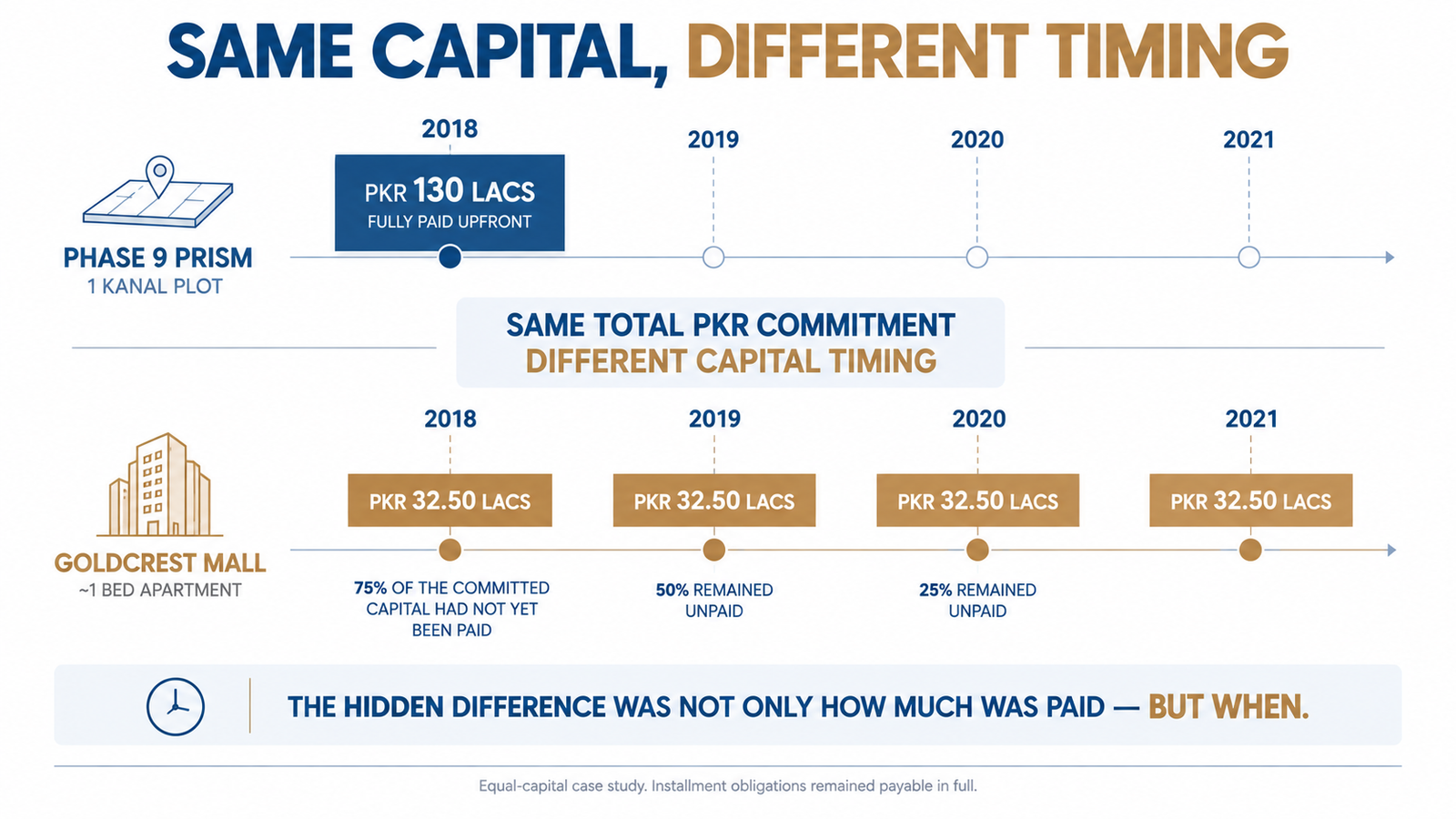
The Phase 9 Prism allocation required the full PKR 130 lacs upfront in 2018. Goldcrest divided the same amount into four payments of PKR 32.50 lacs across 2018, 2019, 2020 and 2021.
The nominal commitment is the same, but the cash-flow profile is not. One investor parts with the entire amount at the beginning; the other releases it over several years.
This matters for two reasons. First, capital that has not yet been paid remains available for other needs, subject to the investor maintaining enough liquidity for future installments. Second, for someone earning abroad, every installment has a different cost in their home currency because the PKR exchange rate changes.
An installment plan can affect capital efficiency and annualized performance. It also creates obligations: missed payments, idle cash or project delays can change the outcome.
How Installments Reduced the USD Capital Requirement
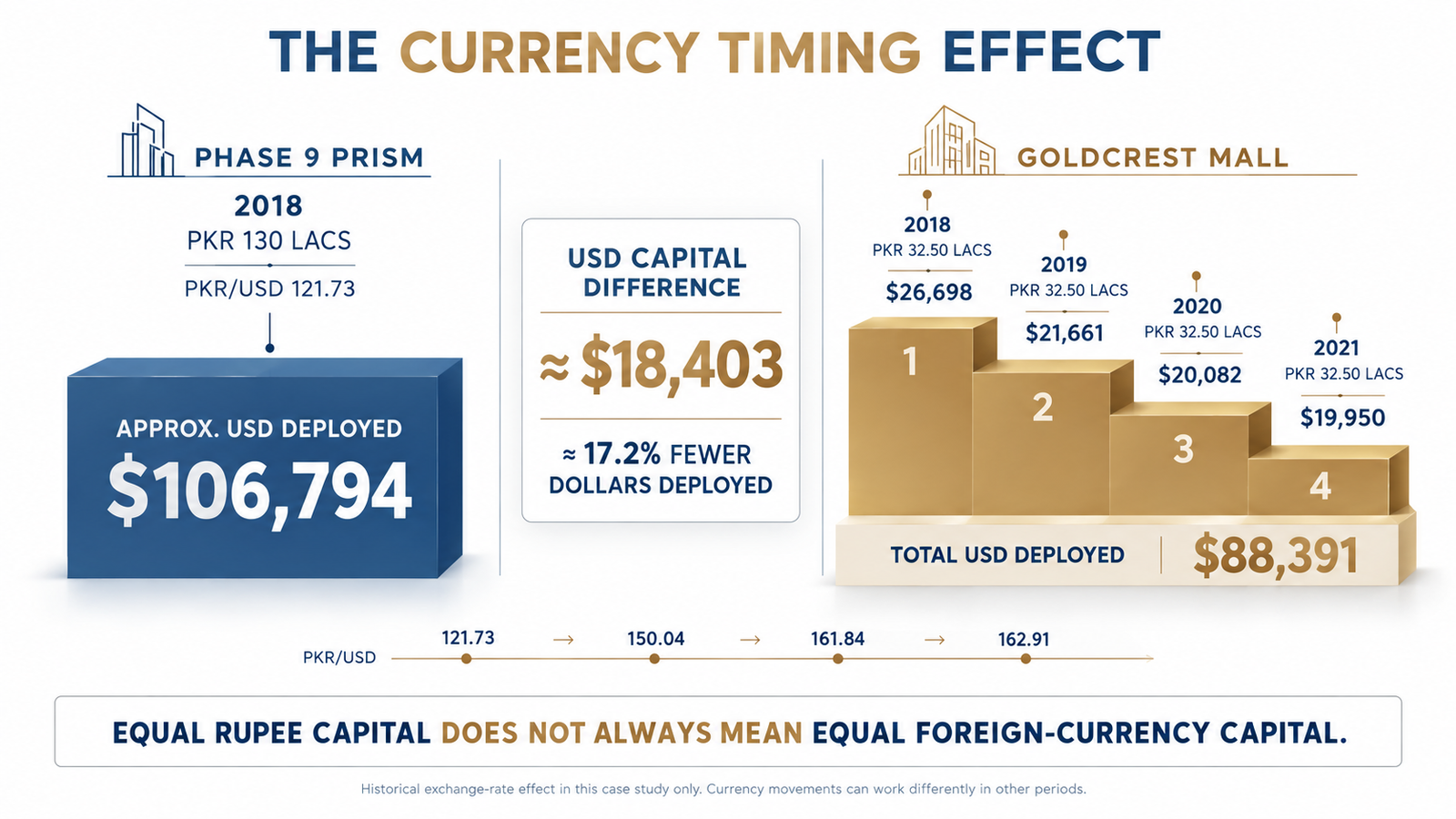
The presentation translates each payment into dollars using the exchange rate assigned to its year.
| Year | Phase 9 Prism payment | Goldcrest payment | PKR/USD | Approx. Goldcrest USD paid |
|---|---|---|---|---|
| 2018 | PKR 130 lacs upfront | PKR 32.50 lacs | 121.73 | $26,698 |
| 2019 | — | PKR 32.50 lacs | 150.04 | $21,661 |
| 2020 | — | PKR 32.50 lacs | 161.84 | $20,082 |
| 2021 | — | PKR 32.50 lacs | 162.91 | $19,950 |
| Total | PKR 130 lacs | PKR 130 lacs | — | $88,391 |
At PKR 121.73 per dollar, the upfront Phase 9 Prism investment represented approximately $106,794 in 2018. Goldcrest’s four installments totalled approximately $88,391 using the annual exchange rates in the table.
The difference is $18,403, or approximately 17.2% fewer dollars deployed for the same PKR allocation.
The speaker describes this rhetorically as earning roughly $20,000 when the decision was made. Financially, that is not realised profit on day one. The more accurate interpretation is that gradual PKR deployment reduced the modeled historical USD funding requirement by $18,403. Goldcrest still had to be completed, valued, rented or sold before an actual investment profit could exist.
The benefit also depended on the direction of the exchange rate. As the rupee weakened from 2018 through 2021, each later PKR 32.50 lacs payment required fewer dollars. A different currency path could have narrowed, removed or reversed that advantage.
Investment insight: The payment schedule is part of the investment return—not merely a financing convenience.
Goldcrest Then Added an Income Stream
The next difference appeared after possession. The transcript places Goldcrest possession and the start of rent in 2022. The speaker also says the referenced market rents could be checked, but the formal presentation still labels the calculation as a model. That label governs how the result should be reported.
A plot that remains undeveloped does not ordinarily generate rent; its return depends mainly on appreciation and exit price. A rentable property can produce appreciation plus income, provided possession, demand, occupancy and management support the expected rent.
Goldcrest therefore becomes a two-component case in this model. Phase 9 Prism remains a one-component case. This is mathematics, not a moral judgment about either asset class.
How PKR 64.48 Lacs of Modeled Rent Was Calculated
The Goldcrest model begins at PKR 100,000 monthly rent in 2022 and applies 10% annual growth. Rent is not reinvested. Only six months are counted in 2026.
| Period | Monthly modeled rent | Annual/period rent |
|---|---|---|
| 2022 | PKR 100,000 | PKR 12.00 lacs |
| 2023 | PKR 110,000 | PKR 13.20 lacs |
| 2024 | PKR 121,000 | PKR 14.52 lacs |
| 2025 | PKR 133,100 | PKR 15.97 lacs |
| Jan–Jun 2026 | PKR 146,410 | PKR 8.78 lacs |
| Total | — | PKR 64.48 lacs |
Under the rental model used in IMLAAK’s case study, Goldcrest accumulates approximately PKR 64.48 lacs of rental income through June 2026. Phase 9 Prism records nil rent.
Goldcrest receives no compounding credit on rental cash. The model also does not separately deduct vacancy, brokerage, service charges, repairs, management expenses or taxes, so actual net rent could differ.
Rental Income Changed the Wealth Equation
Property value and total wealth are not the same measure.
Goldcrest’s June 2026 reference property value is PKR 313.79 lacs. Its modeled total wealth is higher because PKR 64.48 lacs of rent is added, producing PKR 378.27 lacs. Phase 9 Prism has a PKR 250 lacs reference value and no rent, so its property value and total wealth are identical in this calculation.
This illustrates why an income-producing property in Pakistan can behave differently from passive land. Rent does not guarantee superior performance, but it adds another return source while the asset is held.
Investment insight: Rental income can turn a property from a single-engine asset into a two-engine wealth strategy.
Goldcrest Mall vs Phase 9 Prism in PKR
The PKR table presents a clear nominal result.
| Metric | Phase 9 Prism | Goldcrest Mall |
|---|---|---|
| Equal allocation | PKR 130.00 lacs | PKR 130.00 lacs |
| Current/reference value | PKR 250.00 lacs | PKR 313.79 lacs |
| Rent to June 2026 | Nil | PKR 64.48 lacs modeled |
| Total wealth | PKR 250.00 lacs | PKR 378.27 lacs |
| Net profit | PKR 120.00 lacs | PKR 248.27 lacs |
| Total PKR ROI | 92.3% | 191.0% |
| Approx. annualized return | 8.0% | 17.4% |
Phase 9 Prism rises from PKR 130 lacs to PKR 250 lacs. That creates PKR 120 lacs in nominal profit and a 92.3% total PKR ROI. The annualized return shown is approximately 8.0%.
Goldcrest produces PKR 248.27 lacs in modeled profit after combining its reference value and rent. Its total PKR ROI is 191.0%, with an approximate annualized return of 17.4% under the case-study calculation.
The total wealth difference is PKR 128.27 lacs, approximately PKR 1.28 crore, in Goldcrest’s favour. That result should not be reduced to “rent won” or “the apartment price won.” Both components matter.
Where Did the PKR 1.28 Crore Gap Actually Come From?
The difference can be reconciled in three lines.
| Component | Amount |
|---|---|
| Goldcrest’s higher reference valuation | PKR 63.79 lacs |
| Goldcrest’s modeled rent | PKR 64.48 lacs |
| Combined total wealth advantage | PKR 128.27 lacs |
Goldcrest’s property value is PKR 313.79 lacs versus PKR 250.00 lacs for Phase 9 Prism. That is a PKR 63.79 lacs valuation advantage.
Adding PKR 64.48 lacs of modeled rental income creates the full PKR 128.27 lacs gap. Almost half comes from the higher reference value and just over half from rent. The balance between those two drivers is unusually close.
If actual net rent were lower after vacancy and expenses—or the reference valuation could not be achieved on resale—the wealth gap would narrow.
Why 191% ROI and 17.4% Annualized Return Are Different
Simple ROI divides total profit by the original capital. For Goldcrest, PKR 248.27 lacs of modeled profit divided by PKR 130 lacs gives approximately 191.0%. It tells us the total gain relative to the allocation.
It does not show how quickly the gain occurred or when installments were paid. Annualized return expresses performance as an approximate yearly measure and, under the presentation’s methodology, reflects gradual deployment and interim rent.
This is why Goldcrest’s 191.0% total ROI is paired with a 17.4% annualized return rather than dividing 191 by the number of years. Phase 9 Prism reports 92.3% total ROI and approximately 8.0% annualized.
The slides do not label the calculation as IRR or provide exact dated cash flows. It should therefore remain described as annualized return, the term used in the source material.
Investment insight: Headline ROI measures how much; annualized return adds the question of how long and when.
Then the Dollar Comparison Changes Everything
The PKR figures matter to a local investor. For an overseas investor, the same case looks different after translating both the original funding and June 2026 wealth into dollars.
| Metric | Phase 9 Prism | Goldcrest Mall |
|---|---|---|
| USD invested | $106,794 | $88,391 |
| Current/reference property value | $89,986 | $112,949 |
| Rent in USD | Nil | Approx. $24,602 |
| Total USD wealth | $89,986 | $137,551 |
| USD profit/loss | -$16,808 | +$49,160 |
| Total USD ROI | -15.7% | +55.6% |
| Approx. annualized USD return | -2.0% | +6.8% |
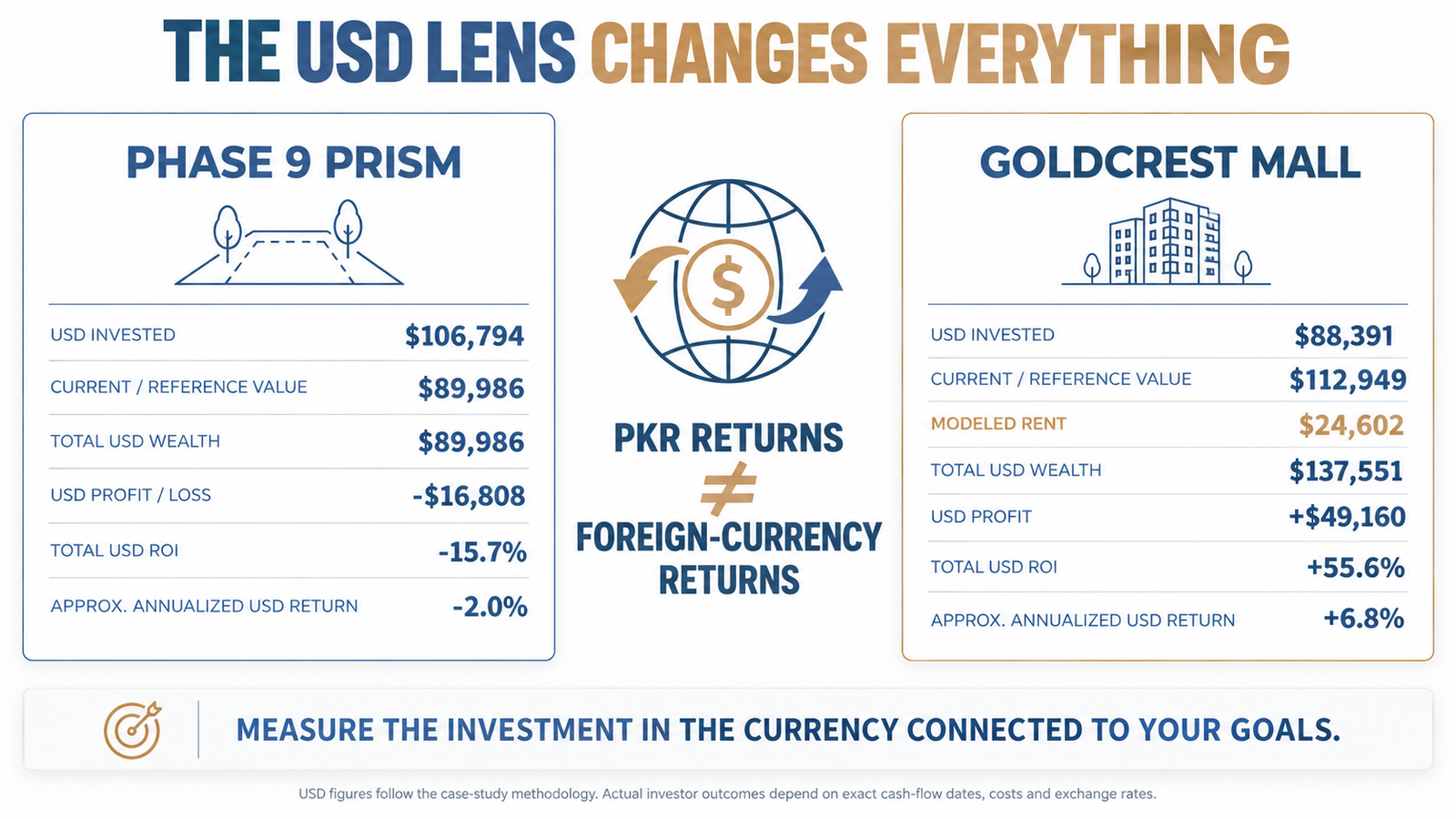
Phase 9 Prism began with a dollar-equivalent investment of $106,794. Its June 2026 reference value converts to $89,986 under the presentation’s exchange-rate treatment. The difference is a $16,808 loss, equivalent to -15.7% total USD ROI and approximately -2.0% annualized.
Goldcrest required $88,391 across four years. Its current property value converts to $112,949, while modeled rent adds approximately $24,602. Total USD wealth reaches $137,551, creating a calculated profit of $49,160, total USD ROI of +55.6% and approximate annualized return of +6.8%.
The contrast is not sensational arithmetic. It is the consequence of using a different unit of measurement and recognising when each cash flow occurred.
How Can a Property Rise in PKR but Lose Value in USD?
Imagine an asset purchased for PKR 100 when one dollar buys PKR 100. The investment costs one dollar. Years later, the asset rises to PKR 180, an 80% nominal gain. But if one dollar now buys PKR 200, the asset is worth only $0.90. It gained rupees while losing ten cents in dollar terms.
Phase 9 Prism follows that broad logic in the case-study model. The allocation rises from PKR 130 lacs to PKR 250 lacs. It did not lose money in PKR. Yet the rupee’s depreciation means the June 2026 value translates into fewer dollars than the 2018 capital originally represented.
PKR vs USD property returns answer different questions. PKR measures local nominal value. USD measures performance against a dollar-based funding or wealth benchmark. Neither should be used without considering the investor’s actual objectives.
Investment insight: An asset can appreciate in PKR and still lose purchasing power in an investor’s home currency.
Why This Matters More to Overseas Pakistanis
Property investment for overseas Pakistanis commonly begins with income earned in USD, GBP, AED, SAR or EUR. Those investors convert foreign currency into rupees, buy a Pakistani asset and may eventually measure the result back in the currency they earn or spend.
They should ask how much foreign currency funded the property, what the current value becomes after reconversion, and what rental cash was worth when received.
USD property returns in Pakistan are useful as a common analytical lens, but everybody need not use dollars. A UAE-based investor may prefer AED; a UK-based family may use GBP. Someone planning future expenses entirely in Pakistan may reasonably prioritise PKR. The benchmark should follow the investor’s liabilities and goals.
Was Goldcrest’s Advantage Only About Currency?
No. Five interacting drivers produced the result.
Staged payments: Goldcrest spread PKR 130 lacs over four years instead of requiring it all in 2018.
Lower historical USD deployment: Rupee depreciation reduced the total dollar cost of later fixed-PKR installments to $88,391.
Capital appreciation: Goldcrest’s June 2026 reference value exceeded Phase 9 Prism’s by PKR 63.79 lacs.
Rental income: The model added PKR 64.48 lacs without reinvesting it.
Cash-flow timing: Capital left the investor gradually, while rent began before the final June 2026 measurement date.
Change any one of those conditions and the return changes. Remove rent, require full payment upfront, delay possession further, lower the exit value or apply operating costs, and Goldcrest’s calculated advantage becomes smaller.
The speaker summarises the argument directly: “The difference is in the strategy.” He follows it with another exact line: “The most important thing in real estate investments is strategy.” The numbers support the relevance of strategy here, but patience and consistency do not remove project-specific risk.
What About Goldcrest’s Delays?
The transcript expressly acknowledges that Goldcrest experienced delay. That fact belongs in the analysis because returns alone do not describe the investor’s full experience.
A delayed project creates construction and developer risk. Capital can remain committed without possession or rent, alternative opportunities may be lost, and uncertain timing can weaken liquidity.
Even after possession, modeled rent is not the same as net cash received. Occupancy, tenant quality, collection, furnishing, repairs, service charges, management costs and taxes can reduce the result. A reference valuation may also take time to achieve if buyer demand is thin or the seller needs a quick exit.
Goldcrest’s strong calculated returns do not erase those risks; they show the outcome under the values and rental model applied through June 2026. A serious Goldcrest Mall Lahore investment review should examine both the result and the path required to reach it.
Rental Property vs Plot Investment in Pakistan: Is One Safer?
Safety and return are different questions. So are liquidity and simplicity.
A plot investment in Pakistan may appeal because there is no tenant to manage, no shared-building service structure and limited day-to-day operating complexity. Land scarcity, infrastructure development or future construction potential can support appreciation. A good Phase 9 Prism investment may also suit someone who wants a long holding period or eventual personal use.
A rental property investment in Pakistan can add cash flow and may offer staged-payment opportunities. Yet it introduces developer execution, possession, occupancy, maintenance and management risk. It is not inherently safe simply because it produces rent.
The useful comparison is the expected return, cash flow, liquidity and risk of a specific asset at a specific price. An apartment vs plot investment decision should follow the investor’s time horizon, currency exposure, income needs and tolerance for delay.
Investment insight: Safety, liquidity and return are three different questions.
The Real Lesson From Case Study 2
Goldcrest Mall vs Phase 9 Prism is valuable because the result cannot be explained by one headline. The same PKR 130 lacs allocation created different wealth because the capital was deployed differently, the rupee moved, the reference valuations diverged and only one asset carried a modeled income stream.
The conclusion is not “buy Goldcrest Mall” today, nor that every plot will underperform. Investment strategy requires a fuller calculation: capital timing, foreign-currency cost, income, realistic value, annualized return and currency-adjusted wealth.
In this historical and modeled rental property vs plot investment in Pakistan comparison, Phase 9 Prism produced PKR 250 lacs of total wealth but a -15.7% USD ROI. Goldcrest produced PKR 378.27 lacs of modeled total wealth and +55.6% USD ROI. Those figures illustrate how nominal appreciation, income and currency-adjusted wealth can tell very different stories.
If you are comparing property investments in Pakistan, IMLAAK can help you look beyond the advertised price to examine capital timing, income potential, currency exposure, project risk and exit liquidity before committing funds.
FAQS
1. Is a rental property better than a plot investment in Pakistan?
Not automatically. Rental property can generate cash flow as well as appreciation, while an undeveloped plot usually relies on a higher future sale price. Rental property also brings developer, possession, vacancy, maintenance and tenant risk; plots may offer simpler ownership and development potential. Goldcrest produced the stronger modeled result here, but it depended on the installment schedule, valuation, rent assumptions and measurement period.
2. Why did Goldcrest Mall outperform Phase 9 Prism in this case study?
Goldcrest benefited from staged payments, lower historical USD deployment, a PKR 63.79 lacs higher June 2026 reference valuation and PKR 64.48 lacs of modeled rent. Total wealth reached PKR 378.27 lacs versus PKR 250 lacs for Phase 9 Prism. This does not prove the result will repeat; it describes IMLAAK’s stated values and rental methodology.
3. How can property make money in PKR but lose money in USD?
A property can rise in rupees while the rupee loses value faster against the dollar. Phase 9 Prism increased from PKR 130 lacs to PKR 250 lacs, producing a positive nominal PKR return. However, the original allocation represented $106,794 in 2018, while the June 2026 reference value converted to $89,986 under the case study. It therefore showed a $16,808 currency-adjusted loss even though its PKR value increased.
4. Why do installment plans affect real estate investment returns?
Installments change when capital leaves the investor and, for overseas buyers, the exchange rate applied to each payment. In this case, paying PKR 32.50 lacs annually from 2018 through 2021 required approximately $88,391. Paying the full PKR 130 lacs in 2018 represented $106,794. Installments reduced the modeled dollar requirement because the rupee depreciated. This advantage is not guaranteed: exchange rates can move differently, and future-payment obligations and project delays create additional risk.
5. Why should overseas Pakistanis calculate property returns in foreign currency?
Overseas investors often fund Pakistani property from USD, GBP, AED, SAR or EUR income. Measuring only PKR appreciation can hide whether the investment preserved or increased wealth in the currency that originally funded it. Investors should compare the foreign currency converted at purchase, later installments, income received and current exit value. The correct benchmark is not always USD; it should reflect where the investor earns, spends and expects to use the money.
Shahnawaz Yaqub Bhatti
Investment Consultant and CEO at Imlaak
- Mobile: +92 300 3343336 (WhatsApp)
- Mobile: +92 333 1616160 (WhatsApp)
[fc id=’19’ align=’left’][/fc]