
This capital-efficient property investment in Pakistan case study begins with two investors allocating the same PKR 1.70 crore in 2022. One deploys the full amount upfront into a Phase 9 Prism plot. The other deploys the same nominal PKR allocation over five years into an approximately 630 sq ft serviced apartment at Sixty6 Gulberg.
By June 2026, neither investment has contributed a single rupee of rent to this comparison. Yet their capital requirements and calculated returns look strikingly different. The plot required approximately $82,979 upfront. The staged Sixty6 allocation required approximately $65,255 across 2022–2026.
How can the same PKR 170 lakh represent two different dollar investments?
That question sits at the centre of this capital-efficient property investment in Pakistan case study—the fourth and final comparison in IMLAAK’s One Crore Challenge 2.0 series. It is what happens when capital timing, currency movement and valuation interact.
The figures below use the payment schedule, exchange rates and June 2026 reference valuations shown in IMLAAK’s presentation. The Sixty6 results are modeled. They should not be confused with guaranteed returns or cash already realised through a sale.
Phase 9 Prism vs Sixty6 Gulberg: The Setup
The comparison begins in 2022 with an equal nominal allocation of PKR 170 lakh on each side. Phase 9 Prism receives the whole amount upfront. Sixty6 Gulberg receives five modeled annual payments of PKR 34 lakh from 2022 through 2026.
The Sixty6 property equivalent is an approximately 630 sq ft serviced apartment. That does not make it physically equivalent to a plot, nor does it mean the assets had identical official list prices. For anyone assessing a Sixty6 Gulberg investment, this is an equal-capital comparison of what the same nominal PKR allocation produced under two payment structures.
The end point is June 2026. At that date, the case study treats Sixty6 as nearing completion and records no rental income for either asset. Its current results therefore come from capital appreciation and deployment efficiency only.
Investment insight: “The same PKR price can represent a very different foreign-currency investment depending on when the payments are made.”
The Same PKR 1.70 Crore Was Not the Same Dollar Investment
In PKR terms, both allocations total PKR 170 lakh. In USD terms, they are not equal because the rupee-dollar rate changed while the installments were being paid.
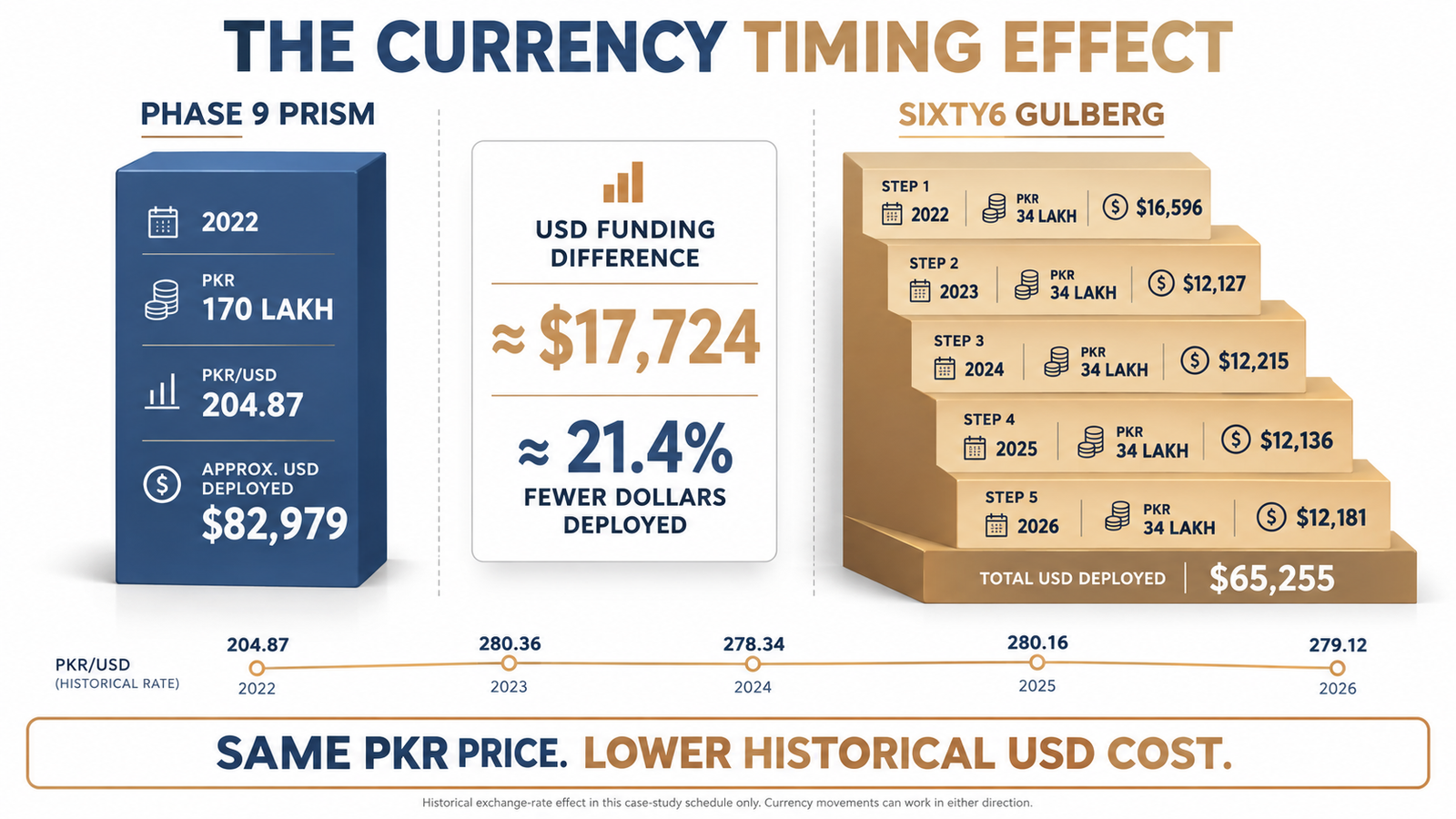
The Phase 9 Prism buyer committed PKR 170 lakh in 2022 at the exchange rate used in the presentation: PKR 204.87 to the dollar. That produces a historical USD capital requirement of approximately $82,979.
The Sixty6 buyer committed only PKR 34 lakh at that 2022 rate. Later PKR 34 lakh installments were modeled at rates between PKR 278.34 and PKR 280.36 per dollar. Because each dollar bought more rupees in those later years, fewer dollars were required to fund the same PKR installment.
This is not a claim that PKR depreciation is automatically good. Currency weakness can damage purchasing power and reduce foreign-currency returns. In this specific payment schedule, however, an overseas investor did not convert the entire amount into PKR on day one. That materially lowered the historical dollar cost of completing the nominal allocation.
How Sixty6 Used 21.4% Fewer Dollars
| Year | Phase 9 Prism payment | Sixty6 payment | PKR/USD | Approx. Sixty6 USD paid |
|---|---|---|---|---|
| 2022 | PKR 170 lakh upfront | PKR 34 lakh | 204.87 | $16,596 |
| 2023 | — | PKR 34 lakh | 280.36 | $12,127 |
| 2024 | — | PKR 34 lakh | 278.34 | $12,215 |
| 2025 | — | PKR 34 lakh | 280.16 | $12,136 |
| 2026 | — | PKR 34 lakh | 279.12 | $12,181 |
| Total | PKR 170 lakh | PKR 170 lakh | — | $65,255 |
The plot’s full 2022 allocation required approximately $82,979. Sixty6’s five staged payments required approximately $65,255. The difference is $17,724, or about 21.4% fewer dollars under the case-study schedule.
That $17,724 is not instant profit. It was not a bonus paid to the investor, and it was not a capital gain realised through resale. It is the difference between two historical USD funding requirements for the same nominal PKR 170 lakh allocation.
Calling it profit would confuse cost-base efficiency with investment performance. Its real importance is that it gave Sixty6 a lower modeled USD cost base before the June 2026 valuation was considered.
Why the Rupee’s Movement Changed the Cost of Investment
The arithmetic is simple. In 2022, PKR 34 lakh divided by 204.87 required approximately $16,596. In 2023, the same PKR 34 lakh divided by 280.36 required approximately $12,127.
The PKR installment did not shrink. Its dollar cost did.
For an investor earning in USD, that is a reduction of roughly $4,469 on one annual installment. The same principle can apply to investors earning in GBP, AED, SAR or EUR, although each investor should calculate performance in the currency that actually matters to their household, savings and future liabilities.
This is why a property payment plan should be analysed as more than a convenience. The schedule can change currency exposure, opportunity cost and annualized performance. But it can also extend construction exposure and delay the point at which the asset becomes usable or income-producing.
Investment insight: “A payment schedule is part of the investment economics—not merely an easier way to pay.”
No Rental Income Is Included
The strongest safeguard against overstating this case is also the simplest: do not add rent that had not started.
| Rental status | Phase 9 Prism | Sixty6 Gulberg |
|---|---|---|
| Income status | No income | Nearing completion |
| Rent to June 2026 | Nil | Nil |
| Rent included in returns | Nil | Nil |
| Future potential | Needs development | Serviced rentals |
| Rent reinvested | No | No |
The Phase 9 Prism plot produced no rent in the comparison. Sixty6 also produced no rent through June 2026. Although the serviced-apartment model may have future rental potential, projected income is irrelevant to the current calculation.
No assumed occupancy, nightly rate, rental guarantee or post-possession yield has been added. That distinction matters because a serviced apartment investment Pakistan buyer may ultimately evaluate both capital growth and operating income, but Case Study 4 measures only what can be compared at the stated date.
Investment insight: “Future rent should not be counted as present performance.”
What Happened to PKR 1.70 Crore?
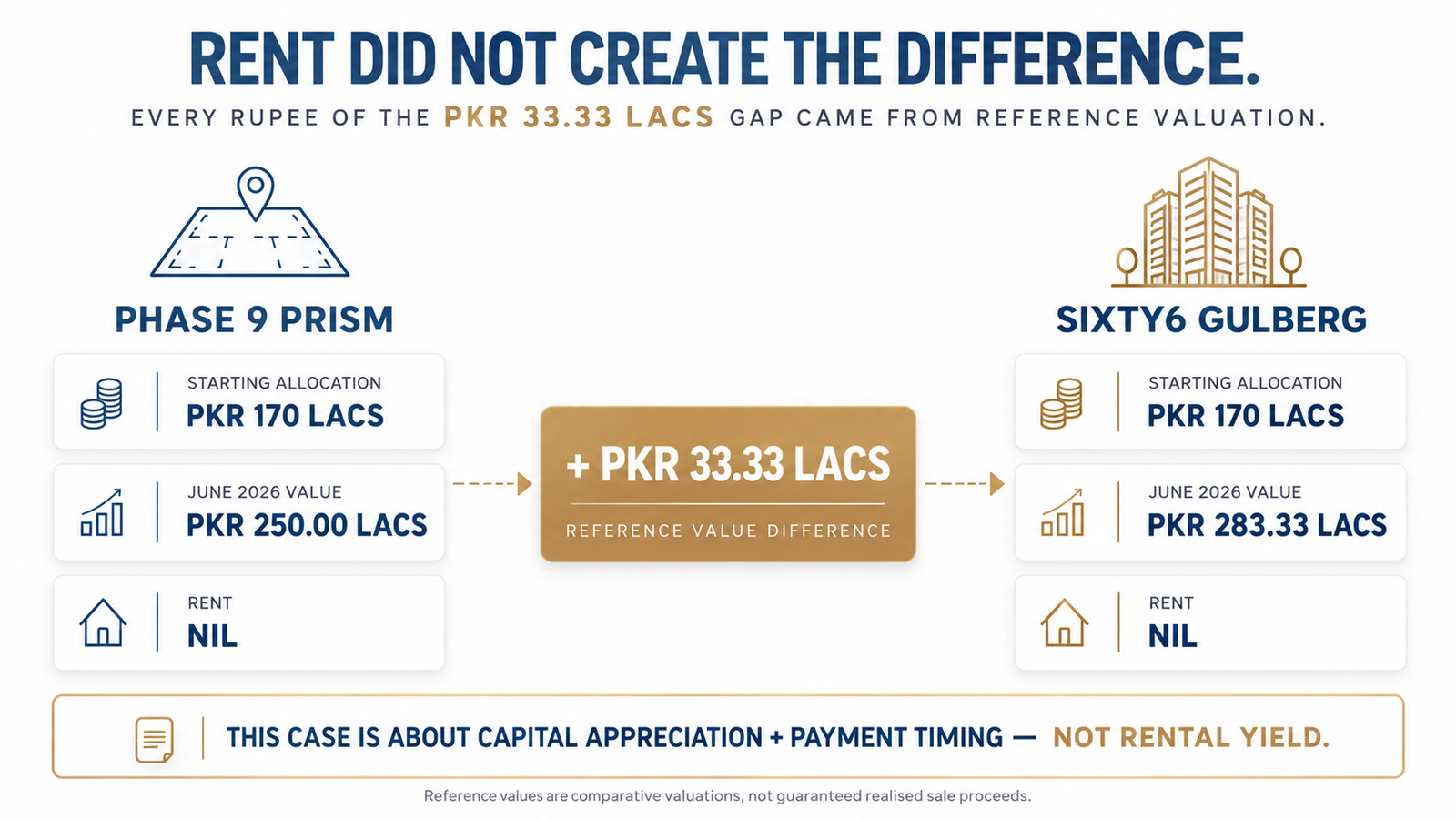
Once the payment schedules are understood, the analysis moves to valuation. Using the June 2026 reference figures, Phase 9 Prism is valued at PKR 250.00 lakh while Sixty6 Gulberg is valued at PKR 283.33 lakh.
The nominal difference is PKR 33.33 lakh. Because rental income is nil on both sides, every rupee of that gap comes from the reference property values—not rent, reinvestment or an income forecast.
That makes this a cleaner capital comparison than a case where one asset has already been collecting rent. It also makes the exit caveat more important: valuation wealth is not the same as cash received from a completed resale.
Phase 9 Prism vs Sixty6 Gulberg in PKR
| Metric | Phase 9 Prism | Sixty6 Gulberg |
|---|---|---|
| Equal allocation | PKR 170.00 lakh | PKR 170.00 lakh |
| June 2026 value | PKR 250.00 lakh | PKR 283.33 lakh |
| Rental income | Nil | Nil |
| Total wealth | PKR 250.00 lakh | PKR 283.33 lakh |
| Net capital profit | PKR 80.00 lakh | PKR 113.33 lakh |
| Total PKR ROI | 47.1% | 66.7% |
| Annualized return | Approx. 9.0% | Approx. 21.0% |
On a simple PKR basis, Phase 9 Prism grows from PKR 170 lakh to PKR 250 lakh. That is a PKR 80 lakh capital profit and a 47.1% total return. It is a positive result—not evidence that the plot “failed.”
Sixty6 grows from the same nominal allocation to PKR 283.33 lakh. Its calculated capital profit is PKR 113.33 lakh and its total PKR ROI is 66.7%.
The result is stronger in this model, but the source of the difference must remain clear. Sixty6 has a PKR 33.33 lakh higher reference value and a staged capital schedule. It does not have a rental advantage in the current numbers.
Why a PKR 33.33 Lakh Gap Produced a Much Larger Annualized Difference
At first glance, PKR 250 lakh versus PKR 283.33 lakh may not look large enough to explain annualized returns of approximately 9.0% versus 21.0%. The reason is that annualized performance asks a different question from the final valuation gap.
The Phase 9 Prism allocation was fully exposed from 2022. All PKR 170 lakh was committed at the beginning of the period.
Under the Sixty6 schedule, only PKR 34 lakh was modeled in each year. A substantial share of the capital entered later, including the final installment in 2026. The full nominal PKR 170 lakh therefore was not tied up for the full comparison period.
The presentation’s approximate annualized return accounts for that timing. It is not simply the 66.7% total ROI divided by four or five years. Nor should it casually be labelled IRR without reproducing and verifying the exact cash-flow calculation as an internal-rate-of-return model. The slide uses “annualized return,” and that is the appropriate term here.
Investment insight: “Annualized return measures a different question from headline appreciation: how effectively capital worked over time.”
Why Total ROI and Annualized Return Tell Different Stories
Total ROI compares the overall gain with the nominal allocation: 47.1% for Phase 9 Prism and 66.7% for Sixty6. Annualized return adds the time dimension, making it especially useful when comparing an upfront purchase with a staged asset.
A serious real estate ROI Pakistan analysis should consider both rather than choosing whichever percentage looks more impressive.
The USD Comparison Is Where the Gap Becomes Larger
The PKR table shows a meaningful valuation advantage. For readers comparing USD property returns in Pakistan, the next table shows how that advantage combines with the lower historical capital base.
| Metric | Phase 9 Prism | Sixty6 Gulberg |
|---|---|---|
| USD invested | $82,979 | $65,255 |
| Current value | $89,986 | $101,984 |
| Rental income | Nil | Nil |
| Total USD wealth | $89,986 | $101,984 |
| USD profit | $7,007 | $36,729 |
| Total USD ROI | 8.4% | 56.3% |
| Annualized return | Approx. 1.8% | Approx. 17.3% |
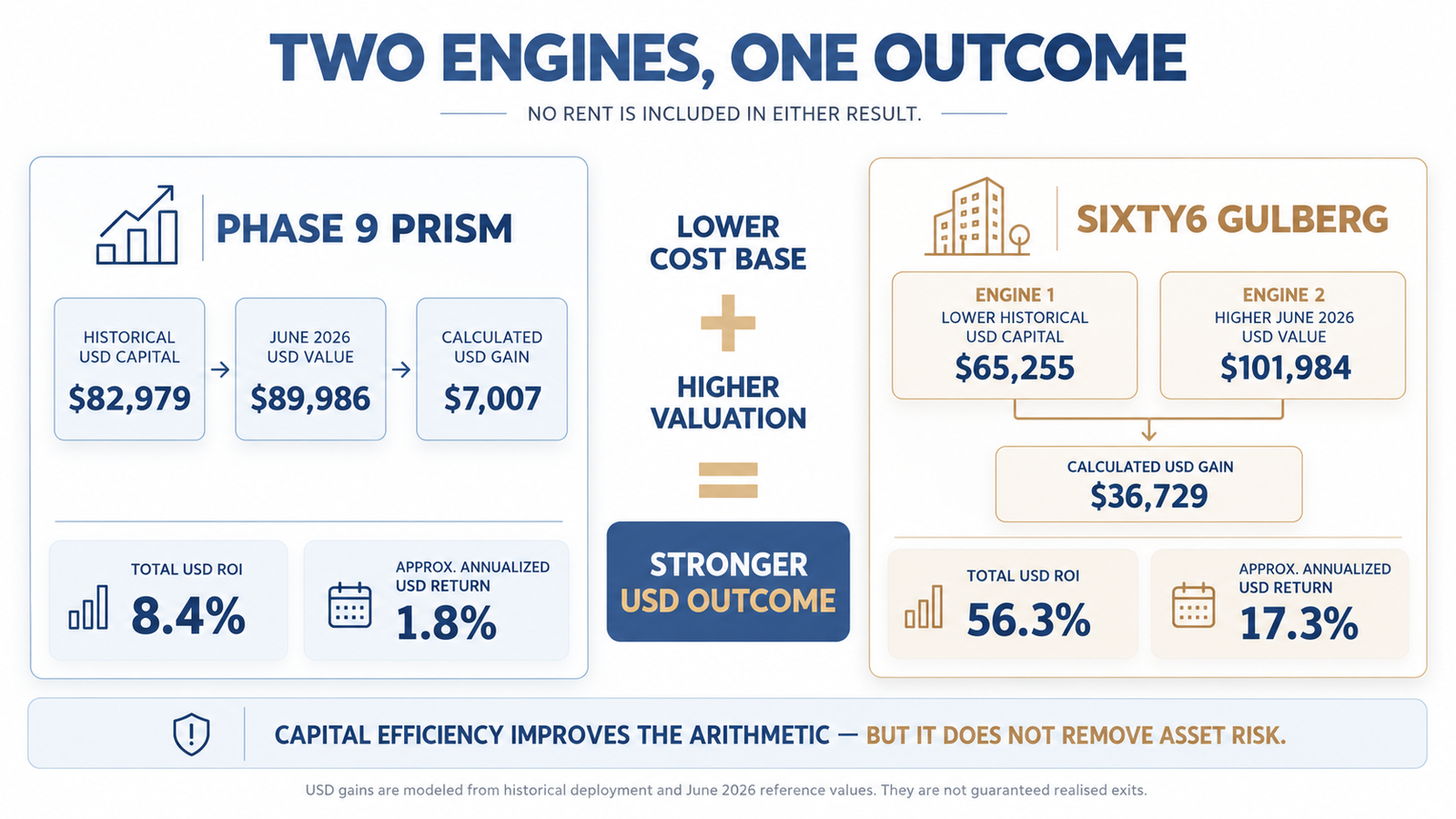
Phase 9 Prism’s modeled USD value rises from $82,979 to $89,986. The calculated gain is $7,007, producing an 8.4% total USD ROI and an approximate 1.8% annualized USD return.
Sixty6’s historical USD deployment is $65,255 and its June 2026 reference value is $101,984. The calculated difference is $36,729, producing a 56.3% total USD ROI and an approximate 17.3% annualized USD return.
No rent appears in either result. In IMLAAK’s model, Sixty6’s stronger USD outcome comes from the interaction of lower historical dollar deployment and a higher June 2026 dollar-equivalent valuation.
$7,007 vs $36,729: What Actually Created the Difference?
There are two return engines in the USD calculation, and neither is rent. Sixty6 begins with a $17,724 lower historical USD cost base and carries a $101,984 reference value, compared with $89,986 for Phase 9 Prism.
Together, those forces widen the profit gap:
| USD return driver | Phase 9 Prism | Sixty6 Gulberg |
|---|---|---|
| Historical USD capital | $82,979 | $65,255 |
| June 2026 USD value | $89,986 | $101,984 |
| Calculated USD gain | $7,007 | $36,729 |
The lower cost base is powerful because return is measured against the capital actually deployed. But it cannot rescue a project whose valuation collapses, whose completion fails or whose units cannot be sold. Capital efficiency improves the arithmetic; it does not eliminate asset risk.
Why Overseas Pakistanis Should Pay Attention to Capital Deployment
An overseas Pakistani property investment may be funded from USD, GBP, AED, SAR or EUR. For that investor, “the property cost PKR 1.70 crore” is incomplete. The better questions are how much of the earning currency was converted, when it was converted, what the property is worth in that currency and whether an exit near the reference value is realistic.
There is no universal benchmark. A PKR earner may prioritise domestic purchasing power; a Dubai-based buyer may prefer AED and a US-based investor may use USD.
A PKR vs USD property returns analysis does not erase rupee growth. It tests whether the investment also increased wealth in the currency from which the capital originated.
But 56.3% Is a Modeled Return—Not a Guaranteed Exit
The Sixty6 slide contains an essential qualification:
“The result is modeled and remains subject to possession, actual rent and resale liquidity.”
The 56.3% USD ROI and approximate 17.3% annualized USD return use the supplied June 2026 reference valuation. Until an investor sells and receives the proceeds, the gain is not realised cash.
Negotiated price, buyer demand, charges, taxes, possession and the time required to find liquidity can all change the outcome. The same caution applies to Phase 9 Prism: neither reference value is a guaranteed exit price.
Investment insight: “A modeled gain becomes a realised gain only when an investor can exit at an achievable net price.”
What About Sixty6’s Delay?
The transcript acknowledges an approximately 6–8 month delay. That can postpone possession, personal use and serviced rentals while extending construction, developer and opportunity-cost exposure.
It answers a narrower question: despite the delay, what did the payment schedule and June 2026 reference valuation produce mathematically?
Investors must still assess construction progress, contractual protections and the route to possession.
What About Escalation Charges?
The speaker states that some early Sixty6 investors faced escalation and that it was incorporated into the comparison, whose total remains PKR 170 lakh. No separate escalation amount appears on the slides, so none should be invented.
The broader lesson for an apartment investment Lahore payment plan is to measure return against full economic cost—not merely an early brochure price. Any charges outside the model can change the net result.
Capital-Efficient Property Investment in Pakistan Does Not Remove Risk
Five-year installments can lower upfront pressure and, in this historical currency path, reduce the dollar cost. They also extend project exposure.
Before treating a Gulberg Lahore property investment as capital-efficient, an investor should test:
- whether construction and completion are credible;
- whether installment dates match realistic cash flows;
- whether escalation clauses are understood;
- whether possession can be documented;
- whether service and maintenance charges are sustainable;
- whether the serviced-rental operator can generate demand; and
- whether resale liquidity and net exit proceeds are realistic.
The attractive spreadsheet outcome and delivery risk exist at the same time.
Does This Mean Sixty6 or Installment Property Will Always Outperform?
No. An installment structure creates a different capital path, not an automatic winner. A stronger rupee could make later payments costlier in foreign currency; underperformance, delays, escalation or weak resale demand could reduce the advantage.
The result depends on entry value, payment terms, exchange rates, execution, possession, expenses and exit. This historical/modelled comparison does not establish that every installment property investment Pakistan buyers encounter will beat an upfront plot.
Plot for a Home vs Plot as an Investment
A plot bought for a future home serves a different purpose from an asset purchased only for return. Control, land ownership, design freedom and neighbourhood preference cannot be reduced to annualized ROI. As an investment, a plot may also offer simpler ownership, no tenant management and familiar resale channels.
A serviced apartment offers a different proposition: staged payments and future income potential alongside construction, furnishing, operator, vacancy and service-charge risks.
The right question is which structure fits the investor’s objective, currency, time horizon, risk tolerance and need for liquidity.
The Real Lesson From Case Study 4
Case Study 4 does not need future rent to make its central point. The same PKR 170 lakh nominal allocation required $82,979 when deployed upfront into Phase 9 Prism and $65,255 when staged across five modeled Sixty6 payments. That lower dollar cost base then interacted with a higher June 2026 reference valuation.
The resulting figures favour Sixty6 in this historical/modelled comparison: PKR 283.33 lakh versus PKR 250.00 lakh in total wealth, and 56.3% versus 8.4% in total USD ROI.
Yet Sixty6’s result remains subject to possession, resale liquidity, actual transaction value and expenses. Its 6–8 month delay and acknowledged escalation context cannot be erased by an attractive percentage.
The broader lesson for capital-efficient property investment in Pakistan is straightforward: the price matters, but when the capital is deployed can matter just as much. Investors should examine every payment date, the foreign currency actually committed, the source of the return, completion risk and the path to a real exit.
If you are comparing an upfront purchase with a staged property investment, IMLAAK can help you examine the payment structure, currency exposure, project risk and exit economics before capital is committed.
11. FAQS
1. Is Sixty6 Gulberg a good property investment in Lahore?
This case study does not support a universal yes-or-no recommendation. Under IMLAAK’s stated methodology, Sixty6’s PKR 170 lakh staged allocation required $65,255 and reached a June 2026 reference value of $101,984, producing a modeled 56.3% USD ROI before rent.
Investors must still assess possession, the acknowledged delay, escalation terms, service charges, resale demand, taxes and the achievable exit price. The supplied valuation is not a guaranteed sale price, and future serviced-rental income has not been included or guaranteed.
2. How do installment plans affect property investment returns in Pakistan?
Installment plans spread capital across time. If exchange rates move, the foreign-currency cost of later PKR payments can differ significantly from the cost of paying the entire amount upfront.
Staged deployment can also improve annualized returns because not all capital is tied up for the full holding period. The trade-off is longer exposure to construction, completion, escalation and possession risk. An installment plan should therefore be evaluated as part of the investment economics, not assumed to be beneficial in every project or currency cycle.
3. Why did Sixty6 Gulberg require fewer dollars than Phase 9 Prism?
Phase 9 Prism’s full PKR 170 lakh allocation was modeled upfront in 2022 at PKR/USD 204.87, equal to $82,979. Sixty6’s PKR 170 lakh was divided into five PKR 34 lakh payments from 2022 to 2026.
Later installments were converted at rates near PKR 278–280 per dollar, so fewer dollars funded each PKR payment. Total modeled USD deployment was $65,255—$17,724, or 21.4%, lower. This was a funding difference, not instant or realised profit.
4. How did Sixty6 show a 56.3% USD ROI before rental income?
The calculation uses capital appreciation and deployment efficiency only. Sixty6’s modeled historical USD cost was $65,255, while its June 2026 reference value converted to $101,984.
The $36,729 difference equals a 56.3% total USD ROI under the supplied methodology. No rental income was added. The result remains modeled because the reference value is not necessarily a completed sale price; possession, buyer demand, transaction costs, taxes and resale liquidity can change the amount ultimately realised.
5. What are the risks of a capital-efficient property investment in Pakistan before possession?
Key risks include construction delays, non-completion, developer execution, escalation charges, changing specifications, delayed rental commencement and limited resale liquidity.
Serviced apartments add operating questions such as furnishing cost, service charges, operator quality, occupancy and tenant demand. Currency movements can also work against an investor rather than in their favour. Capital efficiency describes how effectively money is deployed; it does not guarantee delivery or profit. Investors should review contracts, payment milestones, approvals, construction progress, total costs and realistic exit demand before committing capital.
Shahnawaz Yaqub Bhatti
Investment Consultant and CEO at Imlaak
- Mobile: +92 300 3343336 (WhatsApp)
- Mobile: +92 333 1616160 (WhatsApp)
[fc id=’19’ align=’left’][/fc]