
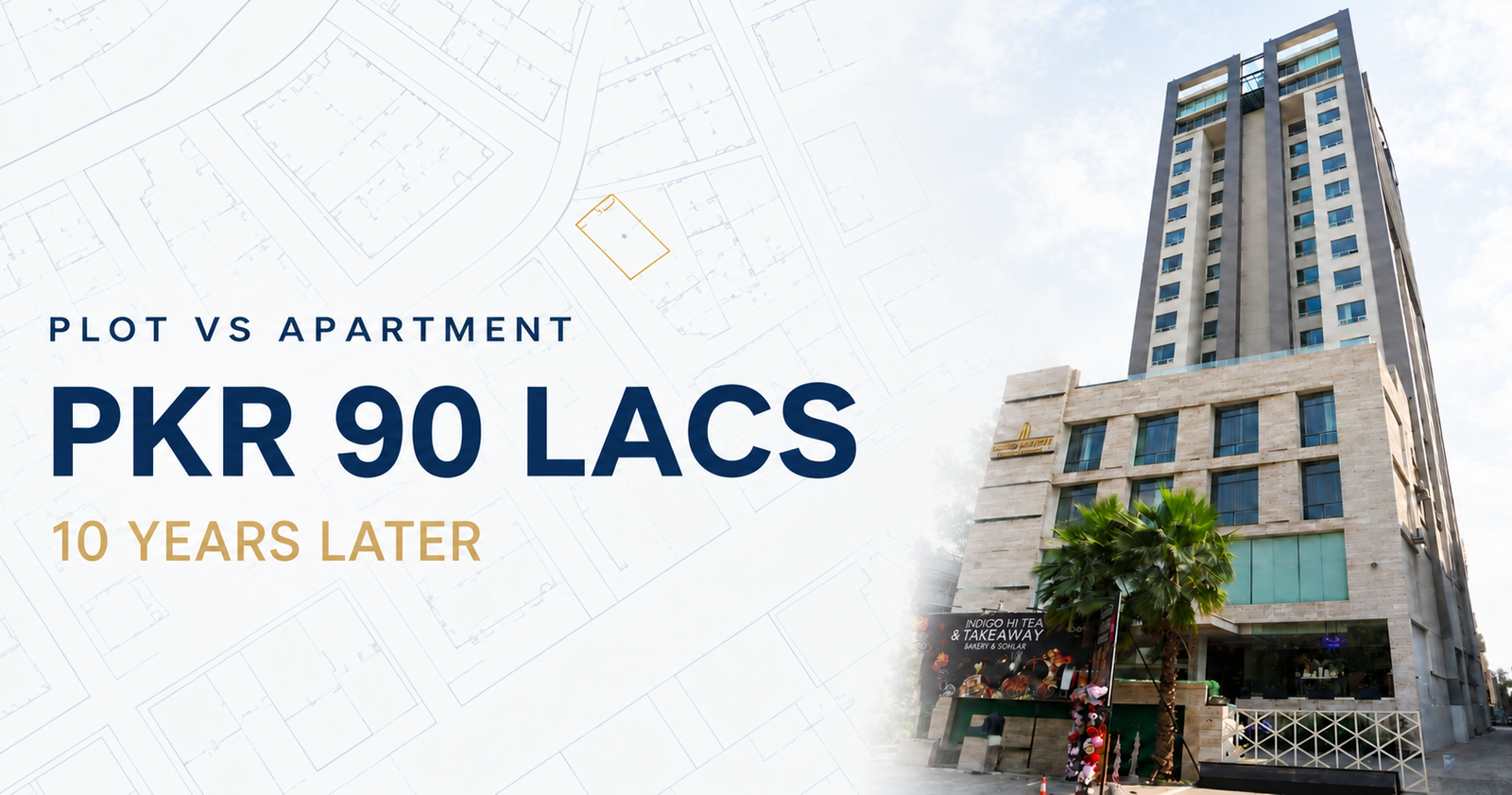
If two investors allocated the same PKR 90 lacs in 2016, why might they reach June 2026 with dramatically different wealth? That is the question behind this plot vs apartment investment in Pakistan case study. One investor acquired a fully paid one-kanal plot in DHA Phase 9 Prism. The other committed the same rupee amount to an approximately 600-square-foot apartment in Indigo Heights Lahore, paid through installments.
At first glance, the comparison seems to be about which property rose more in price. It is not. The more revealing differences are when the capital left the investor’s hands, how rupee depreciation affected an investor earning foreign currency, and whether the asset produced income while it was held.
This is Case Study 1 in IMLAAK’s One Crore Challenge 2.0 series. The purchase periods and reference valuations are historical components of the analysis. The rental schedule, however, is explicitly a model: it begins in 2021 at PKR 75,000 per month, grows by 10% annually and assumes no reinvestment.
Keeping those categories separate allows us to preserve the real-world spirit of the comparison without presenting modeled cash flow as independently verified rent received.
Phase 9 Prism vs Indigo Heights: Setting Up the Comparison
The starting allocation is PKR 90 lacs on each side. In Phase 9 Prism, the analysis uses a one-kanal plot with development charges paid. For Indigo Heights, it uses the same total capital allocation and an apartment equivalent of approximately 600 square feet.
That is an equal-capital comparison, not a claim that a plot and an apartment are physically comparable products. A kanal of land and 600 square feet in a high-rise serve different purposes and carry different risks. Equalising the amount committed is useful because investors ultimately allocate money, not square feet. The question is what happened to the same PKR budget under two different asset structures.
The measurement period runs from 2016 to June 2026. The model counts appreciation for both assets. It adds modeled rental income only to Indigo Heights because the plot produced no rent during the holding period. No rent is reinvested, so the apartment is not being credited with compounding rental proceeds.
Key takeaway: A fair investment comparison begins with equal capital, then follows when that capital was paid and what it produced.
The First Difference Was Not Price—It Was Payment Timing
Phase 9 Prism required PKR 90 lacs upfront in 2016. Indigo Heights required the same PKR 90 lacs in four annual tranches of PKR 22.50 lacs from 2016 through 2019.
For a rupee-based investor who already held all the capital, both commitments still add up to PKR 90 lacs. Yet their cash-flow profiles are not identical. The plot tied up the full amount immediately. The apartment left three-quarters of the capital with the investor after the first payment, half after the second and one-quarter after the third, subject to the obligation to meet every later installment.
The difference becomes more visible when the payments are translated into dollars at the exchange rates used in the presentation.
| Year | Phase 9 Prism payment | Indigo Heights payment | PKR/USD | Approx. USD paid for Indigo |
|---|---|---|---|---|
| 2016 | PKR 90.00 lacs upfront | PKR 22.50 lacs | 104.76 | $21,478 |
| 2017 | — | PKR 22.50 lacs | 105.45 | $21,337 |
| 2018 | — | PKR 22.50 lacs | 121.73 | $18,484 |
| 2019 | — | PKR 22.50 lacs | 150.04 | $14,996 |
| Total | PKR 90.00 lacs | PKR 90.00 lacs | — | $76,295 |
At the 2016 rate, the upfront plot allocation equalled approximately $85,911. Indigo’s first two installments had a broadly similar dollar cost, but the rupee weakened materially by the third and fourth payments. Consequently, each later PKR 22.50 lacs installment required fewer dollars.
This does not make installments free money. The investor accepted project, construction and payment-completion risk. A local investor whose capital remained in cash could also have suffered inflation or opportunity cost. But the timing effect is real: equal rupee totals need not represent equal foreign-currency capital.
Investment insight: The hidden difference is not only what you paid, but when you paid it.
PKR 90 Lacs Was Not the Same Amount in Dollars
The Phase 9 Prism investor deployed approximately $85,911 upfront. Across four years, the Indigo Heights investor deployed approximately $76,295. The gap is about $9,616, meaning the apartment required roughly 11.2% fewer dollars to fund the same PKR 90 lacs allocation.
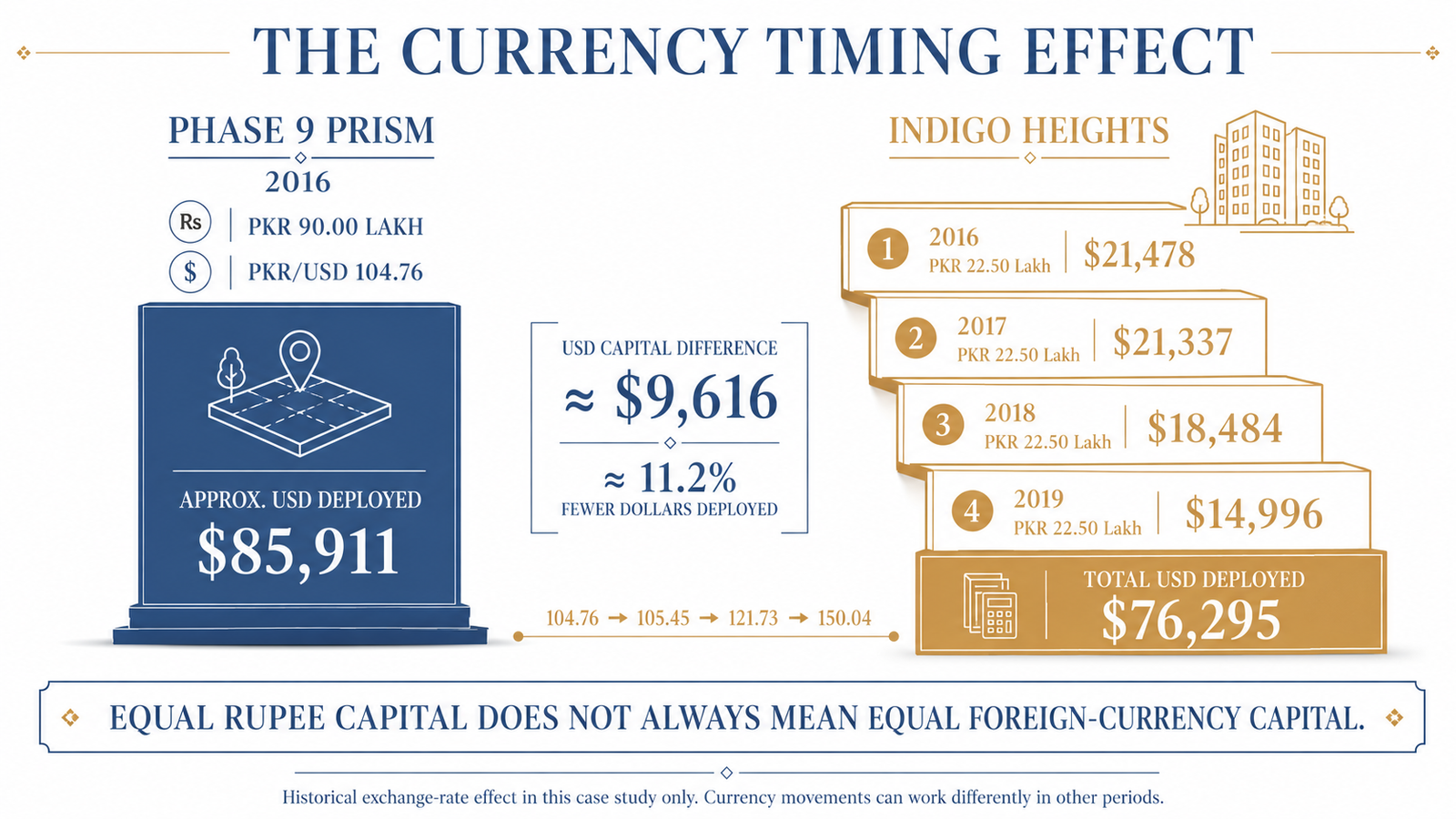
This distinction is especially relevant to overseas Pakistanis. Someone earning in USD, GBP, AED, SAR or EUR does not experience a Pakistani installment plan purely in rupees. Each remittance has a cost in the currency in which that investor earns, saves and measures purchasing power.
An upfront purchase locks in the full conversion at the opening exchange rate. Staged payments spread that currency conversion across several years. In this historical period, rupee depreciation reduced the foreign-currency cost of the later installments.
In a different currency cycle, the effect could be smaller or could move in the opposite direction. The lesson is not that delayed payment must always win; it is that capital timing belongs inside the return calculation.
The Second Difference: One Asset Could Produce Income
A vacant plot normally relies on capital appreciation until it is developed, sold or put to an income-generating use. A completed and occupied apartment can potentially create two return streams: a change in market value and rent.
“Potentially” matters. An apartment does not generate rent merely because it exists. Possession, habitability, tenant demand, occupancy, management, maintenance and collection all affect what the owner actually receives.
For this case study, IMLAAK uses a rental property investment Pakistan model rather than claiming an independently audited rent ledger.
The model starts rent in 2021 at PKR 75,000 per month—equivalent to PKR 9 lacs for the first year, or 10% of the original PKR 90 lacs allocation. It then increases monthly rent by 10% annually. For 2026, only January through June is counted.
| Period | Modeled monthly rent | Modeled rent received |
|---|---|---|
| 2021 | PKR 75,000 | PKR 9.00 lacs |
| 2022 | PKR 82,500 | PKR 9.90 lacs |
| 2023 | PKR 90,750 | PKR 10.89 lacs |
| 2024 | PKR 99,825 | PKR 11.98 lacs |
| 2025 | PKR 109,808 | PKR 13.18 lacs |
| Jan–Jun 2026 | PKR 120,788 | PKR 7.25 lacs |
| Total | — | PKR 62.19 lacs |
Under the rental model used in IMLAAK’s case study, cumulative rent through June 2026 reaches approximately PKR 62.19 lacs. The calculation assumes consistent 10% annual rental growth and does not reinvest the rent.
It also does not show deductions for vacancy, maintenance, service charges, taxes or collection costs. Readers should therefore treat it as a stated model, not a guaranteed net-income record.
Phase 9 Prism records nil rent in the comparison.
How PKR 62.19 Lacs of Modeled Rent Changes the Picture
Without rent, the difference in reference market value is modest relative to the original capital. Phase 9 Prism is valued at PKR 250 lacs and Indigo Heights at PKR 270 lacs—a PKR 20 lacs lead for the apartment.
Once the modeled rent is included, Indigo’s total wealth rises to PKR 332.19 lacs. Its advantage over the plot expands to PKR 82.19 lacs. That is why rental income vs capital appreciation is more than a debate about receiving a monthly cheque. Income becomes part of total wealth creation, even when it is withdrawn and never reinvested.
Capital gain and total return should not be confused. The apartment’s capital gain is the movement from PKR 90 lacs to PKR 270 lacs. Its modeled total outcome also includes PKR 62.19 lacs of cumulative rent.
The plot’s outcome comes entirely from its movement in value because no holding-period income is counted.
Investment insight: Rental income changes the mathematics of wealth creation, even before compounding is introduced.
Plot vs Apartment Investment in Pakistan: The PKR Result
Based on the values used in IMLAAK’s analysis, both assets appreciated substantially in rupee terms. Indigo Heights produced the larger modeled total-return result.
| PKR result | Phase 9 Prism | Indigo Heights |
|---|---|---|
| Original investment | PKR 90.00 lacs | PKR 90.00 lacs |
| Current/reference value | PKR 250.00 lacs | PKR 270.00 lacs |
| Rent to June 2026 | Nil | PKR 62.19 lacs modeled |
| Total wealth | PKR 250.00 lacs | PKR 332.19 lacs |
| Net profit | PKR 160.00 lacs | PKR 242.19 lacs |
| Total PKR ROI | 177.8% | 269.1% |
| Approx. annualized return | 10.2% | 16.4% |
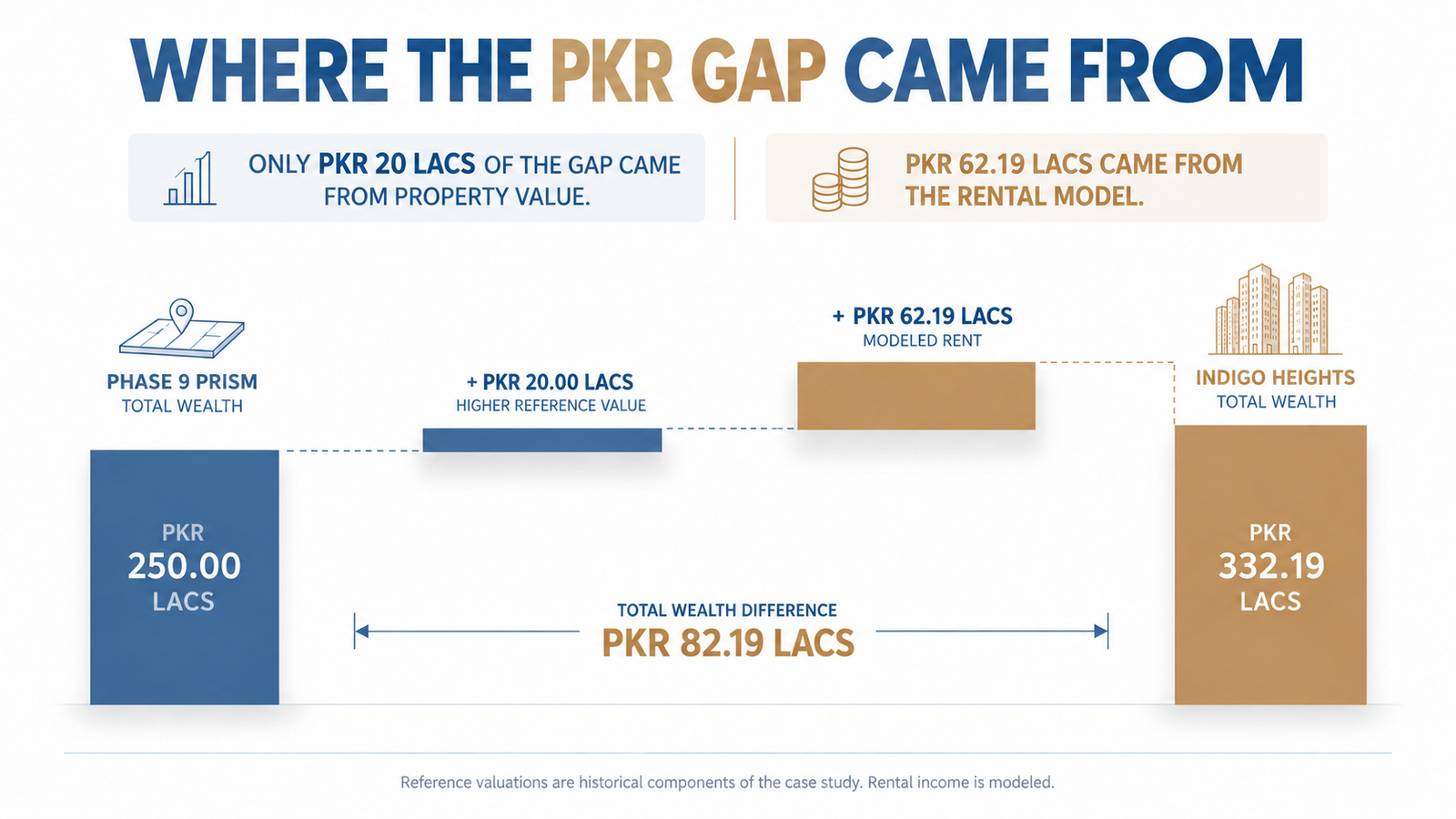
The plot generated PKR 160 lacs of calculated profit and a total PKR ROI of 177.8%. That is a strong nominal gain; this case study does not deny it.
Indigo produced PKR 242.19 lacs of modeled profit when rent is added, equivalent to a total PKR ROI of 269.1%.
In simple terms, the apartment outcome is approximately PKR 82.19 lacs higher. Only PKR 20 lacs of that gap comes from the difference in current/reference value. The remaining PKR 62.19 lacs is the rental model.
This separation is important because the capital value is a reference valuation, while rent depends on the model’s assumptions and actual operating performance.
Why Headline ROI Does Not Tell the Whole Story
Simple ROI asks how much profit was made compared with the original investment. It is useful, but it ignores time. A 100% return earned in four years is not economically the same as a 100% return earned in ten years.
Annualized return translates a multi-year result into an approximate yearly rate. For installment investments, the calculation also needs to recognise that all capital was not deployed on day one. Rent arriving during the holding period is another dated cash flow. Money paid or received in 2016 cannot be treated as if it moved in 2026.
That is why the presentation reports an approximate annualized return of 10.2% for Phase 9 Prism and 16.4% for Indigo Heights. The apartment benefits from staged deployment and interim modeled income, not merely a higher closing valuation.
These figures should be understood as outputs of the case-study methodology. Exact annualized performance will depend on exact transaction dates, rent dates, fees and the method used—such as CAGR or an internal-rate-of-return calculation. The core point remains: headline ROI and annualized return answer different questions.
Key takeaway: Return on investment measures the gain; annualized return also asks how long the capital had to work.
The Dollar Comparison Changes the Story Again
Rupee appreciation can look impressive while the investor’s purchasing power in another currency changes far less. The slides convert both invested capital and ending wealth into USD, producing the sharpest contrast in the case study.
| USD result | Phase 9 Prism | Indigo Heights |
|---|---|---|
| USD invested | $85,911 | $76,295 |
| Current/reference value | $89,928 | $97,122 |
| Rent in USD | Nil | Approx. $25,752 |
| Total USD wealth | $89,928 | $122,874 |
| USD profit | $4,017 | $46,579 |
| Total USD ROI | 4.7% | 61.1% |
| Approx. annualized USD return | 0.4% | 5.7% |
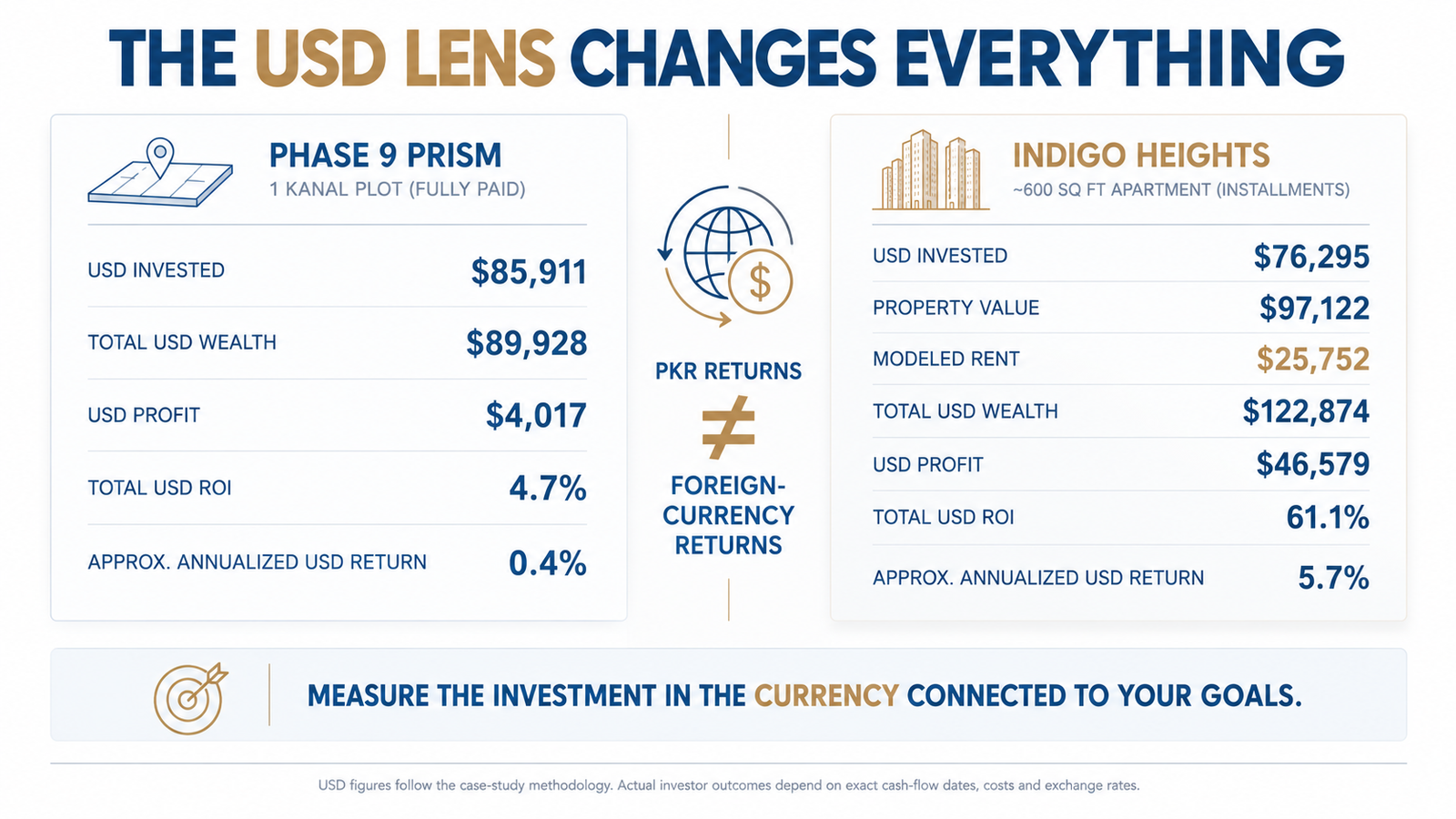
Phase 9 Prism grows from an upfront $85,911 equivalent to a reference value of $89,928. Its dollar profit is $4,017: a 4.7% total USD ROI and approximately 0.4% annualized under the presentation’s calculation.
Indigo Heights begins with lower cumulative USD deployment because of the installment schedule. Its PKR 270 lacs reference value converts to approximately $97,122. The model then adds about $25,752 of rent in USD, taking total dollar wealth to $122,874.
Against $76,295 invested, that is a calculated profit of $46,579, total USD ROI of 61.1% and an approximate annualized USD return of 5.7%.
The apartment’s advantage therefore comes from both sides of the equation: fewer dollars were deployed and more dollar-equivalent wealth was produced. The comparison is not simply $89,928 versus $97,122 in property value. It is $89,928 with no rent versus $122,874 including modeled rent.
Investment insight: A property can multiply in PKR yet create only a small gain in the currency that funded it.
Why Overseas Pakistanis Should Measure Returns in Their Earning Currency
For overseas Pakistani property investment, PKR is necessary but not always sufficient. An investor paid in dollars should ask how many dollars entered and what the investment is worth in dollars at exit. The same principle applies to someone earning pounds, dirhams, riyals or euros.
This is not an argument that USD is the only valid benchmark. A Pakistan-based investor who earns, spends and plans future liabilities in rupees may reasonably prioritise PKR returns. An expatriate saving for retirement abroad may care far more about GBP or USD returns. Someone investing for a future home, children’s education in Pakistan or family support may need both views.
Currency-adjusted analysis prevents nominal appreciation from being mistaken for a complete performance measure. It also exposes how payment timing affects the true cost of property investment in Pakistan.
For readers considering apartment investment in Lahore, this is a practical framework for examining USD returns on Pakistan property—not merely the advertised PKR gain. Investors should calculate in the currency connected to their goals, then test the result after realistic expenses and repatriation considerations.
What Actually Created Indigo Heights’ Advantage?
Five forces explain the modeled lead in this particular real estate ROI Pakistan comparison.
1. Staged capital deployment
Indigo divided PKR 90 lacs into four annual payments. Phase 9 Prism required the full allocation upfront. Less capital was tied up at the beginning, although the buyer remained responsible for later installments.
2. Rupee depreciation during the installment years
The exchange rate used in the analysis moved from PKR 104.76 per dollar in 2016 to PKR 150.04 in 2019. For a dollar earner, later fixed-rupee installments became cheaper, reducing cumulative deployment by about $9,616.
3. Capital appreciation
Both assets rose in rupee value. The plot reached PKR 250 lacs; the apartment reached PKR 270 lacs. This created only PKR 20 lacs of the total wealth gap, but it still contributed to Indigo’s lead.
4. Modeled rental income
The apartment model adds PKR 62.19 lacs from 2021 through June 2026. The plot contributes no income. This is the largest direct bridge between the two total-wealth figures.
5. Timing of cash flows
Rent received during earlier years has more economic value than the same nominal amount received only at the end. Likewise, capital paid later has not been committed for the full ten-year period. The annualized calculation captures part of what simple ROI hides.
None of these drivers works in isolation. Remove rental income and the apartment’s PKR wealth lead falls sharply. Require all apartment capital upfront and the USD-cost advantage disappears. Change the currency path, possession date, rent growth or ending valuations, and the result changes too.
Does This Mean Apartments Always Beat Plots?
No. This case study shows what occurred under one set of historical/reference values and modeled cash flows. It is not a universal verdict on plot vs apartment investment.
An under-construction apartment introduces developer and execution risk. Construction can slow, possession can be delayed, specifications can change, and the building’s long-term management may fall short.
Once operational, actual rent depends on occupancy, tenant quality and collection. Service charges, repairs, furnishing, brokerage, vacancy, taxes and management costs can reduce net yield. Resale liquidity and price discovery may also be weaker than the headline asking price suggests.
Plots have their own economics. A well-located plot may offer simpler holding, control over future construction and meaningful appreciation as an area develops. It may suit an investor who does not need current income, wants land for eventual personal use or prefers an asset without shared-building management.
Development status, title, location, holding period and entry price remain decisive.
The correct decision is therefore not “apartment good, plot bad.” It is whether the expected return adequately compensates for the asset’s specific risks and whether its cash-flow pattern matches the investor’s objective.
Income-producing real estate can be powerful, but only when the property is delivered, rentable, well managed and purchased at a sensible price.
The Real Lesson From Case Study 1
The deeper lesson from Phase 9 Prism vs Indigo Heights is not simply to buy apartments. It is to measure the complete investment.
How much capital was committed? When did each payment leave the investor? Did the property produce cash flow? Was that income modeled or actually collected? What did maintenance, vacancy and taxes do to the result? Which currency funded the purchase? How much annualized return remained after translating the outcome into that currency?
In this case, PKR 90 lacs became PKR 250 lacs in Phase 9 Prism. Under IMLAAK’s stated rental model, the Indigo Heights outcome reached PKR 332.19 lacs. In dollar terms, the comparison was $89,928 versus $122,874 in total wealth, with approximate annualized returns of 0.4% and 5.7%, respectively.
That is what makes this plot vs apartment investment in Pakistan comparison useful: it moves the real estate investment in Pakistan discussion beyond advertised appreciation and towards capital efficiency, income and currency-adjusted wealth. Different assumptions may produce different answers, but the questions should remain.
If you want to evaluate a property investment beyond the advertised price and projected appreciation, IMLAAK can help you examine the numbers, cash-flow structure and risks before committing capital.
FAQS
1. Are apartments better than plots for investment in Pakistan?
Not automatically. Apartments can combine appreciation with rent, while plots often depend mainly on appreciation until developed or sold. Apartments also carry developer, possession, occupancy, maintenance and management risk.
Plots may suit investors seeking land ownership, future construction or a lower-management holding. The better choice depends on entry price, location, cash-flow needs, time horizon and risk. In this plot vs apartment investment in Pakistan case study, Indigo Heights produced the stronger modeled outcome; that does not guarantee the same result elsewhere.
2. Why should overseas Pakistanis calculate property returns in USD?
Overseas investors usually earn in USD, GBP, AED, SAR or EUR. A Pakistani property may rise substantially in PKR yet produce a smaller gain when converted into the investor’s earning currency.
Currency analysis shows the cost of each remittance and the foreign-currency value of the ending asset and income. USD is IMLAAK’s common benchmark here, but investors should also calculate returns in the currency linked to their goals.
3. How did Indigo Heights outperform Phase 9 Prism in this case study?
Under IMLAAK’s methodology, Indigo Heights benefited from staged payments, rupee depreciation during 2016–2019, a PKR 20 lacs higher reference value and PKR 62.19 lacs of modeled rent through June 2026.
It required approximately $76,295 over four years versus $85,911 upfront for Phase 9 Prism. Modeled total wealth was PKR 332.19 lacs for Indigo and PKR 250 lacs for the plot. The advantage depends materially on rent and payment timing.
4. What is the difference between ROI and annualized return?
ROI measures total profit relative to the amount invested. It does not show how long the investment took or when payments and income occurred. Annualized return expresses performance as an approximate yearly rate and can reflect installment and rent timing.
Here, Phase 9 Prism shows 177.8% total PKR ROI and approximately 10.2% annualized. Indigo Heights shows 269.1% total PKR ROI and approximately 16.4% annualized under the case-study methodology.
5. What are the main risks of investing in under-construction apartments?
Risks include developer failure, approval or title issues, construction delays, specification changes and late possession. After completion, performance depends on occupancy, achievable rent, service quality, maintenance charges, taxes and resale liquidity.
Projected rent can differ materially from rent collected. Investors should verify legal documents, delivery history, construction progress, payment terms, management arrangements and realistic net rental demand before treating an apartment as dependable income-producing real estate.
Shahnawaz Yaqub Bhatti
Investment Consultant and CEO at Imlaak
- Mobile: +92 300 3343336 (WhatsApp)
- Mobile: +92 333 1616160 (WhatsApp)
[fc id=’19’ align=’left’][/fc]